Your Custom Text Here
Pelvic Floor Rehab-Beginner & Intermediate Workouts
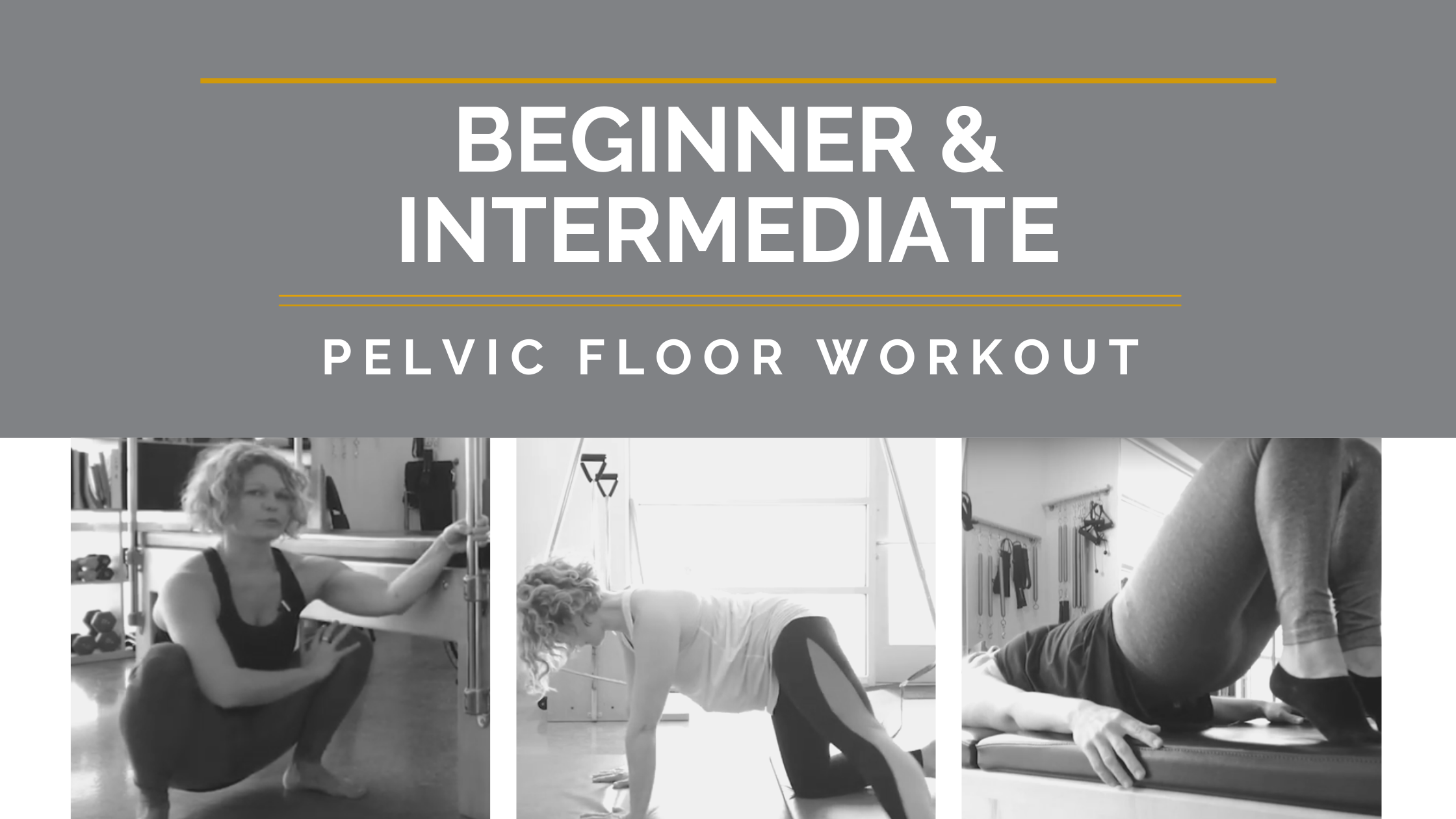
Now that we have massaged/stretched/turned on all of the things, it’s time to do some coordinated movement.
This beginner workout video is targeted to those recently in pain or currently in pain. It’s a series of gentle, mindful movements to connect these areas we’ve covered in the course and start to build some basic strength connections. We start with some cat/cow, thinking about it from your pelvic floor over just the breath or what the spine is doing. Then, we do a series of exercises to connect your legs into the fascial line of the pelvic floor, closely mirroring what should happen as you walk. We then migrate up into glute and hamstring strength, combining it with some ankle work. Our grand finale is a 1 minute squat, focusing on relaxing and releasing the pelvic floor and then pulling up energetically for some grounding work.
In the intermediate workout, we start with various exercises with the legs in a diamond shape to target the inner and outer thighs. Have a 12 inch ball or foam roller and a towel/yoga strap nearly. We then move to some hip exercises weight-bearing in the arms for a bit of a stability challenge. Then, using a towel or yoga strap, we do an exercise to isolate the adductors/inner thighs. We wrap up the workout with a series of squats to work the thighs and ankles as well as the pelvic floor.
Pelvic Floor Rehab-Energetic Connections
An aspect of my approach to bodywork is looking at emotional stressors or energetics and how that contributes to someone’s pain patterns. I always say, there are a lot of crooked people out there, but not all of them are in pain.
The root chakra and sacral chakra come into play with the pelvic floor. The root chakra can close off with anything that involves fear. I think all of us can agree that we’ve felt some amount of this over 2020-21. Any history of abuse or trauma, at any point in life, can contribute to issues in the root. Fear usually involves the breath to tighten, and as we’ve discussed, the breath mirrors into the pelvic floor. If the root gets closed off, it shuts off connection to the feet. I often feel that a lot of knee/foot issues are not just about the pelvic floor in terms of mechanics, but also this holding from current or past fear patterns.
The root is also all about stability. So any type of lack-of-safety feelings would play into dysfunction here as well. This could be financial, physical or emotional.
The sacral chakra obviously involves sexuality, but also creativity and sensuality. If you don’t feel safe, how can you feel like you have the energy or bandwidth the be creative or truly yourself?
You can bring more opening and awareness to these areas by visualizing the sphincters of the pelvic floor opening up like a valve and that water is coming down the legs. If color is your thing, the corresponding colors are red for the root and orange for the sacral.
Take this for a walk and you can visualize those colors going down one leg, back up and over to the other leg like a light up yo-yo. Check in with your body and see as you put those colors in your mind’s eye, are they vibrant? If they start off more dusky or dark, let the old stuff drop out of your feet and into the ground. Then as the light comes back up the leg, can it be a bit brighter? If you continue to do this, the colors will become clearer and you’ll feel better—promise.
This is my favorite book on energetic systems. The author connections modern psychology with the chakra system. It’s a great balance of ‘woo woo’ and philosophy.
Pelvic Floor Rehab-Release Pelvic Floor Muscles & How to Activate the Pelvic Floor
We’re finally into the meat! In this video we go over how to release SUPER common problem spots for pelvic pain and lower back pain—the pesky pectineus, iliacus and obterators.
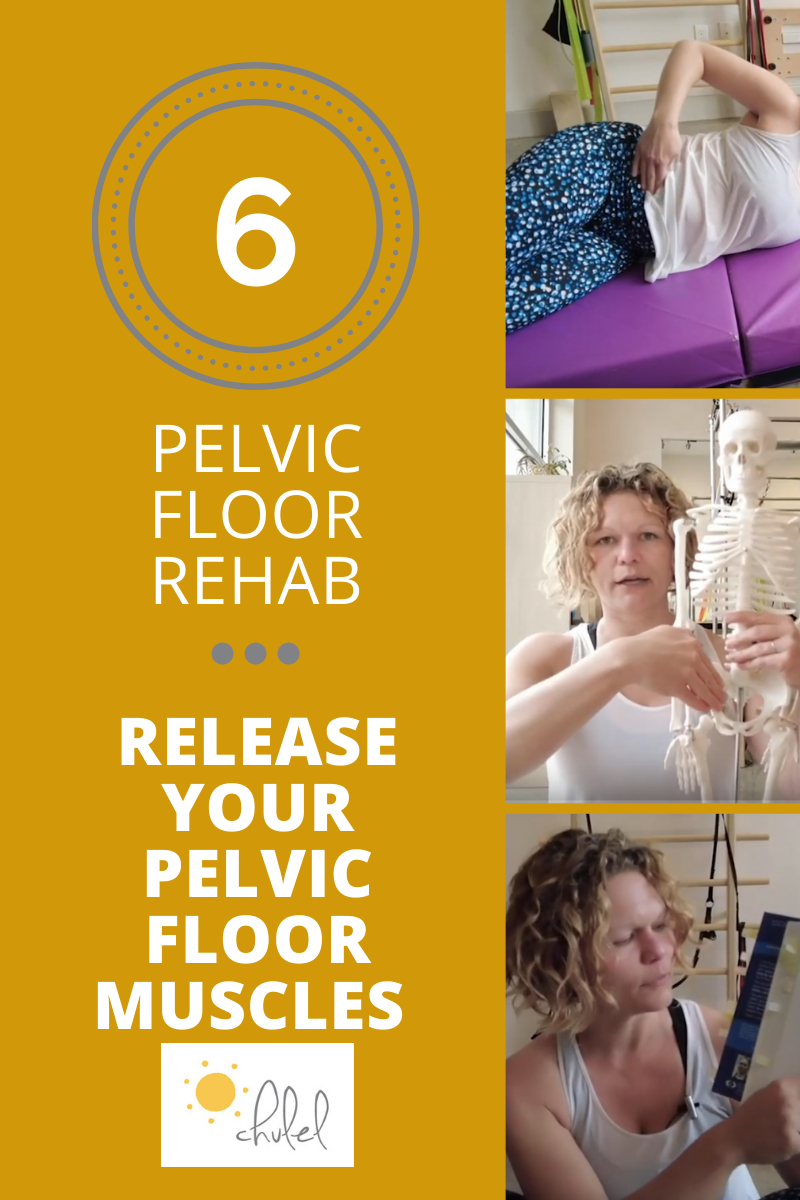
You can use just your hands to get some relaxation in these areas and they do *wonders* for relieving pain all over the body, including the neck and shoulders.
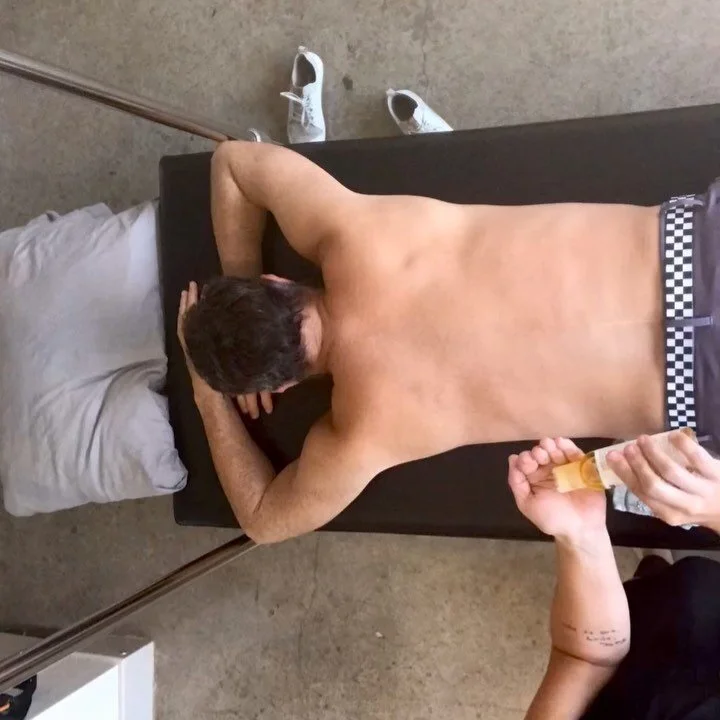
To release the pectineus, you’ll want to pin the pocket of the groin, and then you can use the weight of your leg to act as a stretch. In massage it’s called a ‘pin and stretch’. I go over the details in this video—promise you’ll feel like your leg not only gets longer, but more relaxed afterward.
The iliacus lines the ilia of the pelvis and can be a major core compensation muscle. This muscle can be tight if you also have digestive issues or hold tension in your ‘guts’. Releasing this before attempting core work may help you get more abdominal engagement.
Lastly, we go into the obterators, which are super deep at the base of the pelvis. These get tight from sitting as well as from breath-holding. Many of us also ‘pinch pennies’ down there when we’re stressed, which makes this area chronically tight. Think about the pelvis like a butterfly with its wings spread. Pinching the bottom of the wings together pulls the upper wings apart. Thus, releasing that tether on the bottom wings, relaxes the upper portions. Doing this can be a huge help in lower back pain.
I would not suggest using something like a Theragun on this area—you aren’t trying to pummel your pelvic muscles. This massager has some helpful attachments that help to hook onto bones and it has a vibrational/percussive element instead of just percussive. Also, if you gently try to push those upper edges of the butterfly wings (the ilia) together and that feels relaxing to your body, you may want to invest in a pelvic floor belt. There’s a lot of variety here and you want to find the right thickness for you as if you buy one that has too much depth, it will ride up as you bend over. Here’s the one I’ve heard the best feedback on from clients. You can find my favorite book on the pelvic floor with helpful exercises here.
Again, massaging these spots will help you relax all over and will make it easier to breathe. Please comment or reach out if you have any questions and thanks for watching!
Pelvic Floor Rehab-Feet & Ankles

Foot and ankle tension, weakness and inflexibility can be a huge piece of pelvic and hip pain. If your gait pattern, how you walk and take a step, is compromised on one side, it very often reverberates up the chain into knee, hip and/or lower back pain. So what do we do about it?
Loosening the Feet
There are some simple products that can help here in addition to your hands.
If you want to go all in, this foot massager is lovely. It’s around $100 and it has a heat function. Visualize warm foot rubs in increments of 15 minutes with coffee/tea in hand. My personal favorite is 2 sessions in a row. I have felt like my own gait pattern is normalizing as I do this and then go for a conscious walk.
Trigger point releasers for the feet. I own 2 pairs of these (one that is 10 years old that I have in the studio, so these are durable). This is a newer version that I have personally not tried, but seems similar and is about half of the price of the ones I own.
Yoga toes for stretching out the feet. You can also use those inserts they give you after a pedicure. Or, put your fingers in between your toes and move your ankle around.
Here is a self-massage. There’s another version I do in the video on this page.
Loosening the Ankles
Using a towel or a theraband, you can stretch out the back of your ankles (read: calves). There’s also a version in this video where I combine down dog with a front of ankle stretch—no props needed. That said, this calf boot stretcher is a game changer and I highly recommend the investment. You can stretch the calves and shins using it. This is another case where I own 2—one for home and another for studio.
Rocking your body side-to-side helps work the lateral stability of the ankles. You can also invert/evert your ankle as you stretch it with a band.
Strengthening the Feet & Ankles
In the featured video, I show a simple arch and dorsiflexor exercise. I also demo a simple way to work your foot inverters/everters. You could add resistance with a theraband or resistance band.
There’s also an explanation of 3 versions of a calf raise and how the ankles connect into the pelvic floor muscles. I find this prop to be super helpful to get the right muscles deep in the calves to work and/or place it up at the base of the spine for loose pelvic floors to get those muscles to lift. It’s not on Prime, but it’s seriously the best size and density ball I’ve ever found for this.
Having supple feet and strong ankles is a huge part of aging well. The image I always give here is that of a ballerina. All that strength comes through the foot and is a huge part of the solid core engagement of a dancer. As we age, folks tend to waddle, which is an easy tip over into breaking something. Take care of your feet and ankles and walk sexy!
Purchasing from the links listed on this page helps support my small, woman-owned business.
Why I Hate Kegels

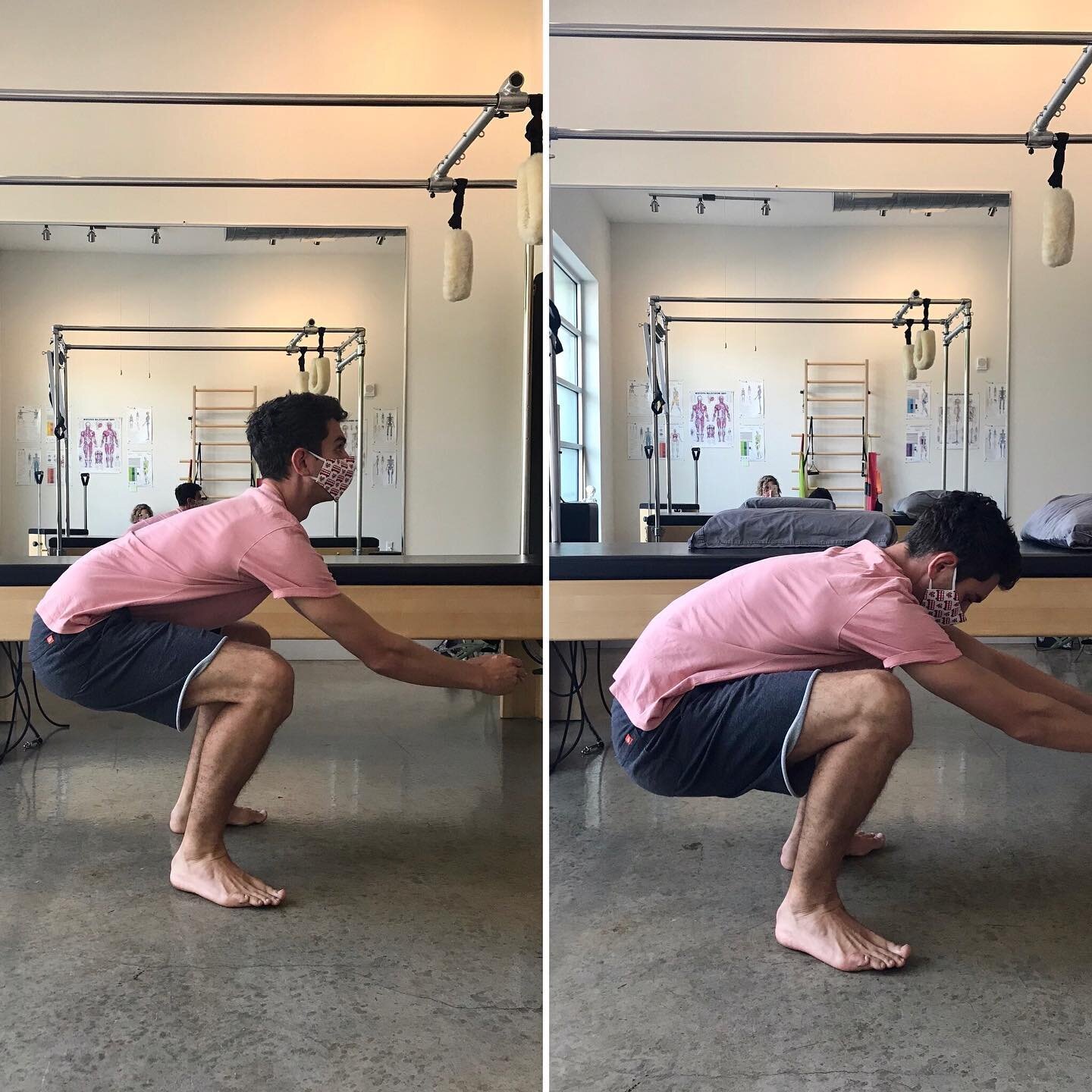
Pilates squats on the reformer for lower body alignment and pelvic floor strength.
Just about every woman out there has had her doctor prescribe Kegel exercises--hold your urine flow for a few seconds to strengthen your pelvic floor. I see Kegels as a constipation view to strengthening the pelvic floor because they encourage bracing and holding in an area that is often too tight. Plus, Kegels are more often emphasized for women over men when we all need strong and flexible pelvic muscles. More about that here. If we all think pelvic floor health=Kegels, we lose the sense of how these muscles are connected to other movement in everyday life. To me, the pelvic floor is more than just your elimination muscles, it includes all the muscles of your pelvis that support your torso and posture--this includes your rear.
One of my favorite pelvic floor exercises is a squat because it works the pelvic floor in a large range-of-motion. This way, you're getting stretching on the way down and strengthening on the way up. Think of squats as coming from the bones of your pelvis to kick these muscles into gear.
Don't feel like you need to go all the way down into a full squat if it doesn't feel good in your body. Many folks can't because of knee or hip pain. Try holding onto something, or putting something underneath your heels, and you may find you can get lower to the floor. As you descend, these muscles are stretching and opening like an umbrella. When you stand up, they contract and come closer together like the closing of an umbrella.
If you think about it, we squat every time we sit down. With a bit of mindfulness and maybe some props, you can reconnect with your pelvic floor and use it to sit down and stand up. No more plopping on the couch!
Pilates is a great modality to strengthen the pelvis for everyday movement. This includes strengthening your inner and outer thighs, which are critical for balance. I love working with clients to rehab their pelvic floors because it's an area of much importance, and for many of us, an area of much trauma. If you've had any abuse in your past, sexual or otherwise, regardless of gender...it may be difficult for you to feel these muscles (read more about this here). This is why I love working one-on-one with clients. In a private session, you're in an environment where it is safe to go here, to connect and to heal, bringing a true sense of self. It brings me to tears when I get to witness this transformation and see my clients discover how much power they have. Love the pelvic floor!!!!
Latest Instagram Posts