Your Custom Text Here
Pelvic Floor Rehab-Release Pelvic Floor Muscles & How to Activate the Pelvic Floor
We’re finally into the meat! In this video we go over how to release SUPER common problem spots for pelvic pain and lower back pain—the pesky pectineus, iliacus and obterators.
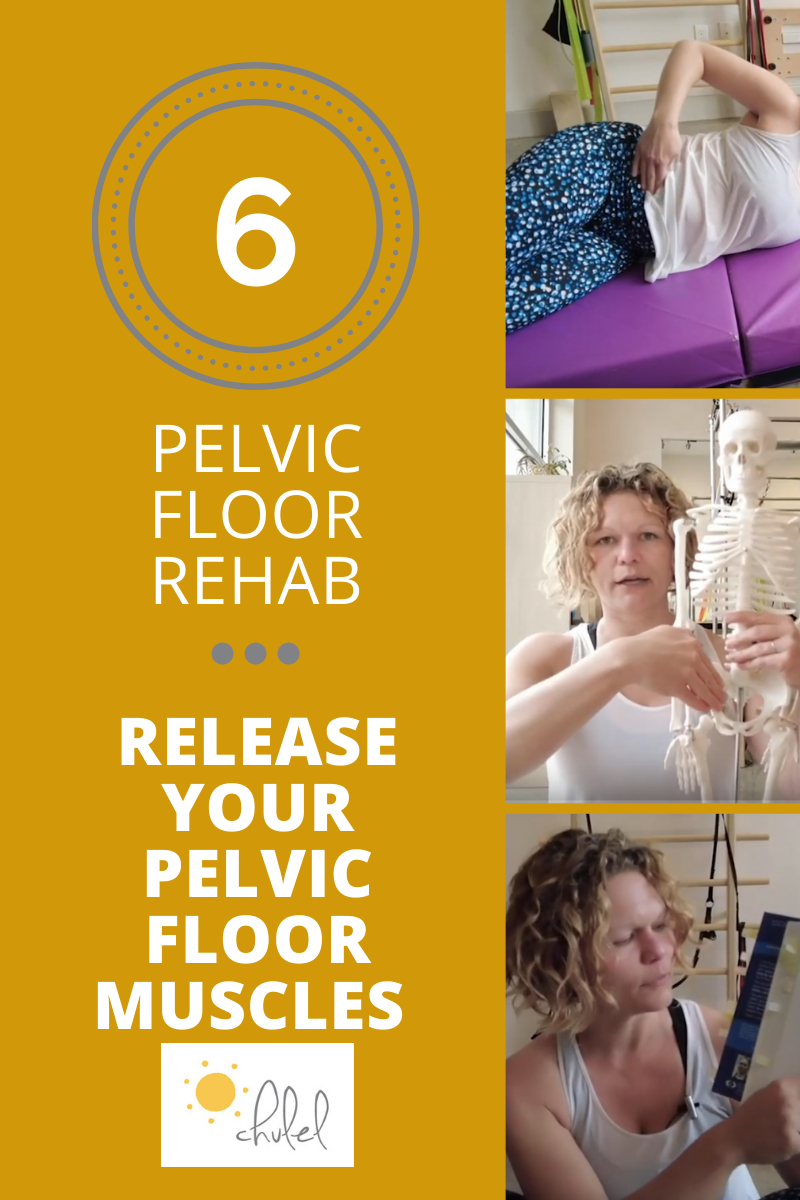
You can use just your hands to get some relaxation in these areas and they do *wonders* for relieving pain all over the body, including the neck and shoulders.
To release the pectineus, you’ll want to pin the pocket of the groin, and then you can use the weight of your leg to act as a stretch. In massage it’s called a ‘pin and stretch’. I go over the details in this video—promise you’ll feel like your leg not only gets longer, but more relaxed afterward.
The iliacus lines the ilia of the pelvis and can be a major core compensation muscle. This muscle can be tight if you also have digestive issues or hold tension in your ‘guts’. Releasing this before attempting core work may help you get more abdominal engagement.
Lastly, we go into the obterators, which are super deep at the base of the pelvis. These get tight from sitting as well as from breath-holding. Many of us also ‘pinch pennies’ down there when we’re stressed, which makes this area chronically tight. Think about the pelvis like a butterfly with its wings spread. Pinching the bottom of the wings together pulls the upper wings apart. Thus, releasing that tether on the bottom wings, relaxes the upper portions. Doing this can be a huge help in lower back pain.
I would not suggest using something like a Theragun on this area—you aren’t trying to pummel your pelvic muscles. This massager has some helpful attachments that help to hook onto bones and it has a vibrational/percussive element instead of just percussive. Also, if you gently try to push those upper edges of the butterfly wings (the ilia) together and that feels relaxing to your body, you may want to invest in a pelvic floor belt. There’s a lot of variety here and you want to find the right thickness for you as if you buy one that has too much depth, it will ride up as you bend over. Here’s the one I’ve heard the best feedback on from clients. You can find my favorite book on the pelvic floor with helpful exercises here.
Again, massaging these spots will help you relax all over and will make it easier to breathe. Please comment or reach out if you have any questions and thanks for watching!
Pelvic Floor Rehab-Glutes and Hamstrings

Continuing on in all-the-things-connected to the pelvic floor journey, we arrive at the derrière and hamstrings. Since this sit cradled in a chair for days and years, it’s incredibly common that adults have underachieve and weak muscles in these areas. The pathway I’m recommending to get them back on…
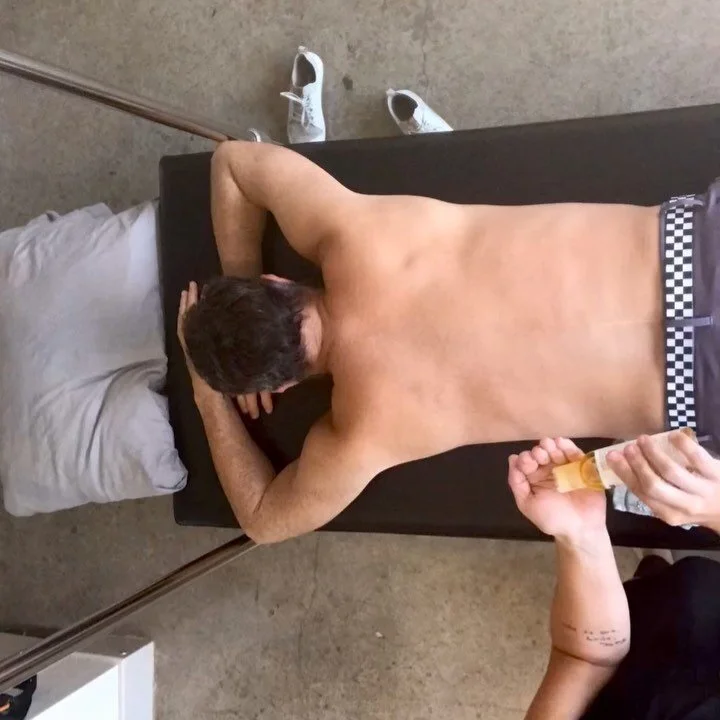
Massage
In short, foam roll just about everything. Hit up your calves, hamstrings, quads, glutes and back first. Tight adductors (groin) is a super common reason the glutes don’t fire correctly, we covered them in the last episode. Here’s a link to a shorter version of how to foam roll those.
Another crazy connection I’ve seen over the years is the opposite shoulder blade being an issue in glute/hamstring recruitment. The body balances itself on diagonals. Think about your footprints in sand, they’re not in a tightrope-like line, they zig zag. In proper gait (how you walk), the upper body should rotate over the forward leg. When working with clients, this element is often off, leading to a kind of waddle instead of a swagger. These folks are often in my studio because of back pain, knee pain and neck tension. All of it can connect to this diagonal element being lost in their walk and instead they pogo stick side-to-side. So, massaging the shoulder blade is critical as well before we get into trying to activate the rear end.
Stretch
The video details a couple approaches to stretching the hamstrings to start—we stretch the muscle as well as the fascial chain. What’s the difference? Stretching the muscle means working the joint in its full range of motion, versus the fascial chain is more like stretching the skin. Someone who taught a training I once attended likened it to if you were wearing jeans or a wetsuit—if there’s greater pull on the fabric, that’s more like a fascial stretch.
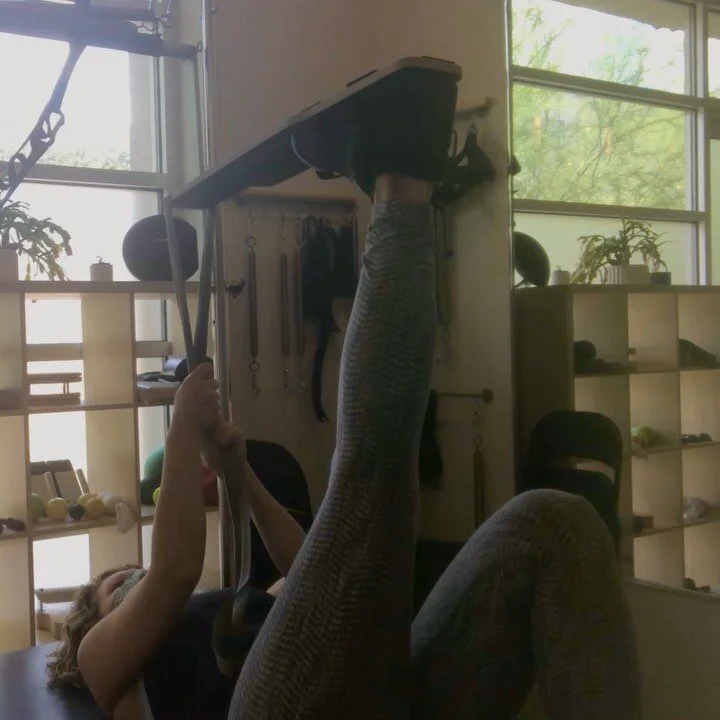
The action of the hamstrings is to bend the knee. Therefore, stretching the hamstring muscle would mean actively pulling open the knee like a clamshell. We have 3 hamstrings muscles, so stretching at different angles means we can target each one.
When most of us think about stretching the hamstrings, we think about a pike stretch or putting a leg out and leaning over it. This is our fascial stretch. Something easy like putting your foot up on a chair and leaning over it, while waving your leg side-to-side to pick up those 3 hamstrings will do the trick.
For the glute and the deeper hip rotational muscles, pigeon pose is a straightforward and good bang for your buck in terms of what it hit and the time you’re in the stretch. There’s a few options in this video to add the active stretch element to pigeon as well as some different fascial components.
Activate
We then move into a couple of simple activations you could even do pre-walk or run. To activate the glute max, gently press your foot into a wall. Make sure your thighs are parallel or have the active thigh slightly behind the standing leg. Feel your rear tone up as you press.
The hamstrings bend the knee, so have the same thigh orientation as above and then pull your heel to your bum. Taking the leg and foot at different angles will help to activate the different hamstring muscles. This is all explained in the video and you can fast forward to 20:23 for details. You can do the same exercise lying on your stomach and it will automatically keep your thighs in that parallel position, making it harder to cheat in the motion.
Lastly, we do a simple hip rotation activation of internal rotation and then external. It’s a gentle exercise, yet deceptively difficult. Another option is the clam series, which you can find here.
I always say my primary concern when doing this work is aging well and not necessarily the biceps and bikini-body. That said, I’m all for a butt-tastic body if it motivates you for some post-Covid fun as well as keeping your hips strong. 🍒
Pelvic Floor Rehab-Abductors & Adductors

As we travel up from the feet and ankles towards the pelvic floor, we hit the adductors and abductors (inner & outer thighs). These are the balance muscles of your legs, the I’m-falling-and-I-can’t-get-up muscles. The inner thighs run contiguous to the pelvic floor and core muscles. AND pretty much everyone is weak in these groups.
Massage
Par for the course of this Pelvic Floor Rehab series, we release, then re-engage. You have a few options for that here. The most cost effective is to purchase a foam roller. I always advocate buying a 36” roller as they are more versatile for things like core work in addition to release work. You have the standard density option (which can be pretty intense for certain areas of the body) or a less dense, softer version. Amazon has everyone beat that I ever see in terms of price, a link to purchase here. And here’s a link to a previous video on how to use a foam roller on the inner thighs as well as a trigger point release for the pubic bone.
You can also use a theragun or other self-massager. Two of my favorite options are here for a more affordable version and here for a more versatile version, particularly for when we get into the pelvic floor releases in a couple episodes. There are attachments to the latter massager that make it easier to access smaller muscles and yield a more pinpointed release.
Lastly, I love cupping the outer thighs/IT band. It’s an easy thing to do as you watch TV and is not rocket science. Here’s a link to the cupping set I’ve used for years. Alternatively, you can foam roll your IT band, link on tips for that here.
So, massage/roll/cup the inner and outer thighs. We also do some work on the Quadratus Lumborum (QL) in this video. This muscle causes a lot of issues for a lot of people and is often tightened up on just one side, lending someone to be crooked. I find that it becomes that way, in part, because of weakness in the muscles targeted in this video.
Stretch
You can easily stretch your IT band/abductors by putting a towel around your foot and pulling your leg across your body. Alternatively, you can put one foot on a surface like a chair or couch and then twist your body over that extended leg. Try to drop the targeted butt cheek towards the floor as you stretch.
For the inner thighs/groin, here is a shortened version of my favorite stretch that is also in this video.
To stretch the QL, stand inside of a doorway, bring your inside leg forward and grab onto the doorframe—you’re bending over the direction of whichever leg is forward. So, right foot in front, you’re bending to the right to grab onto the doorframe. You can gradually add a twist of your chest towards the doorframe and you may feel this stretch go all the way down your back.
Activate
My preferred way to activate the abductors is a simple side leg lift, a la Jane Fonda. I find that this isolates them better than doing a side squat walk with a band around the thighs. In a squat walk, I feel like people load more into the quads. Here’s a link to a shorter version of what I’m talking about.
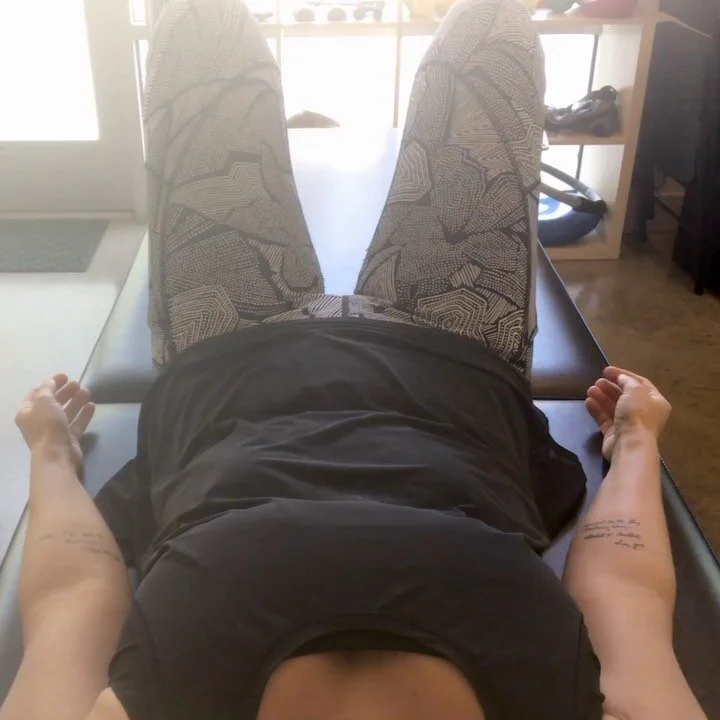
For the inner thighs, you can adduct the legs (bring them together) with them up on a wall or in the air. Here’s a version in the air, which works the core more. If your hamstrings are super tight, the wall might be better. You can also start with a more gentle version like this with the knees bent.
The QL is the ‘hip hiker’ muscle. If you stand on an elevated surface like a curb or even a yoga block, you would pull the hip up directly to your ear on that respective side. You’ll know which side is your weaker if that motion feels completely foreign to your brain.
Having good stability in these muscles is a critical piece to balance and therefore aging well. This means aging well for all genders. Some of my male clients talk about these machines in the gym and refer to them as the ‘chick machines’. Balance is for everyone, so don’t forget to target these just as much as squats and lunges in your workouts—stability in these muscles will make things like lunges easier. And, these are the struts to the pelvic bowl, so inner outer thigh strength is pelvic floor strength. Channel your inner Jane Fonda, y’all.
FREE Pelvic Floor Rehab Course

What is the pelvic floor?
I define the pelvic floor as more than just the elimination muscles—I see it as anything that touches brief underwear lines. If you think about it, those are in contact with a chair for hours a day (for the average person), so they atrophy over time. Then as we age we’re dumbfounded as to why it can be challenging to do day-to-day tasks like squatting down, lifting things off of the floor, getting up off of the floor or even balancing.
I don’t see stand up desks as a cure all for this. I’ve worked on many people with pelvic floor issues who use standing desks. Chances are you were sitting for years professionally or in school before you started using one. So, those imbalances can already be there.
Why is pelvic health important?
These are your falling-and-I-can’t-get-up muscles! They’re critical for aging well and having solid balance and stability. And, they’re often small muscles, so just because you work out, doesn’t necessarily mean that they’re one and strong.
It’s also critical to have good strength here for proper elimination long-term and to head off pelvic organ prolapse and prostate issues.
The pelvic floor also plays a critical role with the breath. Belly breathing is great for relaxation and yogic techniques, but the bandas have to relax and expand for true health in the pelvis. So, I find that a LOT of people need to work on expanding the pelvic floor, yes even moms, because their pelvic floors are tight from improper breathing. For this reason, pelvic floor health and strength isn’t just a postpartum or post-hysterectomy issue, it’s for men and women.
Structure and format of this course
This is not a course on Kegels! I find Kegels to be a constipation view of pelvic floor health and not encouraging dynamic strength that we need there to do things like lifting and balancing.
We’ll start distal (away) from the pelvis and work our way in. We’ll look at common, faulty neuromuscular pathways I’ve seen over the last decade and try to correct those patterns. The modules will have a release then stretch then re-engage format and then I’ll also include some basic as well as intermediate exercise sequences. At that point, you’re free to go about your way in a regular exercise class, hopefully with these areas more engaged.
Why I’m passionate about this content
You can find out more about this in my bio. Long story short, I had an intense and painful bout of piriformis syndrome for about a year and a half after my dad unexpectedly passed away. Thing is, it never got diagnosed as such. I was super active and 28 at the time. MRI came back negative for disc issues and every doctor kept wanting to label it as sciatica, which it wasn’t. After thousands spent on physical therapy/massage/chiropractic/acupuncture, I started studying anatomy and biomechanics and figured out it was the piriformis. I looked up ‘piriformis problems’ and the web said it was common for people who ran a lot and who sat at a desk for a living. That was me to a T!
Thing is, the pain didn’t get better with just the biomechanics. The holistic folks kept saying it was my internalized grief. I was crying all the time, so I didn’t see anything internalized about it. That said, the more I dug into the deeper feelings about how my dad died, the pain started to change. This is why I bring this approach into my work with clients. If something has stuck around for months or years, there’s a good chance you’re holding some deeper stress and emotions around it. I’ll bring in some of the things I’ve researched over the years re:emotions and the pelvis into this course as well.
Another reason why pelvic health is so important to me…my grandmother has had chronic UTIs for 25 years. At this point, she’s pretty much immune to all antibiotics. I can’t help but think if she started doing things like this in her 50s and 60s she wouldn’t have suffered so much and have this risk in her 80s.
Internal pelvic floor physical therapists in Austin
This course is not meant to be a substitute for proper, internal physical therapy. In Texas, you typically need a doctor referral. Here are some of my favorite folks in Austin.
Improve Your Running Form and Walking Gait

In the Covid era, those of us who can exercise outside are doing so. We’re taking longer walks and that may also morph into running. We’re also spending (maybe) more time sitting in front of a screen when we’re not outside, yet we also have more time time on our hands to focus on our health and bodies. Probably a good thing during a pandemic, right? Walking is something we all do and most of us don't do it correctly because of old injuries and repetitive motions as creatures of habit. What follows is a series of suggestions of massages, stretches and exercises to build up good biomechanics in gait. (For today, I’m just going to focus on the lower body as I have a lot of potential suggestions with an upper body post to come.)
Note: everything in this post would also be relevant for those with lower back pain as all of these areas can play into that condition as well.
First, a few basic definitions.
Weak vs. Strong
Strong means that a joint can move in its full range of motion comfortably and with ease. It doesn’t mean how the muscle looks on the outside. Weak would be the opposite of this—a joint that can’t move full range or has pain when doing so. A muscle may also have lost its connection to your brain through an injury or movement compensation from some time in the past. Reconnecting that muscle will automatically make it seem ‘strong’ again because it’s linked back to your brain and can help a joint move appropriately.
Tight Muscles vs. Loose Muscles
Muscles pull on joints to get us to move so they’re like pulleys. Depending on how we hold or orient our body, some of those pulleys may get stuck in a certain direction, meaning one side may be locked short and the other locked long. Thing is, they’re both tight because they’re generally kind of stuck in one direction.
What does proper gait look like?
There are distinct phases to gait so a person would ideally pass through each phase when walking, equally, on both sides. But what happens with that old football injury you had in high school, or that time you feel off your bike, swing, chair, etc… Point is, over time, our bodies naturally make some little adjustments to keep putting one foot in front of the other. So when you decide that now you’re going to take that long walk or start to pick up running (which is a great idea!) those old, little adjustments your body has made may lead into some new areas that feel tight or have pain—or at least, they make you aware of their presence.
For our purposes here, we’re going to simplify to the major 3 phases that I’ll make reference to which are: heel strike, mid-stance and toe off. You can get nerdy about this stuff really fast. I’m going to break down each section starting at the feet of common compensations and how you’d want that area to be on your body.
Foot Goals
Most folks have tight feet.—yes this can be a shoe thing, but it’s also tied to stress and not having a full breath cycle. If you hold your breath, you may feel your feet tighten, it’s subtle, but trust me, it’s happening. Combine this with various shoe choices and boom, ya got tight feet. The feet have a lot of little joints in them, 33 to be exact, so they ideally function as a dexterous, shock-absorbing trampoline. Fun fact, that trampoline also mirrors and connects to your core. So, flexible, strong feet means you’ll use your core more in day-to-day walking and movement. You can keep your feet loose with this simple self-massage and I love love these—they’re a bit pricey, here's a more affordable version that has come out on the market.
Flexible toes, especially the big toe—Another thing that can affect that toe off phase is inflexible toes, particularly the big toe. If you have any form of a bunion, you’re in this category. (On a personal note, however, I’m actually more inflexible on the foot where I don’t have a bunion. 🤔 Haven’t figured this one out yet.) Your big toe should be able to bend upwards 30-45 degrees with your body weight on top. You may be able to find that flexibility laying down, but standing can be a completely different story. This is perhaps my favorite stretch to do before I go for a walk/run as getting that proper toe off completely changes my gait and how I feel muscles engage all the way up my leg. Improper toe off is another thing that can manifest in knee/hip/lower back pain. A way you can understand this re:lower back pain is if you try walking without bending your knees or ankles. You’ll kind of walk like a strange, stiff stork-like character. Where do you feel yourself hinging from? Exactly. A lot of folks walk with some version of this and don’t realize it.
Strong arches—You want the middle of the trampoline to be strong and supple so it can respond to any subtle shifts—this is part of how your body retains balance. You’d want to balance on trampolines (particularly with age and bone density deterioration) over ice skates. Here’s a simple way to do that, even while you watch tv.
Shoes that allow your ankle to move—In order for proper toe off (phase of gait) your knee needs to be able to cross in front of your ankle, over your toes. If your shoes are laced too tightly, they won’t allow for this phase to properly occur. Here’s my preferred way of lacing that I learned in an Aston Patterning workshop. Lacing your walking/running shoes all the way up to that hole that cuts back towards the ankle would be a no-no for the same reason. If your knees can’t clear over your ankles, you may have knee or even hip pain & lower back pain after walking/running.
Equal weight in your feet—Going back to the idea that we’ve all had a tumble or two in our lives since childhood and that our body creates compensation patterns to keep us keeping on, and then we end up walking using more of one leg than another. Yes, to walk we naturally sway our weight from one side to the other. Much of walking is balancing on one leg. The question is if we sway equally from one leg to another. If you don’t have equal balance between your legs, you can hear it when you walk down a hallway or in certain types of shoes. The sound from what one foot does to the other will be different. This is actually moreso a hip/pelvis issue, so we’ll address it later.
The pronation/supination debate—Thing is, in gait the foot pronates AND supinates at different points in gait to allow for shifting bodyweight. That said, yes, some feet send to err more to pronation or supination and that can be a piece of funky foot mechanics. My favorite way of addressing this is a bit complicated to just put into a blog post because if you re-orient the foot from pronation to more supination or vice versa, it will shift everything up the chain. I think it’s important that anything I write about/post to YouTube are things that you can do without hurting something else and this is an area that falls to a personalized session.
Ankles/Calves
Stretch your calves!-The calves help the ankle move. The ankle’s full range of motion is that stretch you may do on a curb to being up on your tip toes. Unless you’re an athlete or trudging the hills of San Francisco, you’re probably not getting that full range daily. We wear shoes that aren’t usually the best at facilitating good mechanics and we walk on flat surfaces all day in them. So, the calves get tight & weak—again, back to that level idea in the beginning of what those words mean. Trigger point work on your calves like this and stretching them—both front with this variation and back as seen here will help things all the way up the body. Tight calves can be a huge underpinning of knee/hip/lower back pain. *See imagery I mentioned on the flexible toe portion. Same thing applies here.
Strengthen your ankles-A really simple way to do this is via calf raises and this is huge for people to age well. People tend to shuffle their feet and waddle as they get older because these joints aren’t worked in full range-of-motion. Strong calves help prevent a ‘falling-and-I-can’t-get-up’ situation because your gait won’t allow you to tip over so easily and break something. Compare this with a ballerina and how everything is engaged when she’s on her toes—strong ankles=strong core. Oddly enough, getting good form on these can be tricky, so here’s a video that includes common errors.
Posterior chain (i.e. your derrière)
Desire buns of steel, well, kind of-Sitting for long periods of time, which we’re doing even more of in the Covid-era, makes the back of the thighs and the bum go flacid and/or get tight. Using a foam roller/massager to get blood flowing back into that area before exercising can help your brain be able to find those muscles see tips here and here. Sometimes it’s tension from the front side of the body that is shutting down the connection to the back side, so getting flow back to the quads like this video is super important as well. A modified pigon pose from yoga is an easy way to stretch all of these places at once, see my tips here.
Pelvic tilt-Think of the sides of your pelvis (where you ‘put your hands on your hips’) as having dials on them that you could rotate to change the pitch, like you can with a car seat. Next, try turning the dials backward—kind of like you’re doing cat/cow, this would be cat. Then dials forward so that the bowl of your pelvis would have soup spilling out of the front or cow. As you work these directions, which makes your spine feel like it’s getting longer? If it’s when you tip forward, then you’re likely a little too posterior on the regular, if the opposite is true, your pelvis sits a little more tipped forward. If your natural state is more posterior or cat, your hamstrings will be locked short and tight, if your natural state is anterior or tipped forward, the front of your hips and thighs will be locked short. So, giving stretching love to the locked short and exercise love to the locked long will, over time, help level you out. **This is something I also prefer to do one-on-one because changing this pitch will affect everything, especially your neck/shoulders. That said, any of the other exercises listed in this post can help.
Buckling into the knees vs hyperextension-Stand and force your kneecaps backwards—you may feel your quads (front of thigh muscles tighten). This is more of a gauge of hyperextension—another one is if you look at yourself from the side in a mirror, you can see your knee caps be forced backward. To correct this, slightly bring your knees forwards as you’re standing and feel your quads unlock. This is your happy place standing, in gait, it’s more a matter of strengthening the muscles of your thighs to hold your knees in their proper place. I find that a lot of people buckle into their knees when walking which correlates to weakness in the pelvic floor and core. I think this is also residual from sitting and the knees forget how to straighten properly. Both are correctable with the proper exercise program. Again, if you want help with that, reach out.
Inner/Outer Thighs (Adductors & Abductors)
Strengthen both-Generally, almost everyone is weak in these muscles, it’s just a matter if one side is locked short/long—particularly for those who have bow legged/knock knee patterns. There’s been a general backlash against foam rolling the IT band as it can’t technically lengthen since it’s a tendon not, not a muscle. Personally, I derive benefit from doing so, particularly for an old knee injury, so directions on how to do so here. My mantra on rolling the IT band, kind of like rolling anywhere, is if it hurts too much, don’t do it because you’re just creating tension in one place while trying to alleviate it in another. Here’s a way to foam roll the inner thigh that is super beneficial for knee pain and lower back issues. These guys also get pulled into the locked long/short patters depending on whether or not you have a pelvic tilt.
Now that these areas have more blood flow and the tissues are loosend up, it's time to work them. Work your inner thighs in full range of motion. For an abductor exercise, see the next section.
Instead of the IT band, look at the TFL-The Tensor Fasciae Latae is just above the IT band. So you can foam roll the IT band all-the-day-long, but you may have a tight and weak TFL. The TFL is critical for proper loading of body weight over the standing leg during mid-stance in gait and it’s under chronic shortening because of sitting. Here's a way to release the TFL with a ball or foam roller, and here’s a way to strengthen it along with the gluteus medius and minimus which all work in tandem for that portion of gait. They’re critical muscles for balance, so keeping strength here will help you in that capacity as well.
Is the problem in your jaw, or your hips?-If the jaw is off, it can throw off this lateral hip stability that the adductors and abductors help with. These are some of the more specific relationships I look at individually in session, but if you know you tend to hold tension here, or that you have jaw issues such as TMJ, your hips as jaw could be in a dysfunctional relationship. Doing some self massage before attempting 👆may help you access the target muscles more easily.
Hip Rotators (Piriformis)
Tight and Weak-In general, I find that most folks have tight and weak hip rotators with an underactive gluteus maximus. Here again, sitting is a major culprit, as these muscles just get lazy when a chair supports them all day and we hold our breath. You can release the piriformis with a tennis or lacrosse ball like so, and then follow that up with some glute strengthening with some hip bridges. I’ll record my favorite progression & post in the next week. You’d also want to get some strength back in those rotational muscles, so here’s my favorite series of exercises for that. Note, if you acutely have piriformis syndrome or lower back pain, I’d just start with some overall foam rolling the glutes like so and a gentle stretch such as this. If you attack the piriformis, I find that it has a hard bite back. Slow and steady is better and more effective in the long run.
Piriformis Syndrome- See notes 👆, but also want to add that the piriformis gets chatty, or ticked off, when weight is not being transferred down through the pelvis symmetrically. In other words, it can have a spinal tie in. You can kind of feel this if you sit and rock side-to-side, is there a side that your body really prefers to swing to? Is that the side where your piriformis is talking to you? Just a thought…I’ll address more upper body things for gait in another post.
Psoas
Oh the psoas-The trifecta of the psoas/quadratus lumborum/piriformis can wreak a lot of pain as well as faulty gait patterns. If you have any amount of crooked or imbalance going on, which most of us do, these guys are getting torked and pulled, which means they’re taking your spine and pelvis with them. Then there’s a lot of bodywork pundits out there with opinions on how or what not to do around psoas release. The psoas gets a lot of attention as THE fight-or-flight muscle as it pulls you into a ball and also helps you run. Personally, I don’t see this muscle as being any more connected to the nervous system or past trauma than any other place in the body. That said, the gentle form of release is the Constructive Rest Position. I’m not going to post here, but if you look that up, there’s plenty out there. If you have active lower back pain, you have probably intuitively done something similar.
Thing is, it’s usually one psoas that’s an issue, creating a torsion through the spine and pelvis. In this video, I instruct you to figure out which side you should release and how.
Iliacus-This is another partner to the psoas to the point where they’re jointly referred to as the iliopsoas. The iliacus lines the inside of your ilia (the butterfly bones of your pelvis). Self-release can be a little tricky. To most easily access the iliacus, I usually have people lay on their side (like you’re side sleeping) so that it moves the belly out of the way. Then you would take 4 fingers and try to essentially pry the muscles from the inside of the ilia—sort of like you’re scooping out ice cream from the inside of the butterfly bone. Depending on how dense your tissue is here, your hand might get tired quickly. But, even a little work here goes a long way to freeing up your pelvis and allowing for more movement in there when weight-shifting from leg to leg in walking/running.
Stretching the psoas-Perhaps the best way is Warrior 1 with the back leg turned out. Easy peasy.
Pelvic Floor Weakness
Weak tight or weak loose?- One, I refer to the pelvic floor in a more broad sense than just the PC muscles, I see them as anything front to bottom to back as anything that provides stability to the pelvis. In session, what I generally see is that more pelvic floors are tight over loose. If you birthed a child through the birth canal (at any point in your life), then yes, you’re more apt to be loose. Your pelvic floor is likely tight if you fit any of these: incontinence (can also be from loose), slow to urinate or if it comes out in a fast burst, male in gender.
If your pelvic floor is loose-try pressing the butterfly bones of your ilia towards one another with your hands. Kind of like you’re trying to squish yourself from the sides. If that feels good, I would look into purchasing and wearing a pelvic floor belt for a little while. They’re inexpensive and it might get your pelvic muscles firing up in a different way. Not to wear all the time, but if there’s an activity that feels stressful on your back or generally fatiguing like standing in one place for a long time (e.g. washing dishes), they can be really helpful.
Loosening the pelvic floor-Hear me out—the use of sex toys safely in either vaginal opening or anus can help. The video below more generally addresses the attachment sites of some of these muscles and can have a relaxation effect. Doing cat cow from yoga with a focus on the pelvis, which I walk through here, can also stretch these muscles.
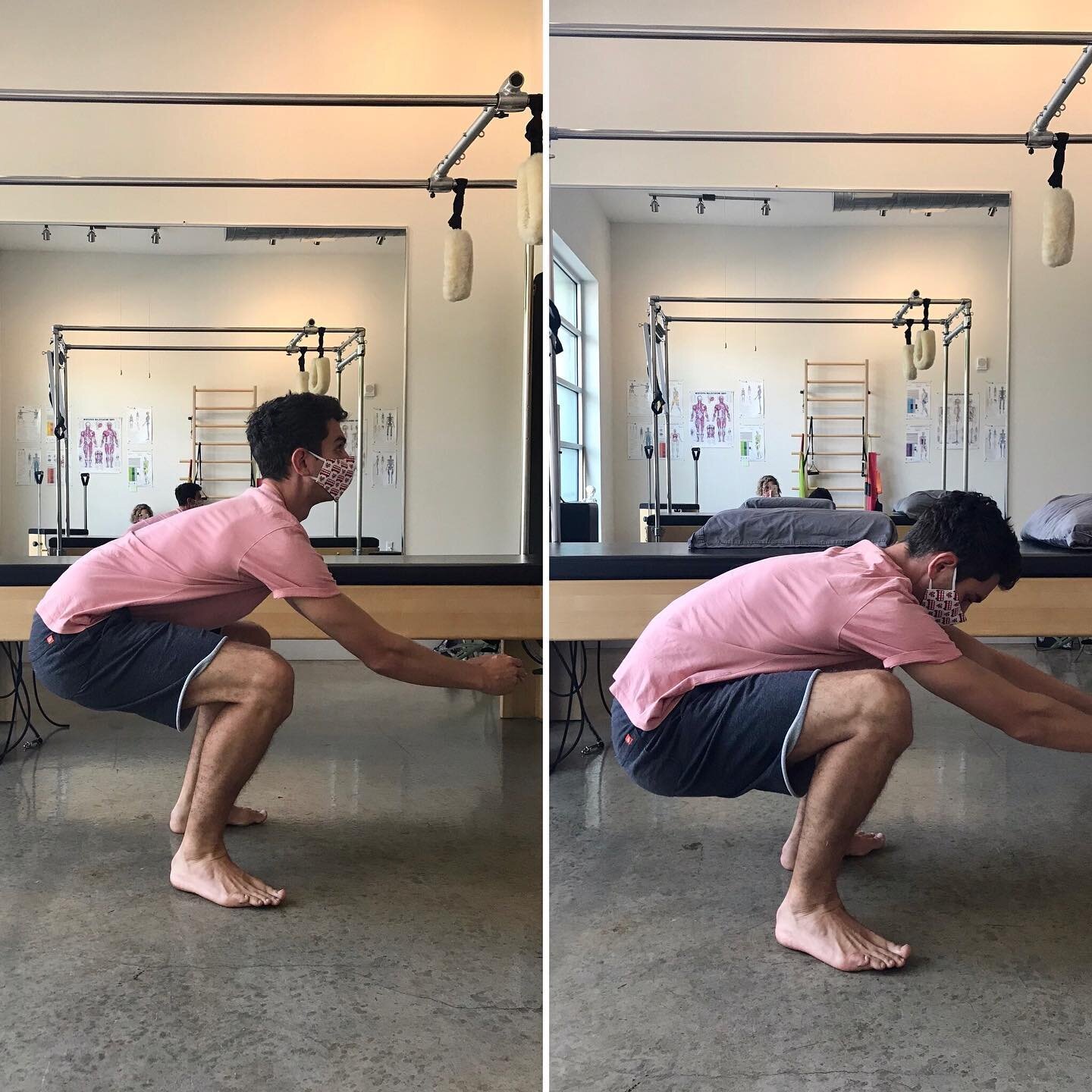
Strengthening the pelvic floor-Going back to the beginning of this post, strength is the ability for a joint to move in full range. With that logic, deep, full squats are the best way to strengthen and stretch the pelvic floor, in my opinion. I know that this isn’t available to everyone, particularly with knee issues. At a minimum, you can use your pelvic floor to stand up from a seated position, see tips in a video here and see below for ways to deepen your squat. Tapping into how your bones spiral can improve your squat in a way that may help knee issues.
I'll do a similar post for things that affect running and walking form as well as stretches and exercises for the upper body. Sending well wishes to you and your loved ones during this time and hope this information allows you to connect with your body and the outdoors.
If you purchase from any of the links provided here, I receive a small commission as an Amazon affiliate.
Latest Instagram Posts