Your Custom Text Here
Fix Your Frozen Shoulder 2-Anterior Fascial Chain
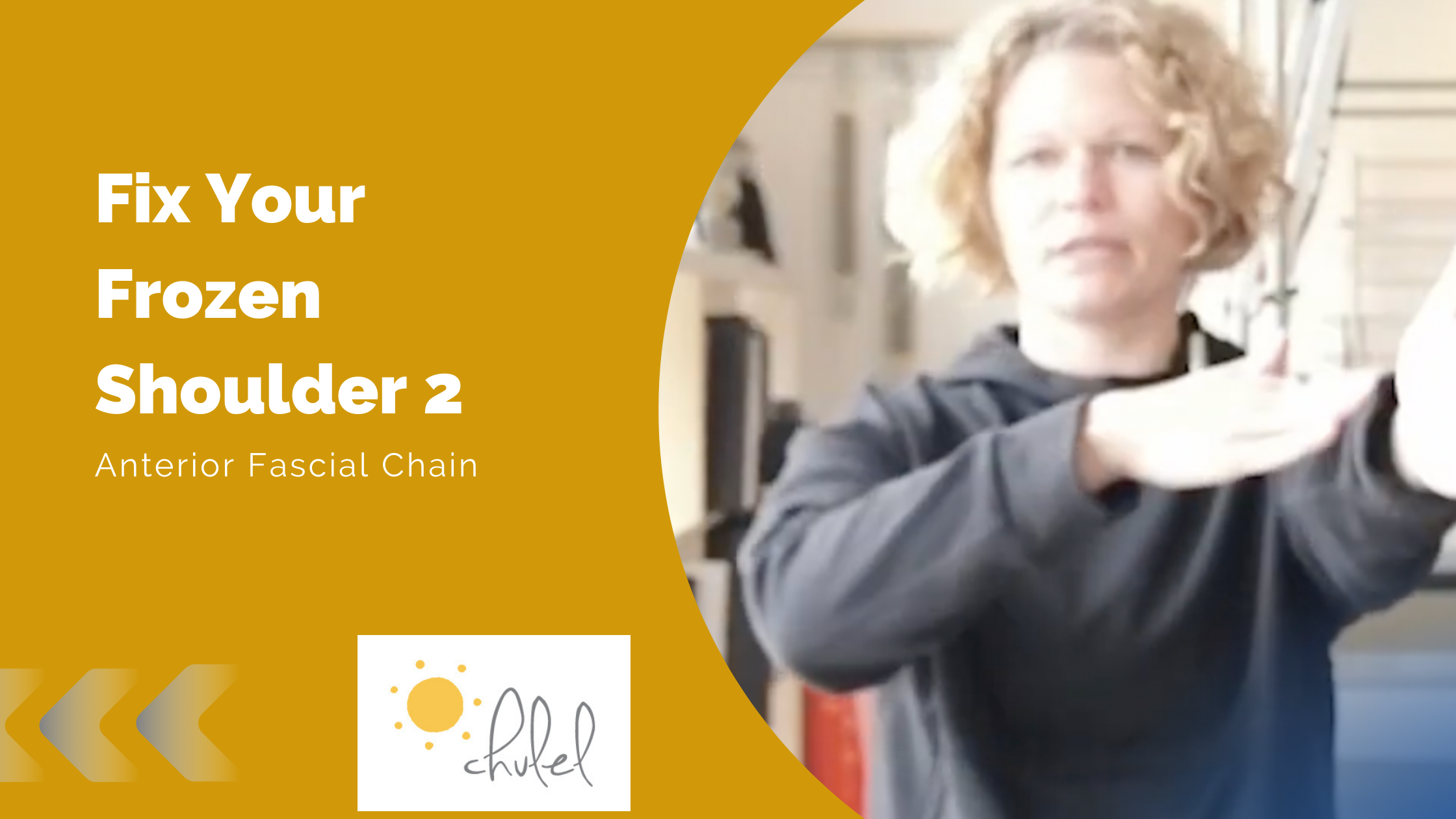
This episode focuses on the anterior fascial chain which goes from the thumb and palm of one hand, across the abdomen and down the inner thigh of the opposite leg—read: your obliques! Most adult bodies don’t really remember how to twist correctly, and instead, use their shoulders/neck to twist and not their core oblique muscles. In this video, we’ll massage and stretch all the areas that are overworking and then re-activate the under-working core musculature.
The first place to stretch and massage is the pec minor and major. This area is perhaps the most important for shoulder impingements as these muscles are contracted all day as we type/drive and do anything with our arms held in front of us. Yes, scroll thumb also applies here. There’s also a bicep stretch where your goal is to have your hands behind you with your pinkys touching—a simple towel will do as a prop.
We then travel up the chain to the face and neck for a self-lymphatic face massage. Then tend to muscles in the sides and front of neck that get testy with chronic jaw tension.
Moving downward, we look at using your hand to release your groin—the pesky pectineus as I like to call it, which can mirror the tension in the pec minor. Both of these muscles deeply pull the ball and socket joints inward to the fetal position. So, if you struggle with the hunched position and/or sleep in the fetal position, you’ll want to take some time to do this release with the follow up abdomen stretch to restore some space to your mid-section. You’ll not only feel longer afterward, you’ll probably feel leaner too!
The goal of these videos is not to just stretch and release, but to also remind your brain of what it should be using more. In this case, it’s your obliques. The ‘exercise’ in this video activates those and also emphasizes the eccentric load on your pecs and inner thighs. When we’re tensed into this crunched, poor posture position, we become a little ball with T-Rex arms in the extreme; meaning the pecs and inner thighs are only strong when they’re close to our torso. In this movement, we’re trying to make big motions with these joints to remind those areas they have way more they can do.
And finally, we activate the front of the shoulder (not the chest) as it often is under-utilized. Important cues here are to keep your elbows straight—no T-Rex and to feel like you’re lifting your arms in water, meaning nice and slow. If this motion bugs the shoulder, try a different angle. You can also play with different wrist positions to hit the different aspects of this muscle.
Hope you find these stretches and movements helpful for your shoulder pain!
Improve Your Running Form and Walking Gait

In the Covid era, those of us who can exercise outside are doing so. We’re taking longer walks and that may also morph into running. We’re also spending (maybe) more time sitting in front of a screen when we’re not outside, yet we also have more time time on our hands to focus on our health and bodies. Probably a good thing during a pandemic, right? Walking is something we all do and most of us don't do it correctly because of old injuries and repetitive motions as creatures of habit. What follows is a series of suggestions of massages, stretches and exercises to build up good biomechanics in gait. (For today, I’m just going to focus on the lower body as I have a lot of potential suggestions with an upper body post to come.)
Note: everything in this post would also be relevant for those with lower back pain as all of these areas can play into that condition as well.
First, a few basic definitions.
Weak vs. Strong
Strong means that a joint can move in its full range of motion comfortably and with ease. It doesn’t mean how the muscle looks on the outside. Weak would be the opposite of this—a joint that can’t move full range or has pain when doing so. A muscle may also have lost its connection to your brain through an injury or movement compensation from some time in the past. Reconnecting that muscle will automatically make it seem ‘strong’ again because it’s linked back to your brain and can help a joint move appropriately.
Tight Muscles vs. Loose Muscles
Muscles pull on joints to get us to move so they’re like pulleys. Depending on how we hold or orient our body, some of those pulleys may get stuck in a certain direction, meaning one side may be locked short and the other locked long. Thing is, they’re both tight because they’re generally kind of stuck in one direction.
What does proper gait look like?
There are distinct phases to gait so a person would ideally pass through each phase when walking, equally, on both sides. But what happens with that old football injury you had in high school, or that time you feel off your bike, swing, chair, etc… Point is, over time, our bodies naturally make some little adjustments to keep putting one foot in front of the other. So when you decide that now you’re going to take that long walk or start to pick up running (which is a great idea!) those old, little adjustments your body has made may lead into some new areas that feel tight or have pain—or at least, they make you aware of their presence.
For our purposes here, we’re going to simplify to the major 3 phases that I’ll make reference to which are: heel strike, mid-stance and toe off. You can get nerdy about this stuff really fast. I’m going to break down each section starting at the feet of common compensations and how you’d want that area to be on your body.
Foot Goals
Most folks have tight feet.—yes this can be a shoe thing, but it’s also tied to stress and not having a full breath cycle. If you hold your breath, you may feel your feet tighten, it’s subtle, but trust me, it’s happening. Combine this with various shoe choices and boom, ya got tight feet. The feet have a lot of little joints in them, 33 to be exact, so they ideally function as a dexterous, shock-absorbing trampoline. Fun fact, that trampoline also mirrors and connects to your core. So, flexible, strong feet means you’ll use your core more in day-to-day walking and movement. You can keep your feet loose with this simple self-massage and I love love these—they’re a bit pricey, here's a more affordable version that has come out on the market.
Flexible toes, especially the big toe—Another thing that can affect that toe off phase is inflexible toes, particularly the big toe. If you have any form of a bunion, you’re in this category. (On a personal note, however, I’m actually more inflexible on the foot where I don’t have a bunion. 🤔 Haven’t figured this one out yet.) Your big toe should be able to bend upwards 30-45 degrees with your body weight on top. You may be able to find that flexibility laying down, but standing can be a completely different story. This is perhaps my favorite stretch to do before I go for a walk/run as getting that proper toe off completely changes my gait and how I feel muscles engage all the way up my leg. Improper toe off is another thing that can manifest in knee/hip/lower back pain. A way you can understand this re:lower back pain is if you try walking without bending your knees or ankles. You’ll kind of walk like a strange, stiff stork-like character. Where do you feel yourself hinging from? Exactly. A lot of folks walk with some version of this and don’t realize it.
Strong arches—You want the middle of the trampoline to be strong and supple so it can respond to any subtle shifts—this is part of how your body retains balance. You’d want to balance on trampolines (particularly with age and bone density deterioration) over ice skates. Here’s a simple way to do that, even while you watch tv.
Shoes that allow your ankle to move—In order for proper toe off (phase of gait) your knee needs to be able to cross in front of your ankle, over your toes. If your shoes are laced too tightly, they won’t allow for this phase to properly occur. Here’s my preferred way of lacing that I learned in an Aston Patterning workshop. Lacing your walking/running shoes all the way up to that hole that cuts back towards the ankle would be a no-no for the same reason. If your knees can’t clear over your ankles, you may have knee or even hip pain & lower back pain after walking/running.
Equal weight in your feet—Going back to the idea that we’ve all had a tumble or two in our lives since childhood and that our body creates compensation patterns to keep us keeping on, and then we end up walking using more of one leg than another. Yes, to walk we naturally sway our weight from one side to the other. Much of walking is balancing on one leg. The question is if we sway equally from one leg to another. If you don’t have equal balance between your legs, you can hear it when you walk down a hallway or in certain types of shoes. The sound from what one foot does to the other will be different. This is actually moreso a hip/pelvis issue, so we’ll address it later.
The pronation/supination debate—Thing is, in gait the foot pronates AND supinates at different points in gait to allow for shifting bodyweight. That said, yes, some feet send to err more to pronation or supination and that can be a piece of funky foot mechanics. My favorite way of addressing this is a bit complicated to just put into a blog post because if you re-orient the foot from pronation to more supination or vice versa, it will shift everything up the chain. I think it’s important that anything I write about/post to YouTube are things that you can do without hurting something else and this is an area that falls to a personalized session.
Ankles/Calves
Stretch your calves!-The calves help the ankle move. The ankle’s full range of motion is that stretch you may do on a curb to being up on your tip toes. Unless you’re an athlete or trudging the hills of San Francisco, you’re probably not getting that full range daily. We wear shoes that aren’t usually the best at facilitating good mechanics and we walk on flat surfaces all day in them. So, the calves get tight & weak—again, back to that level idea in the beginning of what those words mean. Trigger point work on your calves like this and stretching them—both front with this variation and back as seen here will help things all the way up the body. Tight calves can be a huge underpinning of knee/hip/lower back pain. *See imagery I mentioned on the flexible toe portion. Same thing applies here.
Strengthen your ankles-A really simple way to do this is via calf raises and this is huge for people to age well. People tend to shuffle their feet and waddle as they get older because these joints aren’t worked in full range-of-motion. Strong calves help prevent a ‘falling-and-I-can’t-get-up’ situation because your gait won’t allow you to tip over so easily and break something. Compare this with a ballerina and how everything is engaged when she’s on her toes—strong ankles=strong core. Oddly enough, getting good form on these can be tricky, so here’s a video that includes common errors.
Posterior chain (i.e. your derrière)
Desire buns of steel, well, kind of-Sitting for long periods of time, which we’re doing even more of in the Covid-era, makes the back of the thighs and the bum go flacid and/or get tight. Using a foam roller/massager to get blood flowing back into that area before exercising can help your brain be able to find those muscles see tips here and here. Sometimes it’s tension from the front side of the body that is shutting down the connection to the back side, so getting flow back to the quads like this video is super important as well. A modified pigon pose from yoga is an easy way to stretch all of these places at once, see my tips here.
Pelvic tilt-Think of the sides of your pelvis (where you ‘put your hands on your hips’) as having dials on them that you could rotate to change the pitch, like you can with a car seat. Next, try turning the dials backward—kind of like you’re doing cat/cow, this would be cat. Then dials forward so that the bowl of your pelvis would have soup spilling out of the front or cow. As you work these directions, which makes your spine feel like it’s getting longer? If it’s when you tip forward, then you’re likely a little too posterior on the regular, if the opposite is true, your pelvis sits a little more tipped forward. If your natural state is more posterior or cat, your hamstrings will be locked short and tight, if your natural state is anterior or tipped forward, the front of your hips and thighs will be locked short. So, giving stretching love to the locked short and exercise love to the locked long will, over time, help level you out. **This is something I also prefer to do one-on-one because changing this pitch will affect everything, especially your neck/shoulders. That said, any of the other exercises listed in this post can help.
Buckling into the knees vs hyperextension-Stand and force your kneecaps backwards—you may feel your quads (front of thigh muscles tighten). This is more of a gauge of hyperextension—another one is if you look at yourself from the side in a mirror, you can see your knee caps be forced backward. To correct this, slightly bring your knees forwards as you’re standing and feel your quads unlock. This is your happy place standing, in gait, it’s more a matter of strengthening the muscles of your thighs to hold your knees in their proper place. I find that a lot of people buckle into their knees when walking which correlates to weakness in the pelvic floor and core. I think this is also residual from sitting and the knees forget how to straighten properly. Both are correctable with the proper exercise program. Again, if you want help with that, reach out.
Inner/Outer Thighs (Adductors & Abductors)
Strengthen both-Generally, almost everyone is weak in these muscles, it’s just a matter if one side is locked short/long—particularly for those who have bow legged/knock knee patterns. There’s been a general backlash against foam rolling the IT band as it can’t technically lengthen since it’s a tendon not, not a muscle. Personally, I derive benefit from doing so, particularly for an old knee injury, so directions on how to do so here. My mantra on rolling the IT band, kind of like rolling anywhere, is if it hurts too much, don’t do it because you’re just creating tension in one place while trying to alleviate it in another. Here’s a way to foam roll the inner thigh that is super beneficial for knee pain and lower back issues. These guys also get pulled into the locked long/short patters depending on whether or not you have a pelvic tilt.
Now that these areas have more blood flow and the tissues are loosend up, it's time to work them. Work your inner thighs in full range of motion. For an abductor exercise, see the next section.
Instead of the IT band, look at the TFL-The Tensor Fasciae Latae is just above the IT band. So you can foam roll the IT band all-the-day-long, but you may have a tight and weak TFL. The TFL is critical for proper loading of body weight over the standing leg during mid-stance in gait and it’s under chronic shortening because of sitting. Here's a way to release the TFL with a ball or foam roller, and here’s a way to strengthen it along with the gluteus medius and minimus which all work in tandem for that portion of gait. They’re critical muscles for balance, so keeping strength here will help you in that capacity as well.
Is the problem in your jaw, or your hips?-If the jaw is off, it can throw off this lateral hip stability that the adductors and abductors help with. These are some of the more specific relationships I look at individually in session, but if you know you tend to hold tension here, or that you have jaw issues such as TMJ, your hips as jaw could be in a dysfunctional relationship. Doing some self massage before attempting 👆may help you access the target muscles more easily.
Hip Rotators (Piriformis)
Tight and Weak-In general, I find that most folks have tight and weak hip rotators with an underactive gluteus maximus. Here again, sitting is a major culprit, as these muscles just get lazy when a chair supports them all day and we hold our breath. You can release the piriformis with a tennis or lacrosse ball like so, and then follow that up with some glute strengthening with some hip bridges. I’ll record my favorite progression & post in the next week. You’d also want to get some strength back in those rotational muscles, so here’s my favorite series of exercises for that. Note, if you acutely have piriformis syndrome or lower back pain, I’d just start with some overall foam rolling the glutes like so and a gentle stretch such as this. If you attack the piriformis, I find that it has a hard bite back. Slow and steady is better and more effective in the long run.
Piriformis Syndrome- See notes 👆, but also want to add that the piriformis gets chatty, or ticked off, when weight is not being transferred down through the pelvis symmetrically. In other words, it can have a spinal tie in. You can kind of feel this if you sit and rock side-to-side, is there a side that your body really prefers to swing to? Is that the side where your piriformis is talking to you? Just a thought…I’ll address more upper body things for gait in another post.
Psoas
Oh the psoas-The trifecta of the psoas/quadratus lumborum/piriformis can wreak a lot of pain as well as faulty gait patterns. If you have any amount of crooked or imbalance going on, which most of us do, these guys are getting torked and pulled, which means they’re taking your spine and pelvis with them. Then there’s a lot of bodywork pundits out there with opinions on how or what not to do around psoas release. The psoas gets a lot of attention as THE fight-or-flight muscle as it pulls you into a ball and also helps you run. Personally, I don’t see this muscle as being any more connected to the nervous system or past trauma than any other place in the body. That said, the gentle form of release is the Constructive Rest Position. I’m not going to post here, but if you look that up, there’s plenty out there. If you have active lower back pain, you have probably intuitively done something similar.
Thing is, it’s usually one psoas that’s an issue, creating a torsion through the spine and pelvis. In this video, I instruct you to figure out which side you should release and how.
Iliacus-This is another partner to the psoas to the point where they’re jointly referred to as the iliopsoas. The iliacus lines the inside of your ilia (the butterfly bones of your pelvis). Self-release can be a little tricky. To most easily access the iliacus, I usually have people lay on their side (like you’re side sleeping) so that it moves the belly out of the way. Then you would take 4 fingers and try to essentially pry the muscles from the inside of the ilia—sort of like you’re scooping out ice cream from the inside of the butterfly bone. Depending on how dense your tissue is here, your hand might get tired quickly. But, even a little work here goes a long way to freeing up your pelvis and allowing for more movement in there when weight-shifting from leg to leg in walking/running.
Stretching the psoas-Perhaps the best way is Warrior 1 with the back leg turned out. Easy peasy.
Pelvic Floor Weakness
Weak tight or weak loose?- One, I refer to the pelvic floor in a more broad sense than just the PC muscles, I see them as anything front to bottom to back as anything that provides stability to the pelvis. In session, what I generally see is that more pelvic floors are tight over loose. If you birthed a child through the birth canal (at any point in your life), then yes, you’re more apt to be loose. Your pelvic floor is likely tight if you fit any of these: incontinence (can also be from loose), slow to urinate or if it comes out in a fast burst, male in gender.
If your pelvic floor is loose-try pressing the butterfly bones of your ilia towards one another with your hands. Kind of like you’re trying to squish yourself from the sides. If that feels good, I would look into purchasing and wearing a pelvic floor belt for a little while. They’re inexpensive and it might get your pelvic muscles firing up in a different way. Not to wear all the time, but if there’s an activity that feels stressful on your back or generally fatiguing like standing in one place for a long time (e.g. washing dishes), they can be really helpful.
Loosening the pelvic floor-Hear me out—the use of sex toys safely in either vaginal opening or anus can help. The video below more generally addresses the attachment sites of some of these muscles and can have a relaxation effect. Doing cat cow from yoga with a focus on the pelvis, which I walk through here, can also stretch these muscles.
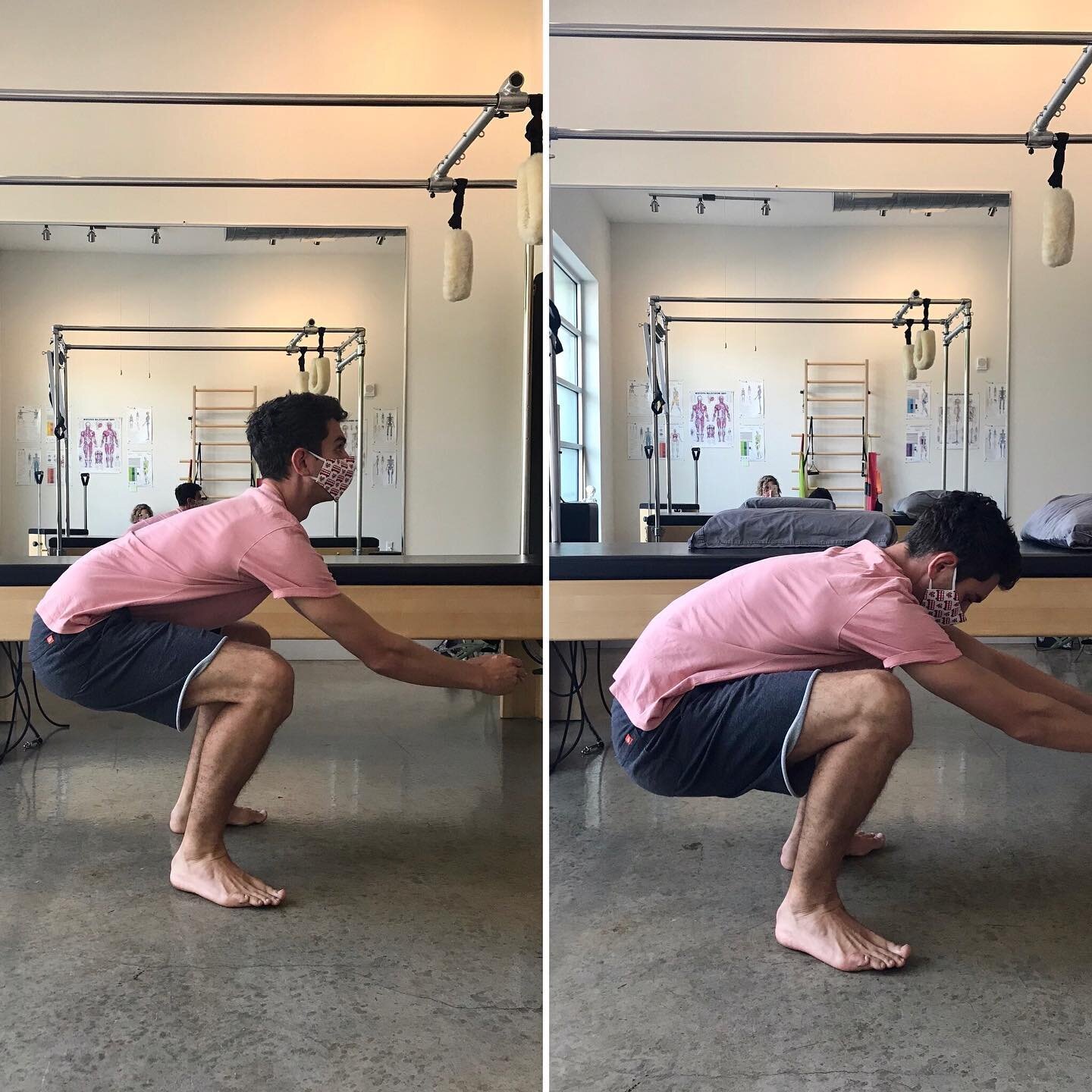
Strengthening the pelvic floor-Going back to the beginning of this post, strength is the ability for a joint to move in full range. With that logic, deep, full squats are the best way to strengthen and stretch the pelvic floor, in my opinion. I know that this isn’t available to everyone, particularly with knee issues. At a minimum, you can use your pelvic floor to stand up from a seated position, see tips in a video here and see below for ways to deepen your squat. Tapping into how your bones spiral can improve your squat in a way that may help knee issues.
I'll do a similar post for things that affect running and walking form as well as stretches and exercises for the upper body. Sending well wishes to you and your loved ones during this time and hope this information allows you to connect with your body and the outdoors.
If you purchase from any of the links provided here, I receive a small commission as an Amazon affiliate.
Common Cause of Knee & Ankle Pain
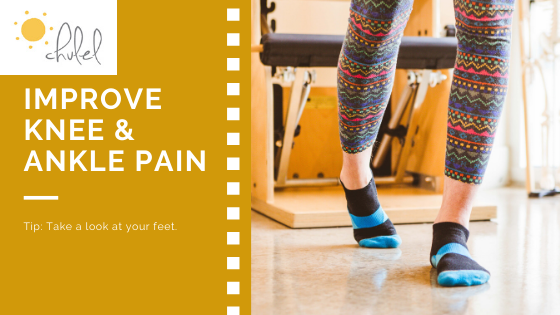
TIGHT TOES! Take a little walk—long enough to get your stride and pace going and notice if you feel your ankle roll out to the side just a little bit as you push off. You may even feel a twinge of pain in your ankle or knee. Another option is to get someone to video you (maybe even in slow motion) and see if you can watch yourself doing it. It will look like a little ankle whip around as you propel forward as in the picture below.

How would the toes get tight?
The top two reasons from my experience with clients are shoe selection and not breathing fully. Any shoe that encourages a toe scrunch would create a situation where your body would start tighten when walking instead of being wide and open (I refer to this preferred state as ‘Frodo Feet’). This isn’t just the easy scapegoat of high heels and pointy shoes, flip flops or any shoe that is so loose that your toes have to work to keep them on would create tight toes. Wearing shoes that are too small or lacing shoes too tightly would cause similar footing.
Next, hold your breath and feel how your feet tighten up a bit (all your muscles, really). We all have a tendency to shallow breathe when we feel stressed, so being under prolonged stress or if you’re in a job/school environment where you heavily focus day-to-day, usually means that you’re holding your breath. I often see that if someone grew up in an environment where they were often afraid or anxious (this could also translate into present-tense adulthood) the toes also scrunch as a response to that fear factor. I call it the Bird-on-a-Wire grip whereas that Frodo Foot is grounded and open…calm.
How should I walk?
This goes with a bit of an * in that we’re all shaped differently and have varied movement/injury backgrounds so there isn’t one for sure right way. That said, the first two toes (big toe and second toe) should more or less line up with your shin bone and thigh bone. This may be difficult if you have flat arches or have had other lower leg injuries. These bones are considered your weight-bearing bones so your body weight is centered over the mid-line of your body. Your weight centered here would naturally allow your core and posture muscles to support you as you walk or run. Lack of weight-centering can cause weight to shift to the outer or lateral lines of the body in walking, which could be a factor in a tight IT band, lower back pain, knee pain and ankle issues.
As you take a step forward, the foot should roll through the mid arch to push off with the ball of foot and then the toes. If you have a tight first or second toe and/or a bunion, you are likely not pushing off of that foot correctly and you may be rolling to the outside of the foot as shown in the picture above.
An exercise to stretch your toes and allow for proper toe push off.
This simple stretch can be done with a rolled up towel or a tennis/lacrosse ball against a wall. In the video, my model is demonstrating it with one of my favorite foot stretching and release tools, the Yamuna Foot Savers. Here’s another way they can be used to release foot tension and help with plantar fasciitis. You can easily purchase them online through Amazon and they last forever. Take them with you when you travel because they take up virtually space and really help loosen the feet after sitting in a car or being in a plane for long periods of time. If you do have a bunion and this stretch feels uncomfortable, you can stretch your big toe off to the side and focus on your second toe. No need to do more than about 10ish repetitions on any given toe and only about once per day at most.
Happy, grounded feet=better balance and core stability!
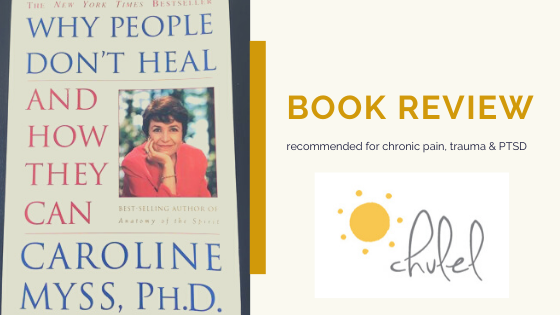
Why People Don't Heal And How They Can

I first came across Carolyn Myss, the author of this book, about 8 years ago. Since then, I've started this book 3 times and stopped because I saw different aspects of myself in the pages I wasn't yet ready to confront. If you were to put one self-improvement book on your summer reading list, I'd highly suggest this one.
Many of my clients initially come to me because they suffer from chronic pain and chronic fatigue. Naturally, they feel angry at their body and that they can't live their lives to the extent that they would like. Feeling stuck and depressed is an understandable companion to this anger. That said, the more anger we project back onto our bodies, the longer and more fraught the healing process is. A more effective path to healing is seeing the pain as a point of entry to explore deep within ourselves. In Why People Don't Heal and How They Can, Myss offers some ways to identify if we're suffering from what she calls Woundology and belief systems that could stifle our healing process.
These are the author's top 5 belief systems that most people get caught in when they're in pain or are ill. To move forward, we have to detach from the belief.
5 Myths of Healing
1. My life is defined by my wound (Woundology).
Seeing life through the lens of a traumatic experience means projecting that onto every future relationship and experience (though a book I wrote about last year here says the brain naturally will do this after trauma). Those stuck in this pattern will seek out a social support network that will be sympathetic to their experience and then they never have to move past it. Moreover, they connect with others by comparing wounds and feel empowered if they are more wounded than someone else. She specifically mentions survivor and addiction groups and that they are helpful at certain stages. To continue healing, however, one has to move past that identity of survivor or addict.
In short, we can get stuck in the healing process if we define our identity and live our lives through our wounds rather than evolving past them. It can be a tricky process because someone may think they're addressing their wounds, but what they're really doing is carrying them around like a badge of honor. Over time, our wounds accumulate and gradually suck our energy, leaving us prone to depression, pain and illness. To move past your wounds, focus efforts on things that feed you rather than deplete you. If a current event triggers you to recall all the other times this has happened to you, rather than listing the wounds, look at what you're doing in your life that is creating part of that pattern.
2. Being healthy means being alone.
This is a system that I've personally been guilty of over the last couple of years until I acknowledged that by engaging with others means I have to grow through the things that trigger me. When I envisioned myself as healthy, I was the only one in the room rather than being surrounded by those who I know love and support me. Myss contends healing is an ongoing process that is best done in a community that can help support our changes; "Healing does not represent the closure of the needs of the heart; rather, it is a doorway toward opening your heart." She cites American individualism as a culture block to realizing this yet also acknowledges that sometimes we do need to separate from someone or a community to grow.
3. Feeling pain means being destroyed by pain.
It's normal to believe that pain or illness is negative, yet these feelings can also push us to explore within ourselves and move away from destructive habits and behavioral patterns. She cautions against relying too much on prescription drugs or painkillers in general because they can mask the symptoms of what our body is asking us to heal. She suggests using a mindfulness practice like yoga or meditation to help with healing consciously.
4. All illness is a result of negativity and we are damaged at our core.
Myss encourages readers to not immediately blame a failure to heal on a past experience or negative belief. Illness is complex and there's plenty of toxins in our environment and genes that can be an aspect of illness. Our focus should instead be on our ability to create change over controlling our thoughts. Sometimes it's better to just let go of the negative thoughts or past experiences over trying to dive into them and understand them....that can do more harm than good.
5. True change is impossible.
Most of us don't really like change and to change but healing and change are the same thing. We associate illness with fear and negativity so it can be intimidating to confront the illness and look at how much we really take care of ourselves versus the needs of others. Try shifting the belief that healing will be hard or depressing to relieving and exciting.
This is one of the few books on healing that I've read that actually provides a structure for analyzing one's beliefs and how to better understand and forgive--she actually encourages making a chart/spreadsheet and guides readers on specificially how to structure it. That said, it's a very East meets West, spiritually-minded approach, so if that's not your bag, this may not be for you. If it is, Myss has a unique perspective on understanding how American culture looks at pain and illness that I found to be eye-opening in forgiving myself and others because we're all stuck in some collective, old mindsets that we can let go of reacting to individually.
Cross Training for Runners
We are deep in marathon-training season here in Texas thanks to temperatures that make outdoor activity easier. It's also a season when logging high mileage can lead to poor movement patterns and then injury. Using a combination of massage, trigger point therapy, stretching and strength training can not only keep you inury-free, it can also improve time and performance on the road.
This is a collection of some of my favorite stretches and exercises for runners, particularly for folks who stare at a screen for a living and love running for cardiovascular and mental health. As someone who is a bit 'Type A' I love my exercise and stretching routines to have twofers or threefers meaning you're getting multiple benefits from each. We're all busy so we might as well feel like we're accomplishing a few things at once from our stretching routines.
Massage & Trigger Point Release
We could all use to take better care of our feet, especially if you're out pounding the pavement for miles every week. Consider this massage like foam rolling for your feet. It only takes a couple of minutes and is easy to do while watching tv or before you pop on those shoes for a jog. Check and see if your foot changes color after you do it!
Trigger Point
The gist of trigger point work, if you have not heard of it before, is that you find a tender spot and apply consistent pressure until the muscle starts to relax. This can take minutes and can be confusing at first if you can't feel the muscles releasing. The more you practice the easier it is to know when the muscle is letting go. You can use a ball, foam roller or other trigger point therapy tool--my only reminder is to breathe! Below are two different releases you can do with a ball and a foam roller.
Piriformis (hip rotation) Trigger Point Release
Gluteal (butt) Muscle Trigger Point
Calf Trigger Point Release
Stretching
If you want to up your stretching routine and do something beyond the basic quad and calf stretch you learned in grade school, these are my favorites for stretching multiple places at one time. They incorporate stretching muscles as well as facial or connective tissue lines. Many runners may be aware that their calves and hamstrings could use a stretch (find my favorite version here), but knowing how to stretch the front of the shins is a bit more complicated. Click here for my suggestion for a good shin stretch.
Strengthening Exercises
When you're spending so much time on the road just trying to get your mileage in, stretching may be the only thing you may take time to do. Cross training exercises are soooo important for runners as you're doing a highly repetitive action. This plus long hours potentially looking at a screen usually means the hip muscles become weak because they're being supported by a chair most of the day. Hip weakness combined with high mileage is a recipe for chronic pain or an injury. Most runners I've worked with need more lateral (abductor) strength, inner thigh (adductor) strength as well as core stability via the obliques.
Strengthen You Rear
Inner Thigh Stretch and Strengthening
When looking at a screen most hours of the day and then participating in exercise that is also very forward-oriented, the obliques and the cross body stability muscles become weak. Improving these means improving balance so your energy can carry you forward. An added bonus is that you may even see your waistline shrink if you work on these muscles. Here's a simple, yet super challenging one using a foam roller.
Core Strengthening and Stability
How I can help
Ki Hara active stretching (see example here) is super effective in creating flexibility and strength at the same time. Having this muscular dexterity not only allows you to run longer, but also faster. Many professional athletes and sports teams across the country use this technique as their secret weapon.
I also use a piece of equipment called the CoreAlign that is phenomenal for gait training and orienting the body to the core in a running motion (see more about it here). I've helped many marathoners streamline their gait patterns so they can lower their per mile time. If you've ever, even as a teen, had an injury to the lower half of your body, you may have established some compensation patterns in your walk. Running with these compensation patterns can be an underlying component to chronic pain and injury. Peeling back those patterns will give you more agility and speed as you run. You have more power than you realize!!
Latest Instagram Posts