Your Custom Text Here
Fix Your Frozen Shoulder 2-Anterior Fascial Chain
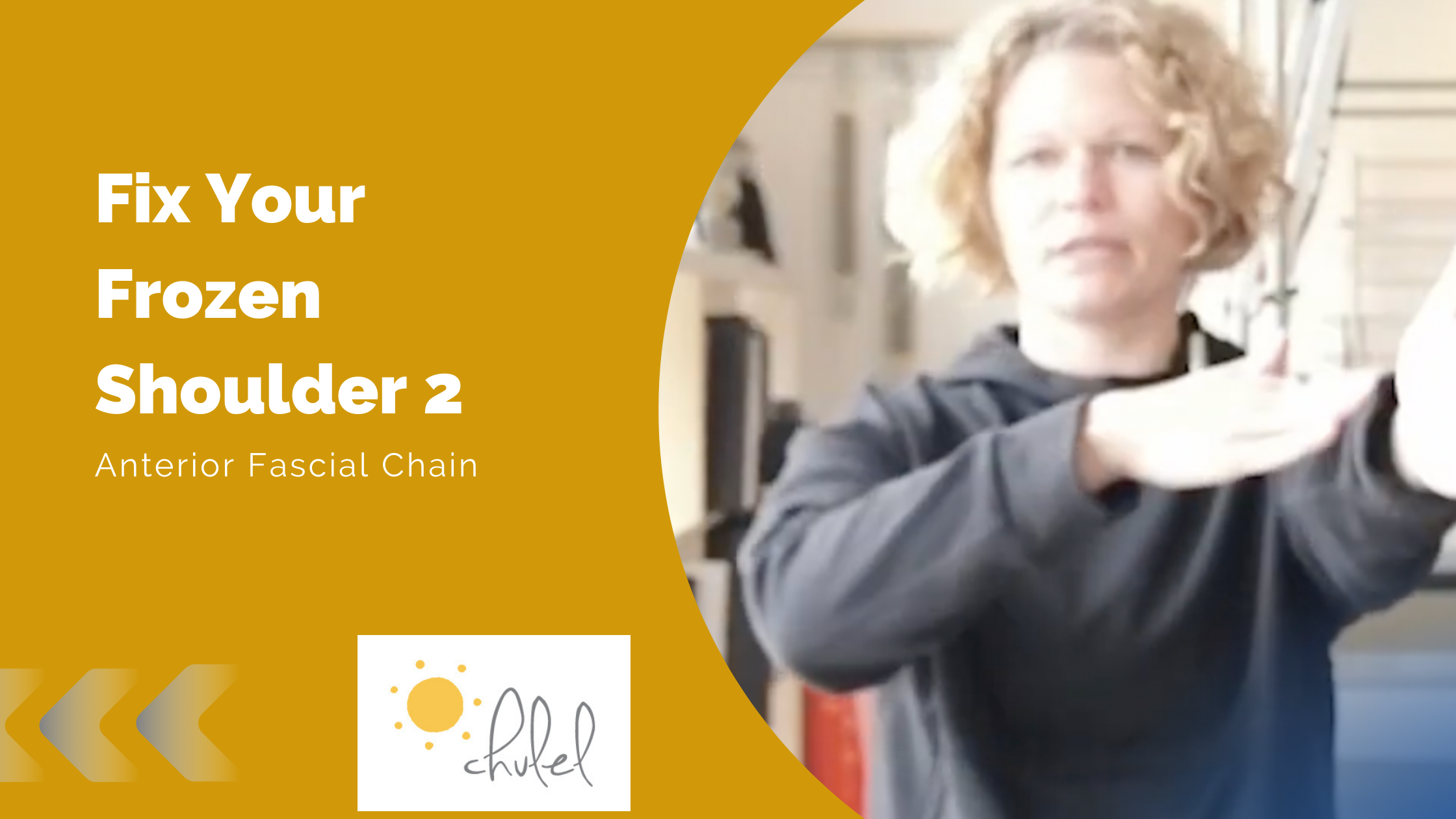
This episode focuses on the anterior fascial chain which goes from the thumb and palm of one hand, across the abdomen and down the inner thigh of the opposite leg—read: your obliques! Most adult bodies don’t really remember how to twist correctly, and instead, use their shoulders/neck to twist and not their core oblique muscles. In this video, we’ll massage and stretch all the areas that are overworking and then re-activate the under-working core musculature.
The first place to stretch and massage is the pec minor and major. This area is perhaps the most important for shoulder impingements as these muscles are contracted all day as we type/drive and do anything with our arms held in front of us. Yes, scroll thumb also applies here. There’s also a bicep stretch where your goal is to have your hands behind you with your pinkys touching—a simple towel will do as a prop.
We then travel up the chain to the face and neck for a self-lymphatic face massage. Then tend to muscles in the sides and front of neck that get testy with chronic jaw tension.
Moving downward, we look at using your hand to release your groin—the pesky pectineus as I like to call it, which can mirror the tension in the pec minor. Both of these muscles deeply pull the ball and socket joints inward to the fetal position. So, if you struggle with the hunched position and/or sleep in the fetal position, you’ll want to take some time to do this release with the follow up abdomen stretch to restore some space to your mid-section. You’ll not only feel longer afterward, you’ll probably feel leaner too!
The goal of these videos is not to just stretch and release, but to also remind your brain of what it should be using more. In this case, it’s your obliques. The ‘exercise’ in this video activates those and also emphasizes the eccentric load on your pecs and inner thighs. When we’re tensed into this crunched, poor posture position, we become a little ball with T-Rex arms in the extreme; meaning the pecs and inner thighs are only strong when they’re close to our torso. In this movement, we’re trying to make big motions with these joints to remind those areas they have way more they can do.
And finally, we activate the front of the shoulder (not the chest) as it often is under-utilized. Important cues here are to keep your elbows straight—no T-Rex and to feel like you’re lifting your arms in water, meaning nice and slow. If this motion bugs the shoulder, try a different angle. You can also play with different wrist positions to hit the different aspects of this muscle.
Hope you find these stretches and movements helpful for your shoulder pain!
Fix Your Plantar Fasciitis-Episode 8 How to Improve Your Gait
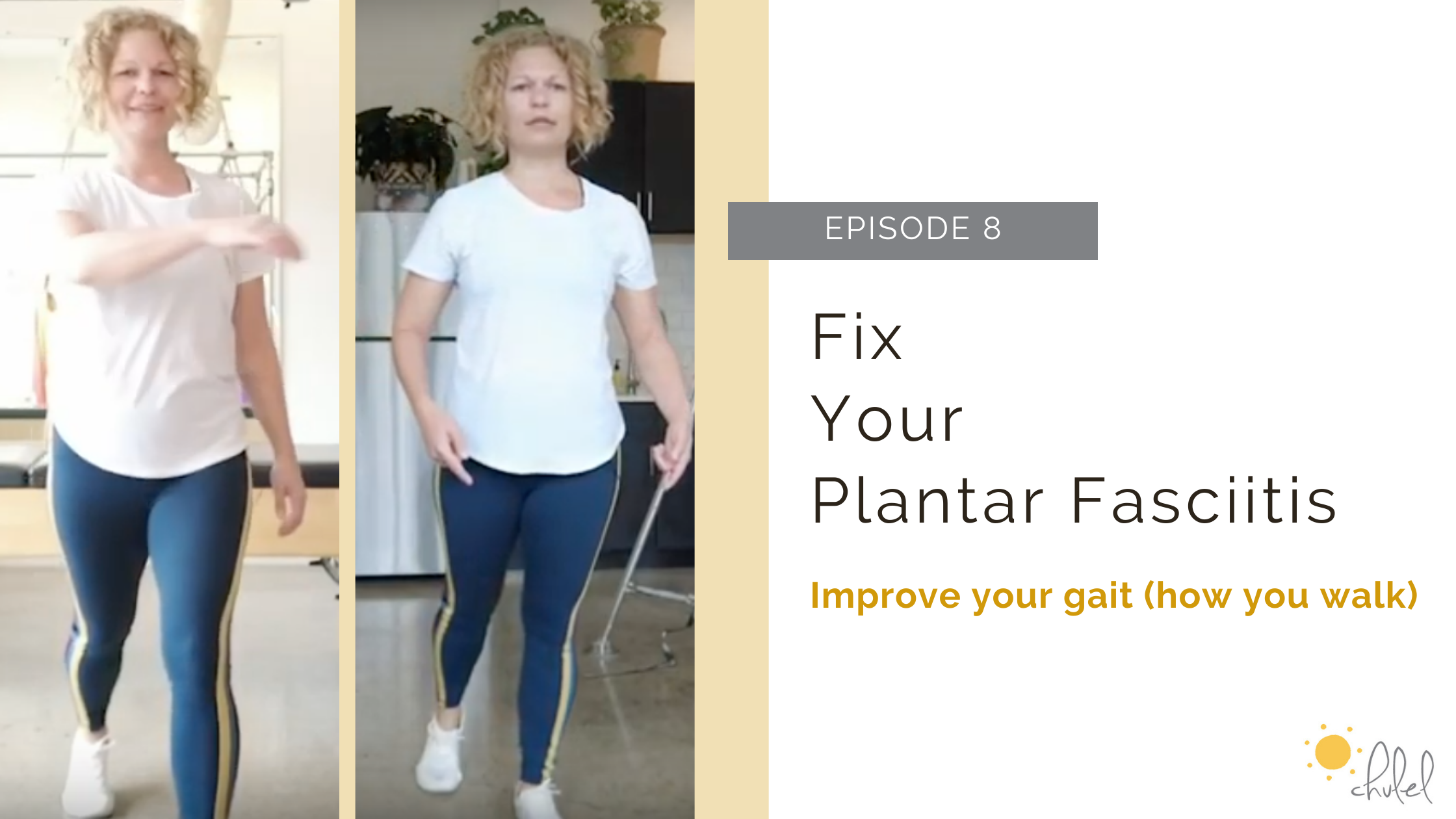
Over the years I’ve taken several workhops and read many books on how to fix your gait (how you walk/run) to correct several injuries I’ve had to my lower leg—including being hit by a car in a crosswalk.
This video highlights some of my favorite exercises I’ve learned that can be done from anywhere.
The first is from an Aston Patterning workshop that trains your body how to transfer weight from one leg up through the pelvis to the other leg. I always liken it to feeling like you have a slinky momentum as you walk. I’ve noticed that those with plantar fasciitis, tight feet, even bunions and Morten’s neuroma don’t fully roll through their midarch when they roll through their foot. It’s more of a heel-toe clomp. This simple exercise can help your body improve balance and change that pattern.
The next couple of exercises are from a workshop I took with James Earls who wrote a book called Born to Walk. They emphasize a fascial spring to walking and really hone in on the rotation aspect of walking. This is another plantar fasciitis thing—that gait pattern can often be more of a waddle instead of there being a subtle twist of the upper body on the lower body with each stride.
Lastly, we look to deepening the feeling of that twist with a connection to the diaphragm. This is a good, little balance challenge.
I recommend doing these on a longer walk or a run to let your tissues get into the flow and so that the new pattern can set into your tissues.
Fix Your Plantar Fasciitis-Episode 7
In this episode we dive into some of the emotional or energetic undercurrents for plantar fasciitis.

Over the years of doing this work, I’ve found that there’s usually a top down approach over a bottom up in which the person approaches life. So, rather than being connected to the feet and the ground, the person is a heavy thinker and rationalizer.
A way to try to shift this mindfully in your body is to visualize your feet having roots that grow into the ground. Another suggestion is to connect to a place you can feel in your body and create new veins so-to-speak down each leg and into each toe. Then check in and see if it is easier to have a sensation of your feet in the ground.
Yet another suggestion is to purchase an earthing mat. The concept here is that we have chronic inflammation issues because we walk in rubber-soled shoes and concrete and that our bodies are unable to discharge negative ions. I know it sounds like a load of you-know-what, but I actually did find great benefit from sleeping on one of these for several years. My general sleep improved and I felt less allergies/illness. You can find ones that you can just have your feet on it, there are yoga mats and you can have ones that fit the entire bed as well.
Check out the video for the rest of my explanation on the mental aspect of plantar fasciitis.
Fix Your Plantar Fasciitis-Episode 6 Release the Plantar Fascia
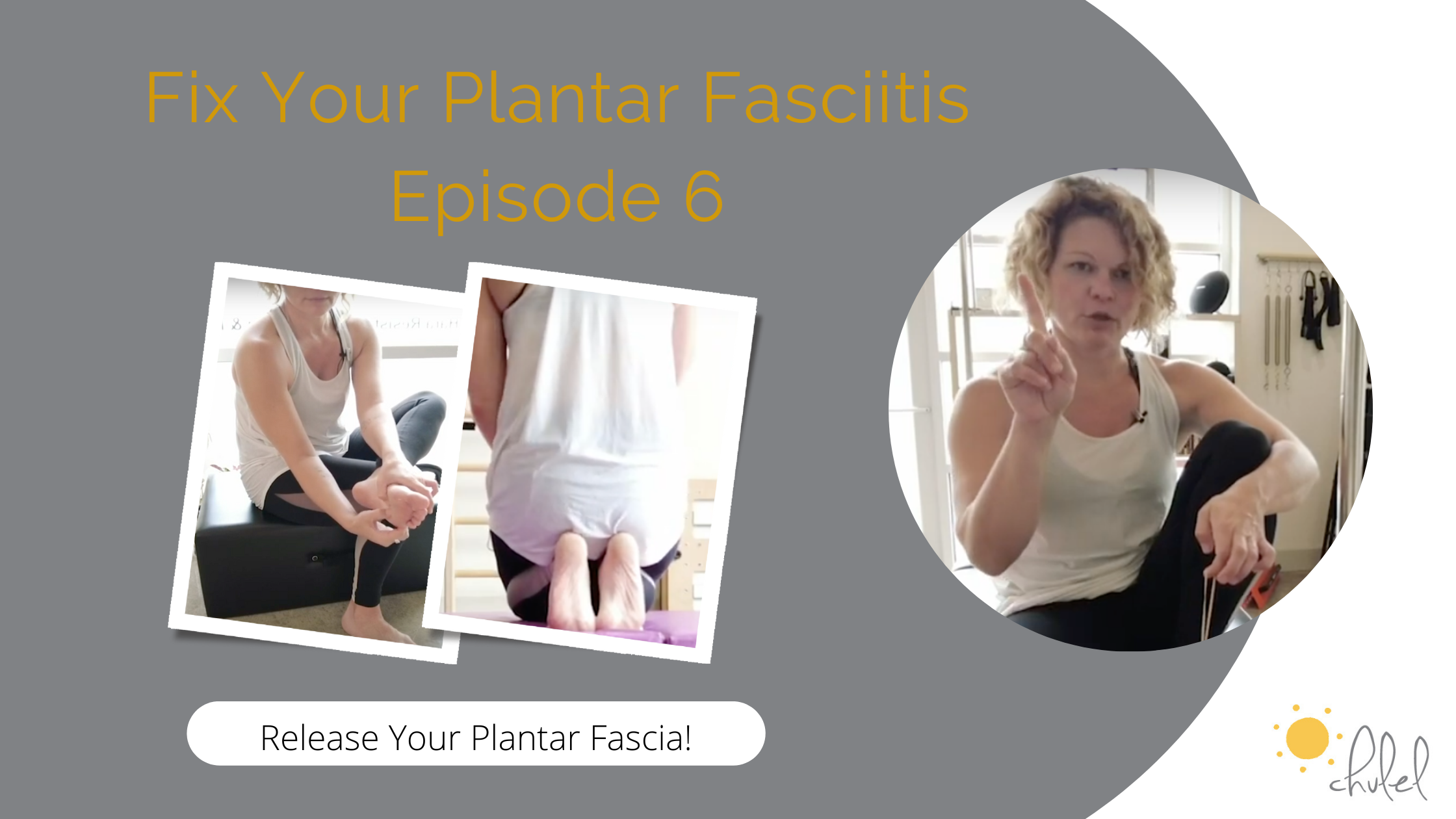
We’re finally at the plantar fasciia aspect of this plantar fasciitis course! I start with a couple of my favorite products you may want to invest in—one being a lovely foot massager. Imagine working on your plantar fasciitis by getting a foot massage with coffee or tea in hand!
We then go to some more esoteric ways of releasing your foot fascia in different directions to also loosen up the intrinsic muscles of the feet. Specifically, I have found that a lot of people don’t have proper bone alignment through the heel bones. The massage I show in this video is gentle and you can actually start to re-align those bones yourself. It will take time and your touch will sensitize so you’ll be able to feel those places better the more you try it.
After the self-massage, there’s several examples of how to fascially stretch your plantar fascia as well as the fascia of your toes!
Lastly, I suggest some ways to start engaging the deep muscles of your feet and arches. You may get some foot cramps initially, but I promise it gets better. Over the years I have found that those with plantar fasciitis leverage through tight skin to use their feet instead of tapping into the deeper muscles of the feet. This is extra important to work on, not just for pain relief, but because the feet muscles mirror the core muscles. Plus, strong feet and ankles mean you’re aging well and not shuffling your feet, which could lead to a fall. Who knew that feet could be the secret to a bathing suit body as well as keeping you from a falling-and-you-can’t-get-up situation?!
Fix Your Plantar Fasciitis-Episode 5 Stretch & Release Tight Calves

If your feet are tight and/or you’re having heel pain, you most definitely have some tight calves and ankles. This episode of the Fix Your Plantar Fasciitis course follows the same structure of the other episodes. We start with self-massage/foam rolling, follow that up with stretching and then proper reactivation of the target areas that are often under working in this pain pattern.
Specifically for this episode, we’ll go over how to foam roll your shins as well as your calves—fun fact, shin rolling=core work. We’ll then get into some fascial unwinding you can do on yourself in the form of soft tissue release (aka massage). Then I’ll show you some stretches you can do with a towel, or one of my two favorite purchases for plantar fasciitis sufferers, the DCT Proflex. I love that thing so much I keep one at the studio and have one at my house so I have no excuse to not stretch my calves frequently.
I’ve chosen ankle stretches that really focus on the fascial component as well. Feel free to spend more time in these positions, particularly the achilles/soleus stretch as that tendon wraps around the heel and could be part of a heel pain pattern.
We’ll end with how to activate the different aspects of your calves in a simple home exercise. Thanks for watching!
Latest Instagram Posts