Your Custom Text Here
Common Cause of Knee & Ankle Pain
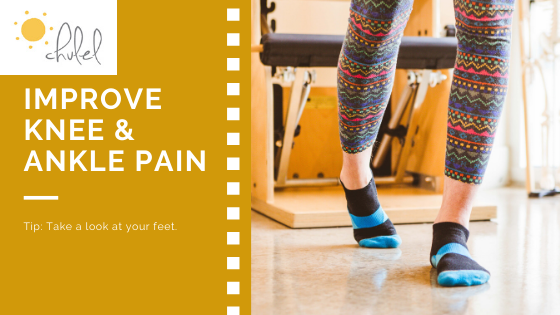
TIGHT TOES! Take a little walk—long enough to get your stride and pace going and notice if you feel your ankle roll out to the side just a little bit as you push off. You may even feel a twinge of pain in your ankle or knee. Another option is to get someone to video you (maybe even in slow motion) and see if you can watch yourself doing it. It will look like a little ankle whip around as you propel forward as in the picture below.

How would the toes get tight?
The top two reasons from my experience with clients are shoe selection and not breathing fully. Any shoe that encourages a toe scrunch would create a situation where your body would start tighten when walking instead of being wide and open (I refer to this preferred state as ‘Frodo Feet’). This isn’t just the easy scapegoat of high heels and pointy shoes, flip flops or any shoe that is so loose that your toes have to work to keep them on would create tight toes. Wearing shoes that are too small or lacing shoes too tightly would cause similar footing.
Next, hold your breath and feel how your feet tighten up a bit (all your muscles, really). We all have a tendency to shallow breathe when we feel stressed, so being under prolonged stress or if you’re in a job/school environment where you heavily focus day-to-day, usually means that you’re holding your breath. I often see that if someone grew up in an environment where they were often afraid or anxious (this could also translate into present-tense adulthood) the toes also scrunch as a response to that fear factor. I call it the Bird-on-a-Wire grip whereas that Frodo Foot is grounded and open…calm.
How should I walk?
This goes with a bit of an * in that we’re all shaped differently and have varied movement/injury backgrounds so there isn’t one for sure right way. That said, the first two toes (big toe and second toe) should more or less line up with your shin bone and thigh bone. This may be difficult if you have flat arches or have had other lower leg injuries. These bones are considered your weight-bearing bones so your body weight is centered over the mid-line of your body. Your weight centered here would naturally allow your core and posture muscles to support you as you walk or run. Lack of weight-centering can cause weight to shift to the outer or lateral lines of the body in walking, which could be a factor in a tight IT band, lower back pain, knee pain and ankle issues.
As you take a step forward, the foot should roll through the mid arch to push off with the ball of foot and then the toes. If you have a tight first or second toe and/or a bunion, you are likely not pushing off of that foot correctly and you may be rolling to the outside of the foot as shown in the picture above.
An exercise to stretch your toes and allow for proper toe push off.
This simple stretch can be done with a rolled up towel or a tennis/lacrosse ball against a wall. In the video, my model is demonstrating it with one of my favorite foot stretching and release tools, the Yamuna Foot Savers. Here’s another way they can be used to release foot tension and help with plantar fasciitis. You can easily purchase them online through Amazon and they last forever. Take them with you when you travel because they take up virtually space and really help loosen the feet after sitting in a car or being in a plane for long periods of time. If you do have a bunion and this stretch feels uncomfortable, you can stretch your big toe off to the side and focus on your second toe. No need to do more than about 10ish repetitions on any given toe and only about once per day at most.
Happy, grounded feet=better balance and core stability!
Cross Training for Runners
We are deep in marathon-training season here in Texas thanks to temperatures that make outdoor activity easier. It's also a season when logging high mileage can lead to poor movement patterns and then injury. Using a combination of massage, trigger point therapy, stretching and strength training can not only keep you inury-free, it can also improve time and performance on the road.
This is a collection of some of my favorite stretches and exercises for runners, particularly for folks who stare at a screen for a living and love running for cardiovascular and mental health. As someone who is a bit 'Type A' I love my exercise and stretching routines to have twofers or threefers meaning you're getting multiple benefits from each. We're all busy so we might as well feel like we're accomplishing a few things at once from our stretching routines.
Massage & Trigger Point Release
We could all use to take better care of our feet, especially if you're out pounding the pavement for miles every week. Consider this massage like foam rolling for your feet. It only takes a couple of minutes and is easy to do while watching tv or before you pop on those shoes for a jog. Check and see if your foot changes color after you do it!
Trigger Point
The gist of trigger point work, if you have not heard of it before, is that you find a tender spot and apply consistent pressure until the muscle starts to relax. This can take minutes and can be confusing at first if you can't feel the muscles releasing. The more you practice the easier it is to know when the muscle is letting go. You can use a ball, foam roller or other trigger point therapy tool--my only reminder is to breathe! Below are two different releases you can do with a ball and a foam roller.
Piriformis (hip rotation) Trigger Point Release
Gluteal (butt) Muscle Trigger Point
Calf Trigger Point Release
Stretching
If you want to up your stretching routine and do something beyond the basic quad and calf stretch you learned in grade school, these are my favorites for stretching multiple places at one time. They incorporate stretching muscles as well as facial or connective tissue lines. Many runners may be aware that their calves and hamstrings could use a stretch (find my favorite version here), but knowing how to stretch the front of the shins is a bit more complicated. Click here for my suggestion for a good shin stretch.
Strengthening Exercises
When you're spending so much time on the road just trying to get your mileage in, stretching may be the only thing you may take time to do. Cross training exercises are soooo important for runners as you're doing a highly repetitive action. This plus long hours potentially looking at a screen usually means the hip muscles become weak because they're being supported by a chair most of the day. Hip weakness combined with high mileage is a recipe for chronic pain or an injury. Most runners I've worked with need more lateral (abductor) strength, inner thigh (adductor) strength as well as core stability via the obliques.
Strengthen You Rear
Inner Thigh Stretch and Strengthening
When looking at a screen most hours of the day and then participating in exercise that is also very forward-oriented, the obliques and the cross body stability muscles become weak. Improving these means improving balance so your energy can carry you forward. An added bonus is that you may even see your waistline shrink if you work on these muscles. Here's a simple, yet super challenging one using a foam roller.
Core Strengthening and Stability
How I can help
Ki Hara active stretching (see example here) is super effective in creating flexibility and strength at the same time. Having this muscular dexterity not only allows you to run longer, but also faster. Many professional athletes and sports teams across the country use this technique as their secret weapon.
I also use a piece of equipment called the CoreAlign that is phenomenal for gait training and orienting the body to the core in a running motion (see more about it here). I've helped many marathoners streamline their gait patterns so they can lower their per mile time. If you've ever, even as a teen, had an injury to the lower half of your body, you may have established some compensation patterns in your walk. Running with these compensation patterns can be an underlying component to chronic pain and injury. Peeling back those patterns will give you more agility and speed as you run. You have more power than you realize!!
A New Way to Improve Posture
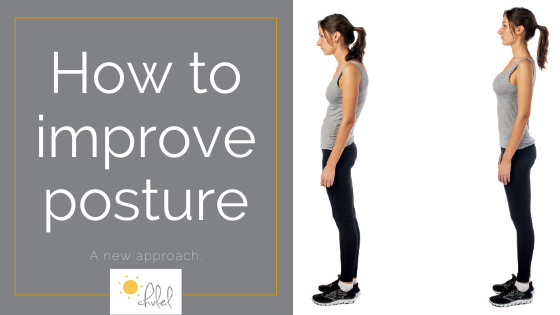
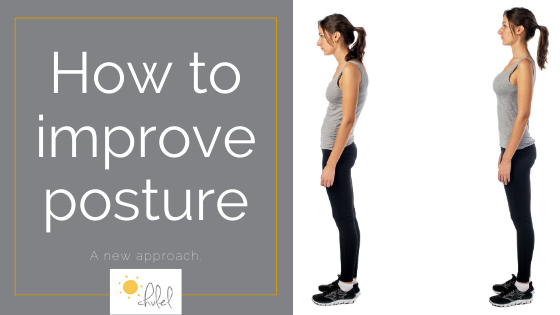
The traditional model of 'good' posture is a 2D approach (e.g. align this bone over this one) when we are 3D beings. We've all seen the poster in the doctor's office of the skeletal system, depicting a skeleton hanging by a hook. We then extrapolate this image to posture thinking we need to stack certain joints on top of one another--feet under hips, hips under ribs, ear lobe over shoulder. Thing is, we don't dangle from hooks, and while we connect to the ground, we're also constantly moving. So, we need a 21st century update to our ideas of posture, including how it connects with the breath and grounding.
How should I stand?
In the past, most of us were taught that good posture means locking our knees, straightening our back, pulling our shoulder blades together and puffing out our chest. How we were supposed to do this and breathe, I'm not sure. Moreover, this model attepts to make the spine straight when it's really shaped more like an S. Tapping into that S idea, and that our body tissues move more like a spring with each step, lends to a more organic posture with greater ease of movement.
What is good posture?
I see the body as a series of archways and that those archways, or diaphragms, act as suspension bridges and shock absorbers.

Strengthening the arch of the foot supports these archways.
- Arch of the foot.
- Arch of the pelvis at the groin.
- Arch of the breath diaphragm at the rib cage.
- Arch of the throat.
- Arch of the eyes/brain.
To me, good posture involves dynamic interaction between each of these areas. I say dynamic, because once again, we're not usually standing (or sitting) completely still. At a minimum, you're breathing, which means one of these diaphragms is always moving.
If you begin to stand and move with the visual of a bunch of suspension bridges instead of a sky hook, stacked bricks or stiff rods, your movement will be easier with alignment. You can practice this while standing and pretend like you're internally lifting your rib cage (on an inhalation) off of your pelvis--not puffing your chest out, but a 360 degree lift. You should feel your core turn on a bit and support your spine. Maintain that lift and breathe as you walk--can you feel that there's a buoyancy to your movement? That's your body moving through its diaphragms! Over time, not only will you have better posture from a state of ease rather than holding, you'll be using your core how it's supposed to be used--keeping you upright. You may even notice some new ab definition in as little as a couple of weeks.
If you didn't feel that buoyancy, you might be holding some tension at one of those diaphragms. This is where an objective pair of eyes (mine) can help you figure out where you're unconsciously holding tension, loosen things up and then you can feel more flexible and move from your core all day!
For a 3D explanation of posture (instead of just text). Here's a video for you:
Take this new feeling into your walk!
Once you feel your diaphragms, you can then tap into that buoyancy in the body as you walk. The ground becomes another 'diaphragm' and we sort of float or even gently bounce forward instead of pounding the pavement. I call it the Tigger Effect. It feels lovely! Here's an eplanation of that sensation and how to feel it when you walk. Using equipment that is spring-based, like Pilates, helps immensely to feel this and integrate it into your body. Contact me for an appointment for more personalized help on improving your posture and gait.
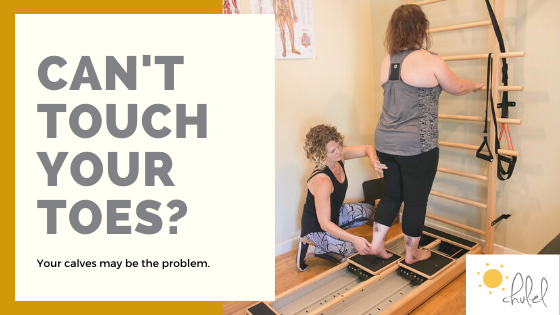
Can You Touch Your Toes? Your Calves May Be the Culprit.

Gait re-patterning to rehab injury and chronic pain.
When was the last time you thought about stretching your calves? Our body awareness typically gets pulled to the places where we hurt or where we want to create more muscle tone leaving the calves a bit lonely. They're just...there. Thing is, calf tightness can correspond with pain in other areas of the body including foot pain, knee pain, back pain and neck pain, even headaches! The fascial or connective tissue line runs up the entire back side of the body--sole of foot, calves, hamstrings, piriformis (deep muscle in the butt), up that respective side of the spine, neck and then stops at the browline of the forehead. This is the connective tissue line that also contacts a chair most of the day, so no wonder there would be some tightness. It can also remain constricted due to our walking pattern.
Why are my calves tight?
Unless you live in San Francisco or in a national park, you're walking on flat surfaces all day long. That's a pretty small range of motion for the ankle so the calf muscles tighten because they aren't being worked in their full, anatomical range. This means that in general, most people have tight and weak calf muscles. Why should you care? Calf and ankle strength affect posture all the way up the body and is critical for balance. Plus, due to the connective tissue line, your calf tightness could be a major culprit in your knee, back and neck pain.
Do my shoes make my calves tight?
Absolutely. High heels are an obvious example because the calf muscles are contracted or shortened all of the time. That said, every Austinite who wears flip flops and cowboy boots year round isn't faring much better. Flip flops cause people to become toe grippers, meaning they're always clawing at the ground, or really the shoe, just to keep it on. When the heel isn't cupped in the back of a shoe, our gait pattern (how we walk) shifts so we stop using our whole foot and calf to take a step. If you love flip flops, look down at your toes and you may even see them scrunched up a bit rather than nice and open. Boots keep the ankle at a fixed, right angle, so this also makes for tight calf muscles--once again, because the full range of motion of the ankle is limited. I'm not suggesting that there's the perfect shoe, or that you should never wear your boots again, but try regularly changing up your footwear. Flip flops on the other hand...if you have any pain or tension along this fascial line, you may want to consider swapping your flip flops for sandals that have a strap around the back to support your ankle. This usually keeps folks from doing the toe grip motion to take a step.
How do I stretch my calves?
I have several options on YouTube, foam rolling and stretching the shins, but this is my favorite:
From an energetic or emotional perspective, I find that when people have tight calves, they can't feel the ground, meaning they don't feel supported by the earth. When someone walks into my studio with chronic neck and shoulder pain, I will often do a deep calf stretch in the first session so that they relax their lower leg. I always stretch one leg first, then have the client stand to feel the difference. About 90% of the time, they feel more relaxed and lighter on that side, plus their shoulder on that side, will lower. Lack of grounding, or feeling supported from below, puts all of the energy into the shoulders and head. This looks more like someone who holds the weight of the world on his/her shoulders instead of feeling relaxed and connected. Try this at home on one side and see if you feel what I'm talking about.
If you know that you have pain along this back, fascial line, and that you may walk a little funny, schedule an appointment and we'll shift your gait a bit so that you aren't reinforcing tension along the back side of your body with every step!
Latest Instagram Posts