Your Custom Text Here
Wrist and Forearm Stretches
We’ve all felt that wrist pain and tension from a long day of typing, gaming, working out, cleaning or yard work. I wanted to offer some of my favorite tools and tips for loosening up the hands, wrists and forearms.
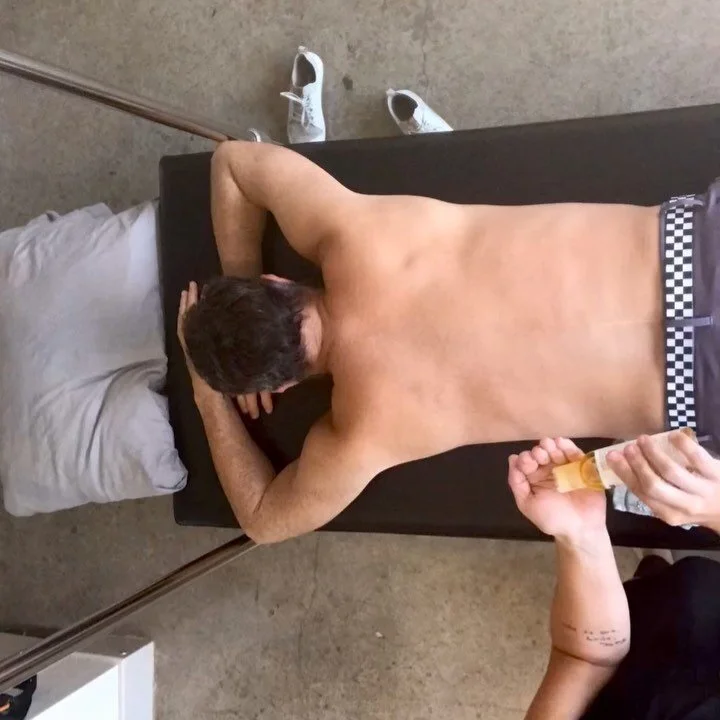
Here’s a video for some simple wrist extensor stretches and a forearm massage:
There are also a couple tools from over the years that I find really help (and are worth the investment) in keeping my hands and forearms loose. If your hands are tight, you won’t be able to access the muscles in your upper arms and shoulders correctly. I can’t tell you how many times someone has walked into my studio wanting to be better at planks/push ups and so much of it has to do with tension in their lower arms. We get that loosened up and BOOM, they recruit their core much better and have more stability in the shoulder girdle.
Breo Hand Massager

Breo Hand Massager
This thing can be too intense for people some people—personally, I love it. This hand massager also does trigger point release all over the hand and will size to conform to the shape of your hand. If you have arthritis or an autoimmune/inflammatory condition that affects your hands, I would not purchase. It has a heat function that I love any time, particularly in winter. I actually sleep better on the nights I do this and notice that I’m not as apt to clench my fists when I sleep—yes I do that too. It will leave an imprint in your palms for about 10 minutes, just a heads up.
Armaid
This thing is amazing if you do repetitive gripping—

Bodyworkers
Manual laborers/those who do a lot of work with tools/handiwork
Athletes—golfers, tennis players, weight lifters, climbers, aerialists
Knitters/sewers/crafters
Gamers
Artists
It easily pivots around and so you can do both sides of each arm. You can also purchase more intense trigger point release balls that intensify the experience. That said, you can size this thing really tight, so I feel like I get a good experience without the turbo props. I bring it with me when I do aerials and it helps my forearms from seizing up in between climbs. Relieving tension in the forearms also helps loosen up the shoulders, making proper form and bodmechanics easier.
Taking care of our hands is something that we often neglect until we start feeling pain. Keeping your forearms loose will not only help head off some more painful conditions like carpal tunnel pains and tennis elbow, you’ll better access the supporting muscles of your shoulder blades and core as you use your hands. The uncoiling massage I’ve created takes this to a completely new level. I’ve had great success with helping people alleviate various arm pains as well as chronic neck pain and even lessening headaches. I recommend these tools and tips for self-care for my clients in between sessions.
If you purchase from the links provided, I do receive a small percentage as an Amazon affiliate.
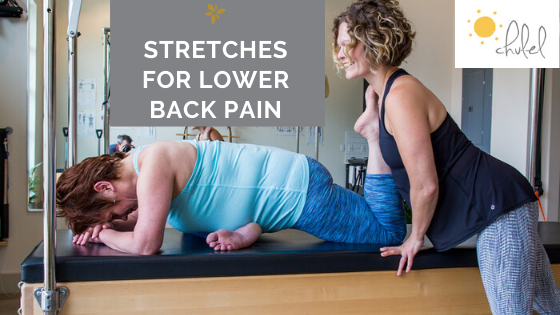
Stretches to Relieve Lower Back Pain
Lower back pain can have many different causes. Muscle weakness, poor posture, disc/spinal issues, leg length differential or an old injury can all factor into back pain. That said, this chronic pain can be helped by stretching certain areas and building hip strength.

From a fascial (connective tissue) line perspective, the tension you feel in the lower back could be coming from anywhere along that posterior side of your body. So a tight foot or calf on that side could also be a tight sacrum. Below is a simple foot fascia stretch you could do while watching tv or before a walk/run. If you know you have tight calves, this is my favorite stretch to release the muscles as well as the fascial line.
For a more active approach, anyone with a tight lower back has tight quad muscles (front of thighs). This version integrates a yoga pose with some turbo options for stretching. Your front leg doesn't need to be crossed in front of the opposite thigh, you can just tuck that knee underneath you. You can also place a pillow underneath the glute that is stretching. Just being here may be intense enough. If so, breathe and visualize new space in your hips. You may also feel this more in your butt than in your quad. Try to bend the elongated leg for the thigh stretch. If your hamstring cramps, scroll up and do the calf stretch first. If you can bend the knee, this stretch is a great twofer for the thigh and rear.
Another area that can pull on the lower back is the groin. Most of us never think to stretch here yet it can really compound tension in the lumbar spine. This is a pretty intense stretch, so here is a more gentle stretch.
When you're out of the pain or as a preventative measure, you want to build hip strength. If you've recently had pain, doing this may not feel good, so listen to your body. If you feel a sharp pain, this is not for you right now. You may need more individualized help, so gimme a call! Or, reach out to your trusted chiropractor, massage therapist or physical therapist.
I find that lower back pain perhaps more than any other chronic pain area always has an emotional or stress-holding connection. I already wrote about how lower back pain connects with breath holding here. Some things to explore for the emotional connection would be: When did this pain start? What else was going on in your life around that time? Does the pain tend to get worse during certain times of the day? If it's in the morning, are you happy in your work/relationship? In the evening, are you feeling burdened by your responsibilities? Does it hurt more when you speak to a certain person? Are you holding or internalizing anger, frustration or another emotion with regard to that person?
Noticing your personal patterns can help you start to process some of these underlying aspects that are keeping this pain chronic. I believe this is a big reason why a massage or even a stretching routine doesn't keep the pain from coming back. If some of this resonates for you, visualize these emotions/memories leaving your body via your breath. Let it go!
An Energetic Approach to Movement

Movement is more than just muscles contracting to make bones move like we see in the gym machine pictures. Our body is a whole unit in which everything participates to create movement. For this reason, I approach the body from a fascial or connective tissue perspective which informs how various parts of the body work in conjunction to make the body shift and move. As I studied the human body, I observed subtle patterns of how things worked together and I could feel someone's jaw release as I stretched their quads (front thigh muscles). Imagine my excitement when I read Anatomy Trains in which Thomas Myers details all of these connections I was feeling. Even more neat is how these fascial lines also mirror Traditional Chinese Medicine/Acupuncture meridians or energetic pathways.

When someone steps into my studio, I immediately begin observing how these fascial lines may be locked too tight or too loose and how that is impacting their movement as well as contributing to pain they could be having. This means that your neck tension, for example, could be coming from a tight IT band. We then stretch and strenghten these other pulleys that could be pulling on a spot where the pain is felt.
This leads to more than just a muscular contraction approach to what is going on in the body both in terms of pain and improving athletic performance. Yoga and martial arts have understood this fluidity in movement approach for centuries. The cool part is you can actually become so connected to your body that you'll be able to feel how your foot tightening on one side is causing your shoulder blade to brace which may be impacting your tennis swing.
Employing the insight of fascial lines/acupuncture meridians and consciously moving through them helps to shift and move energy though the body. For some this may just feel like a muscular release or even a greater mindy body connection. This can also mean that you feel lighter on your feet as you walk and run, or maybe more relaxed and supported by the earth. You may find breathing easier or that you have more power. Some days this means that you can have an emotional release or even feel euphoria as you 'exercise'.
One of the beginnning concepts I teach is that we walk from the front of our low abs/pelvic muscles and that our shoulders balance into our solar plexus. So, it's kind of like we have a triangle from the pelvis to our legs and then if you flip that triangle up-side-down, your shoulders drop into your diaphragm. From an eastern perspective, we're walking from the 2nd chakra or lower dantian which also happens to be our pelvic muscles, the base of our core. Our shoulders nestle onto the shelf of our 3rd chakra or our middle dantian which is also our diaphragm, or the top of our core. Feeling these connections automatically means you're using your core in a fluid sense, instead of overly contracting these muscles, restricting the breath and tightening the hips. Connecting to the core in this way also helps to open these lower energy centers where many of us hold our emotional wounds.
An energetic approach to movement will leave you feeling more relaxed, open and supported which means more energy and less fatigue at the end of the day. Tapping into these connections always takes sports performance to a whole new level--you'll feel lighter as well as more agile. Schedule an appointment to learn how to tap more deeply into your personal power!
Why I Hate Kegels

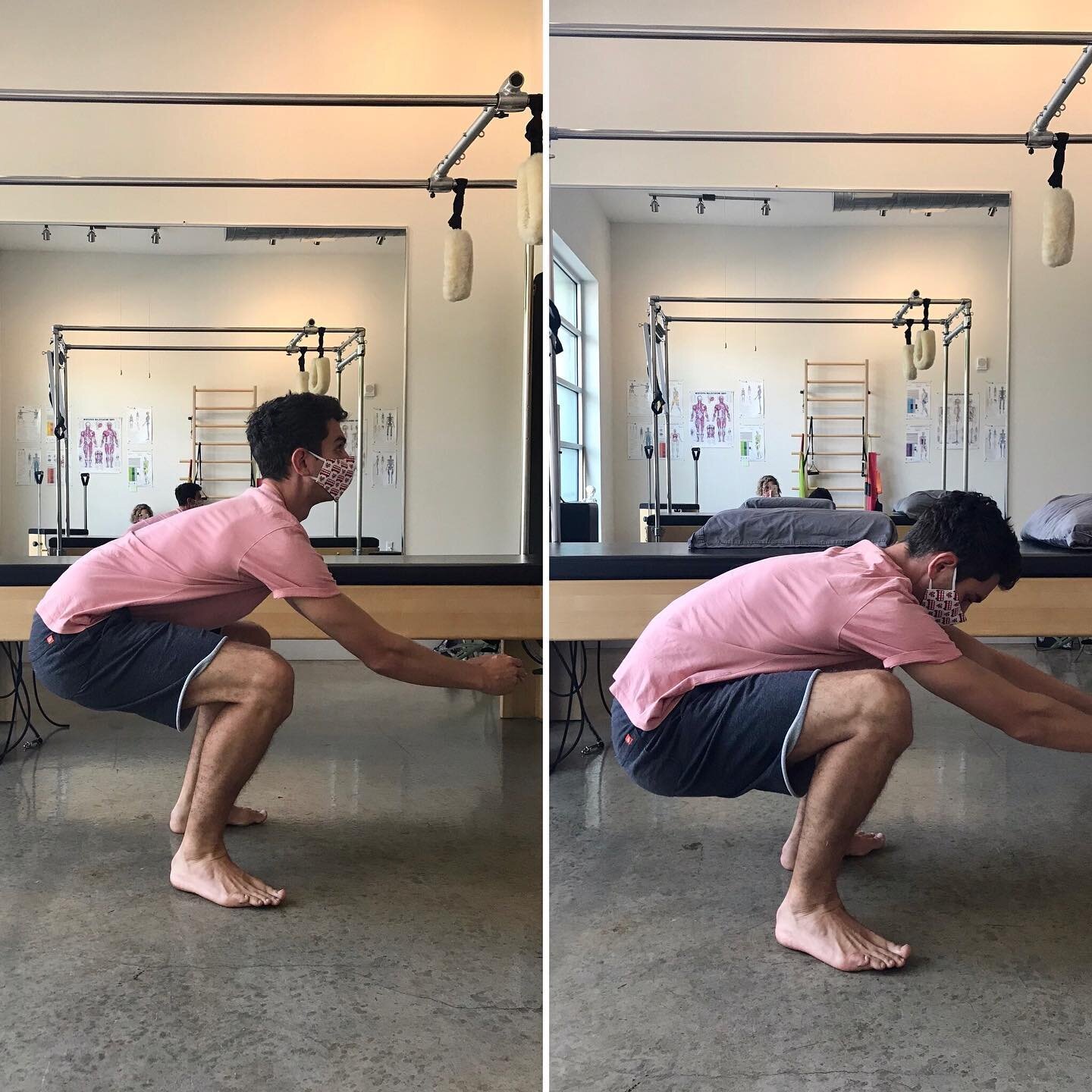
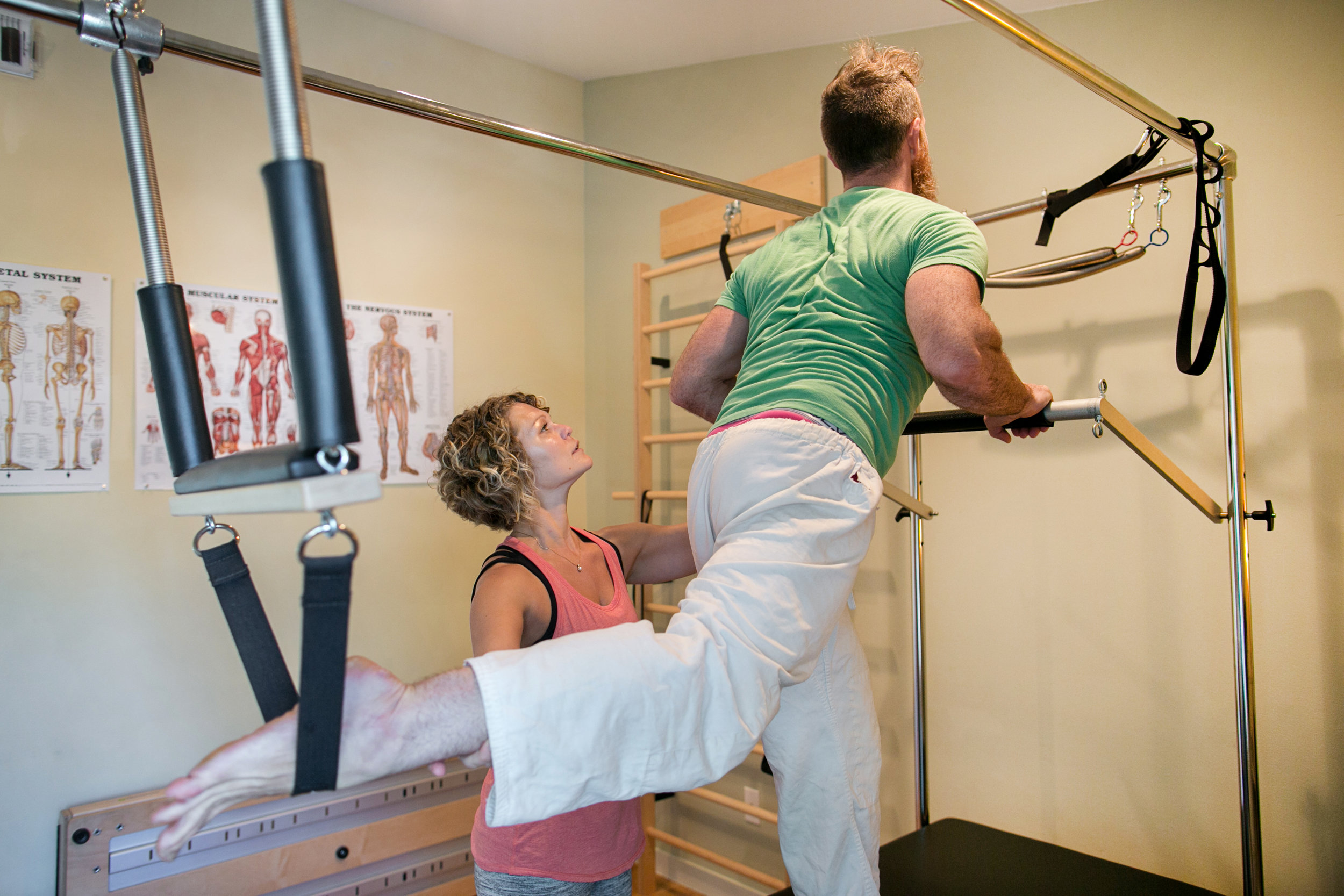
Pilates squats on the reformer for lower body alignment and pelvic floor strength.
Just about every woman out there has had her doctor prescribe Kegel exercises--hold your urine flow for a few seconds to strengthen your pelvic floor. I see Kegels as a constipation view to strengthening the pelvic floor because they encourage bracing and holding in an area that is often too tight. Plus, Kegels are more often emphasized for women over men when we all need strong and flexible pelvic muscles. More about that here. If we all think pelvic floor health=Kegels, we lose the sense of how these muscles are connected to other movement in everyday life. To me, the pelvic floor is more than just your elimination muscles, it includes all the muscles of your pelvis that support your torso and posture--this includes your rear.
One of my favorite pelvic floor exercises is a squat because it works the pelvic floor in a large range-of-motion. This way, you're getting stretching on the way down and strengthening on the way up. Think of squats as coming from the bones of your pelvis to kick these muscles into gear.
Don't feel like you need to go all the way down into a full squat if it doesn't feel good in your body. Many folks can't because of knee or hip pain. Try holding onto something, or putting something underneath your heels, and you may find you can get lower to the floor. As you descend, these muscles are stretching and opening like an umbrella. When you stand up, they contract and come closer together like the closing of an umbrella.
If you think about it, we squat every time we sit down. With a bit of mindfulness and maybe some props, you can reconnect with your pelvic floor and use it to sit down and stand up. No more plopping on the couch!
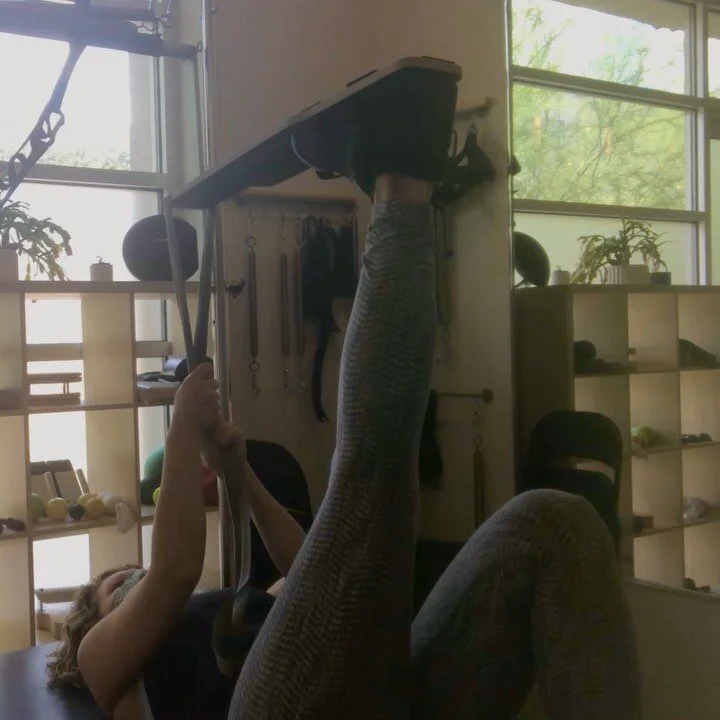
Pilates is a great modality to strengthen the pelvis for everyday movement. This includes strengthening your inner and outer thighs, which are critical for balance. I love working with clients to rehab their pelvic floors because it's an area of much importance, and for many of us, an area of much trauma. If you've had any abuse in your past, sexual or otherwise, regardless of gender...it may be difficult for you to feel these muscles (read more about this here). This is why I love working one-on-one with clients. In a private session, you're in an environment where it is safe to go here, to connect and to heal, bringing a true sense of self. It brings me to tears when I get to witness this transformation and see my clients discover how much power they have. Love the pelvic floor!!!!
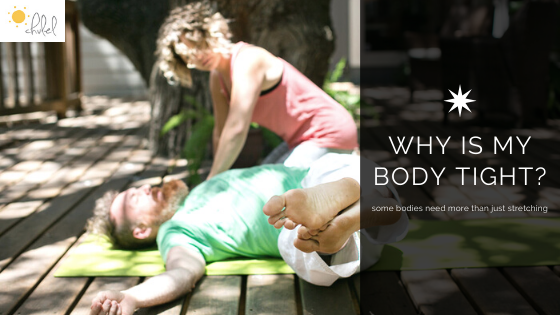
Why is my body tight?

Full body, active Ki Hara stretching! Soooo yummy!
This is a question I'm often asked and believe that we have to look at more than just range-of-motion or trigger points for a good explanation. Some clients immediately tell me that their body is tight because it runs in their family, like they have an inflexiblity gene and traditional stretching just doesn't work for them. I see body tightness that runs in families as a cultural way that the family deals with stress and how we then handle stress as adults. Are things shoved under the rug or not acknowledged? Or, are things discussed and worked through together? Do you feel overwhelmed and overburdened by responsibility? Or, are you able to shift your perspective and carve out some self-care time?
The nervous system automatically charges up to help when we're stressed (sympathetic nervous system). One result when it kicks in is that the muscles tighten to prepare for action--we can see this in animals. When they perceive a threat, the breath cycle shortens, their whole body tightens and is ready to pounce. When we, as humans, hold in this way everyday, it leads to chronic body tightness and fatigue.
To offset this stress from a movement perspective, we most often think exercise. Yet, how many of us hold our breath when we try to burn off some steam? Muscles can't relax if they're being starved of oxygen. As someone who is also prone to this, I've started doing some diaphragm releases to connect with my breath before I intentionally move. This is my favorite diaphragm release to do pre-workout.
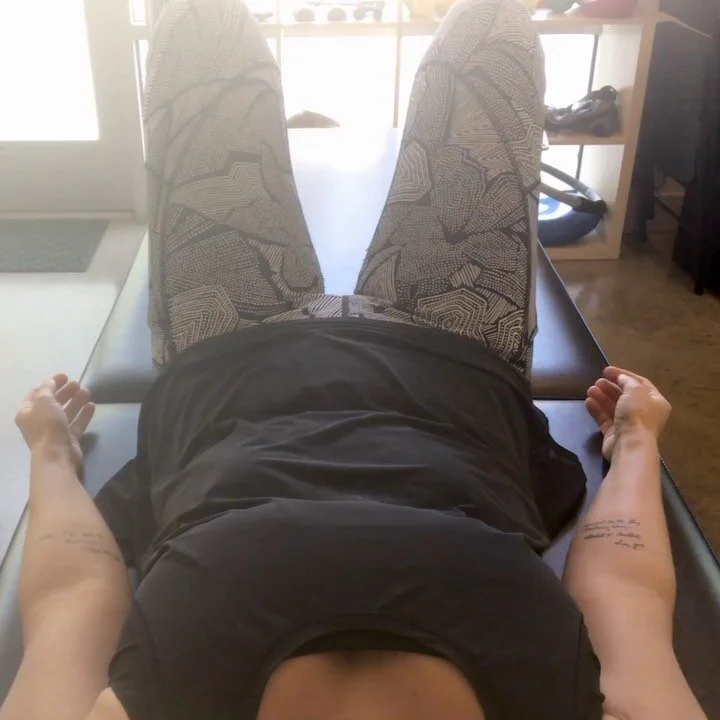
Ki Hara active stretching unwinds tension from the body, creating space for more breath. Clients always stand up at the end of a session saying they feel more alive, relaxed and have more blood flowing through their body. We target the areas you personally hold tension and dynamically release muscle tension there. Full body stretching like in the photo above, allows for the body to have a feeling of flow over bracing. To learn more, click here.
Latest Instagram Posts