Your Custom Text Here
Why I Hate Kegels

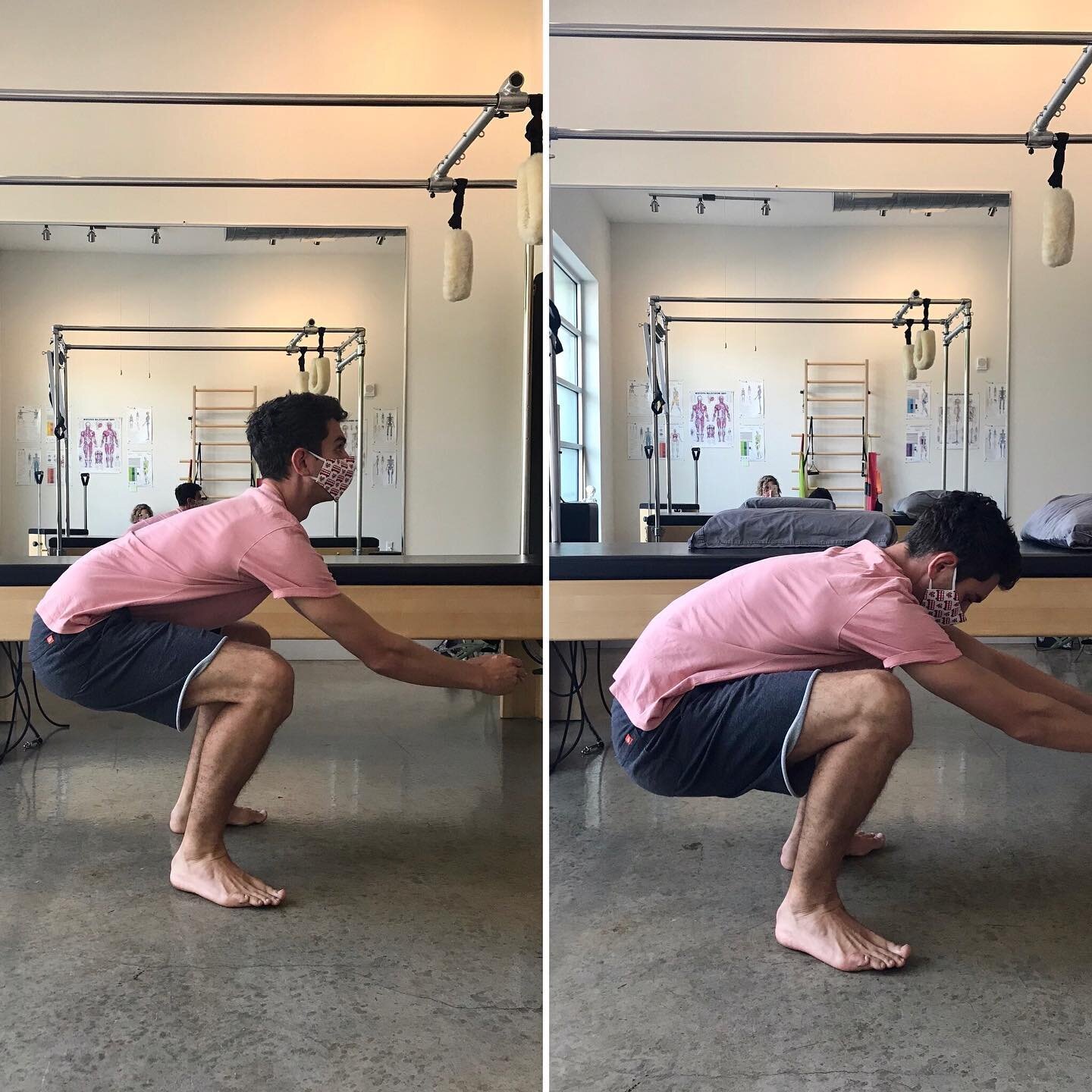
Pilates squats on the reformer for lower body alignment and pelvic floor strength.
Just about every woman out there has had her doctor prescribe Kegel exercises--hold your urine flow for a few seconds to strengthen your pelvic floor. I see Kegels as a constipation view to strengthening the pelvic floor because they encourage bracing and holding in an area that is often too tight. Plus, Kegels are more often emphasized for women over men when we all need strong and flexible pelvic muscles. More about that here. If we all think pelvic floor health=Kegels, we lose the sense of how these muscles are connected to other movement in everyday life. To me, the pelvic floor is more than just your elimination muscles, it includes all the muscles of your pelvis that support your torso and posture--this includes your rear.
One of my favorite pelvic floor exercises is a squat because it works the pelvic floor in a large range-of-motion. This way, you're getting stretching on the way down and strengthening on the way up. Think of squats as coming from the bones of your pelvis to kick these muscles into gear.
Don't feel like you need to go all the way down into a full squat if it doesn't feel good in your body. Many folks can't because of knee or hip pain. Try holding onto something, or putting something underneath your heels, and you may find you can get lower to the floor. As you descend, these muscles are stretching and opening like an umbrella. When you stand up, they contract and come closer together like the closing of an umbrella.
If you think about it, we squat every time we sit down. With a bit of mindfulness and maybe some props, you can reconnect with your pelvic floor and use it to sit down and stand up. No more plopping on the couch!
Pilates is a great modality to strengthen the pelvis for everyday movement. This includes strengthening your inner and outer thighs, which are critical for balance. I love working with clients to rehab their pelvic floors because it's an area of much importance, and for many of us, an area of much trauma. If you've had any abuse in your past, sexual or otherwise, regardless of gender...it may be difficult for you to feel these muscles (read more about this here). This is why I love working one-on-one with clients. In a private session, you're in an environment where it is safe to go here, to connect and to heal, bringing a true sense of self. It brings me to tears when I get to witness this transformation and see my clients discover how much power they have. Love the pelvic floor!!!!
Loosen Your Pelvic Floor, Open Your Root Chakra!

When we hear "pelvic floor" it's usually with regard to women who have had children and how their pelvic floors become weak or distended. Years go by and then there's a new wave of pelvic floor awareness with prostate issues or pelvic organ prolapse. Based on my work with clients, I find tight pelvic floors to be super common due to stress and prolonged hours of sitting which contribute to lower back and hip pain/tightness.
What is the pelvic floor, exactly?
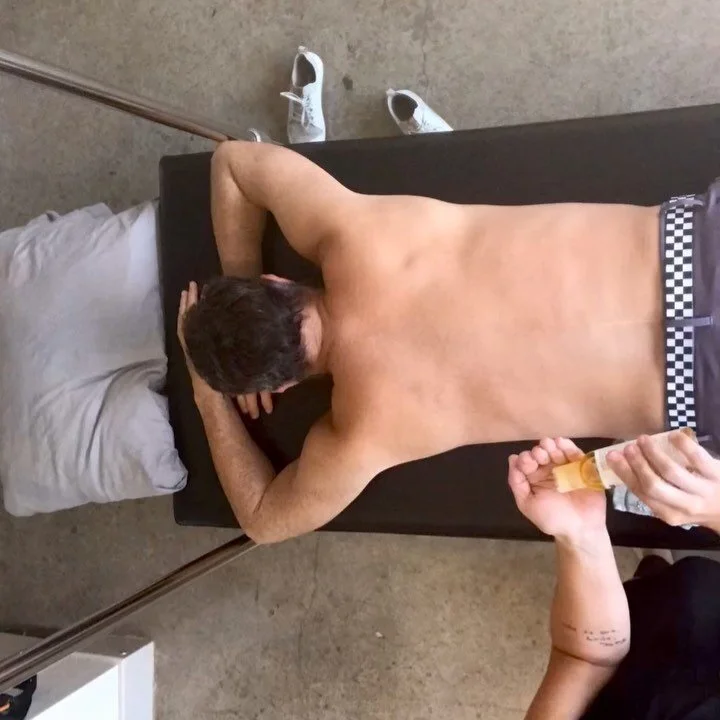
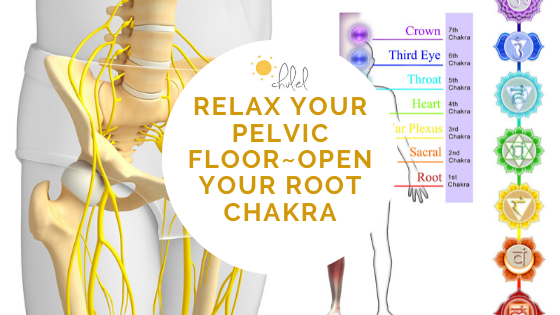
I see it as more than just our elimination muscles. If you were wearing brief underwear as in the photo, your pelvic muscles are in contact with fabric. So, there's three main sections:
- Front-lower abs, the little triangle between your hip sockets and pubic bone
- Undercarriage-elimination muscles and connective tissue
- Back-hip rotational muscles, gluteals
How does the pelvic floor tighten?
Sitting, feeling stressed and holding our breath. I wrote more about this in detail here. If you're prone to sucking in your stomach or have suffered from digestive issues, these muscles would also become chronically tense.
In addition to stress-holding, we can also have some unresolved emotional issues that can cause these muscles to restrict and hold.
What the heck is a 'root chakra'?

You can look at chakras as being areas of the body that emotionally (energetically) represent certain things we all face in life. In the case of the root chakra, it correlates to things that are foundational to our being--safety, security (including financial), family/clan identity and physical health. Issues here can come from not just our personal experience, but from the experiences of our family members. SO, pretty much everyone has crap to work through in this chakra.
Fear is a big factor in holding patterns here including, pelvic floor tightness. If we're constantly bracing for something to happen or afraid that there won't be enough, the muscles of the pelvis respond to that emotional outlook. Origins of that fear can include:
- Abuse, including abandonment or neglect
- Poverty, war
- Major personal illness or in your family
- Not having good personal boundaries so we're constantly at the whim of others' actions
- Inherited trauama and issues from our families
How can you shift these patterns?
Physically, you can practice relaxing these muscles.
In my one-on-one sessions with clients we discover where you're holding physically and emotionally and then intentionally create space there. I construct a series of exercise sequences to reinforce a new pattern in your body that doesn't involve bracing or restriction. With repetition, your body generates a new neurological pattern via flow instead of holding. To reconnect with your root chakra and maintain a relaxed pelvic floor day-to-day, try these tips.
- Breathe and feel the breath connect down to your pelvic floor. I wrote more about that here.
- Do things that honor your body and its health.
- Celebrate what you already have in your life--these things may not be material or tangible.
- Find and connect with a community to feel a sense of belonging.
- Go outside and put your bare feet in the ground. Feel how you are a living being!
Are you a tightass?
Most of us are, and the funny part is, we're completely unaware.
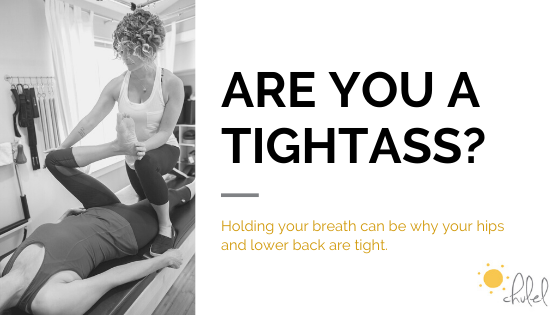
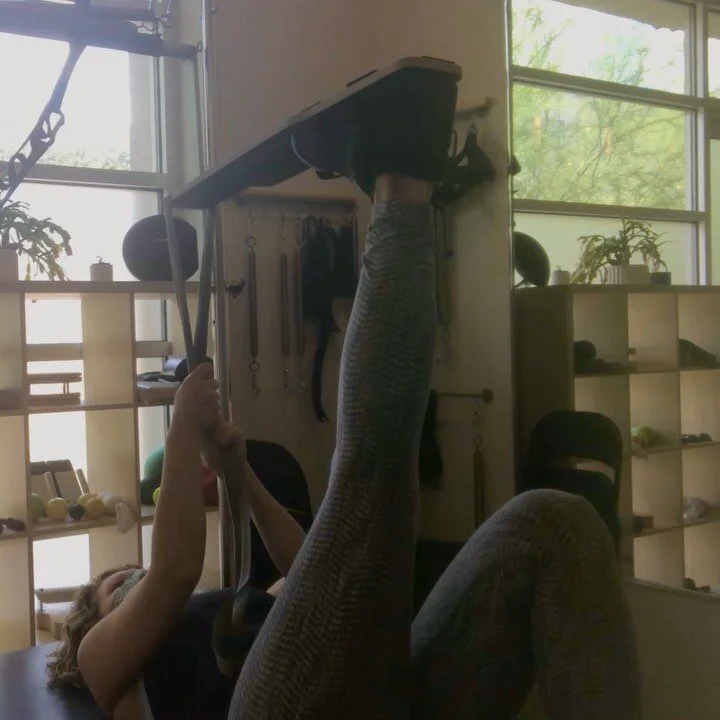
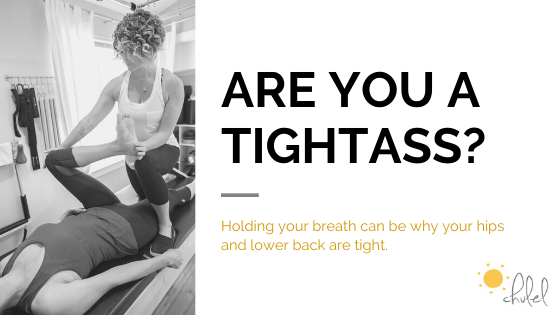
Ki Hara Active Hip Stretch
What is a tightass?
I define it as one who perpetually grips in their pelvis, specifically in the urinary and anal sphincters. Clenching here tightens muscles in the pelvic floor, which pull on the hips, which pull on the lower back.
How does one become a tightass?
Stress
Our bodies (nervous systems) are wired to process stress with fight or flight. Evolutionarily, if something threatened our survival, we fought or we ran. In the 21st century reality, it's usually not possible to discharge stress at the moment we're feeling it. Plus, we usually have multiple stressors hitting us simultaneously. We are then left with a freeze response, so the body goes on lockdown, as do our bums.
Breath
Building on the above, shortening our breath is a top physical holding response when we freeze. Unfortunately, this is where we spend the bulk of our time--barely breathing, which, only keeps our nervous system in a hightened state of stress. So the stress/breath cycle snowballs. Right now, take an inventory of your breath. Can you even out your inhalation and exhalation time? How many seconds does it take you to do an inhale/exhale? Can you increase that duration by 1 second, or maybe even 2 seconds? Does your body (pay attention to your pelvis, in particular) relax a little bit with this slightly longer breath cycle? Now pause and hold your breath...do you feel your sphincters tighten again?
Digestive Issues There's a greater awareness now about food sensitivities and allergies. When our digestive system is upset on a regular basis, it can lead to chronic clenching of the digestive sphincters. I also think sitting for long periods and the subsequent slowing of our metabolism can let things feel stuck in our digestive tract.
Sucking in the Stomach/Wearing Restrictive Clothing This usually applies more to women than men. Wearing restrictive clothing or sucking the stomach in, once again means the breath is affected so the tightass tendency follows.
Energetic/Emotional Component The area we're talking about in the body corresponds to the root chakra. This chakra, or energy center, represents our foundation, sense of safety, financial stability and tribal (family of origin) identity. Pretty much everyone has some emotional crap involving at least one of these issues. Emotional holding patterns surrounding fear, in particular, contribute to chronic clenching in the pelvis.
Why does it matter?
Tightening your holes pulls on your hip rotation muscles (especially the obterator internus), locking your femur (thigh bone) in a shortened range of motion. Chronic holding in this area of the pelvis directly affects not just hip rotation but also low back pain. The femur is a ball and socket, a super mobile joint. When we restrict its full range of motion (most of us don't even work the hips in their full range of motion on a regular basis, that will be another blog post) the sacral area of the low back gets pissed off because it's having to do the work that the ball and socket should be doing. Then we have low back pain. I'm not saying this is the exclusive reason for lower back pain, but it is a significant one.
What should you do about it?
Wear clothing that doesn't restrict your breathing and try to relax these muscles with your breath. For more information, check here on how to do that:
Pay attention to which foods your body is happy and nourished by and try to eat more of those. One of my favorite go-tos for eating more vegetables is eating 5 different vegetables each day. I find that the goal becomes the center-point of my meal planning because the focus is how I give my body nutrients rather than a thou-shalt-not-eat __ approach.
Do something for you throughout each day...even if it's just 5 minutes. As a movement person, let me suggest this be something movement-related. Not just because you're taking care of your body, it will also help aid your digestion and kick in your parasympathetic (calming) nevous system. Maybe it's taking a timer-motivated break for 5 mintues in which you just focus on your breathing or on your favorite cup of tea. Maybe it's repeating a favorite mantra each time you look in the mirror or take a bathroom break.
Start looking at your fear patterns and letting those fears go. We often hold onto fears that took root in our childhood that are no longer relevant and necessary in adulthood. A good place to start is noticing when you're triggered by something someone says or does and ask yourself why you had a reaction at all. Did it highlight a fear you have? Was it a way your parents/sibling/family member spoke to you growing up? Are you reacting to that trigger now the same as when you were younger? How does your body feel? Where do you feel tightness or restriction?
Trying a multi-faceted approach, meaning looking at your back pain (or maybe just your tight ass) from a physical as well as emotional perspective can lead to greater and longer-lasting pain relief...and help you grow as a person.
Double-click to edit...
Latest Instagram Posts