Your Custom Text Here
Fix Your Plantar Fasciitis-Episode 1

Welcome! This is the first episode of a course designed to help loosen up tight feet, alleviate foot pain and heal plantar fasciitis symptoms. In my decade of experience, there can be reasons for tight feet that arise from other places in the body, including emotional stress.
The top reason I’ve seen over the years is tightness along the backside of the body, what Tom Myers, author of Anatomy Trains, calls the Superficial Back Line. This fascial or connective tissue line goes from the sole of the foot, all the way up that respective side of the spine and connects into the eyebrow. This line primarily gets tight from sitting, but it can also be from lack of rotation in walking and movement (we’ll cover that in a later episode of the course). In other words, your head and forehead tension, is related to your tight feet.
Another aspect to this Superficial Back Line is when people try to hard too have good posture. Pinching your shoulder blades together, a common cue we’re given, tightens the mid-back and can play a part in tensing this line down to the feet. I’ve actually come across this more since the pandemic as people are trying to look a certain way while on screen.
Tightness in the opposite forearm can also (!) be a factor. I see this pattern less from folks typing and more from old sports or injury patterns from childhood. If you played things like golf, tennis, lacrosse, archery or an instrument, that too can play a part in the opposite foot being more tight and prone to plantar fasciitis. The body is crazy.
And, because it’s our body, the breath always plays a part. Short breath cycles or holding the breath, also create tension in the feet. If you try holding your breath now, can you feel that in your own feet? Maybe you feel your head tense? This is always an underlying aspect of plantar fasciitis and contributes to the emotional component of the condition. If you’re stressed, you’re probably holding your breath and then we have the tense, ungrounded feet.
Hope you enjoy and please subscribe on YouTube for alerts on this course as well as future courses and updates on how to improve your body in terms of pain and performance.
Pelvic Floor Rehab-Beginner & Intermediate Workouts
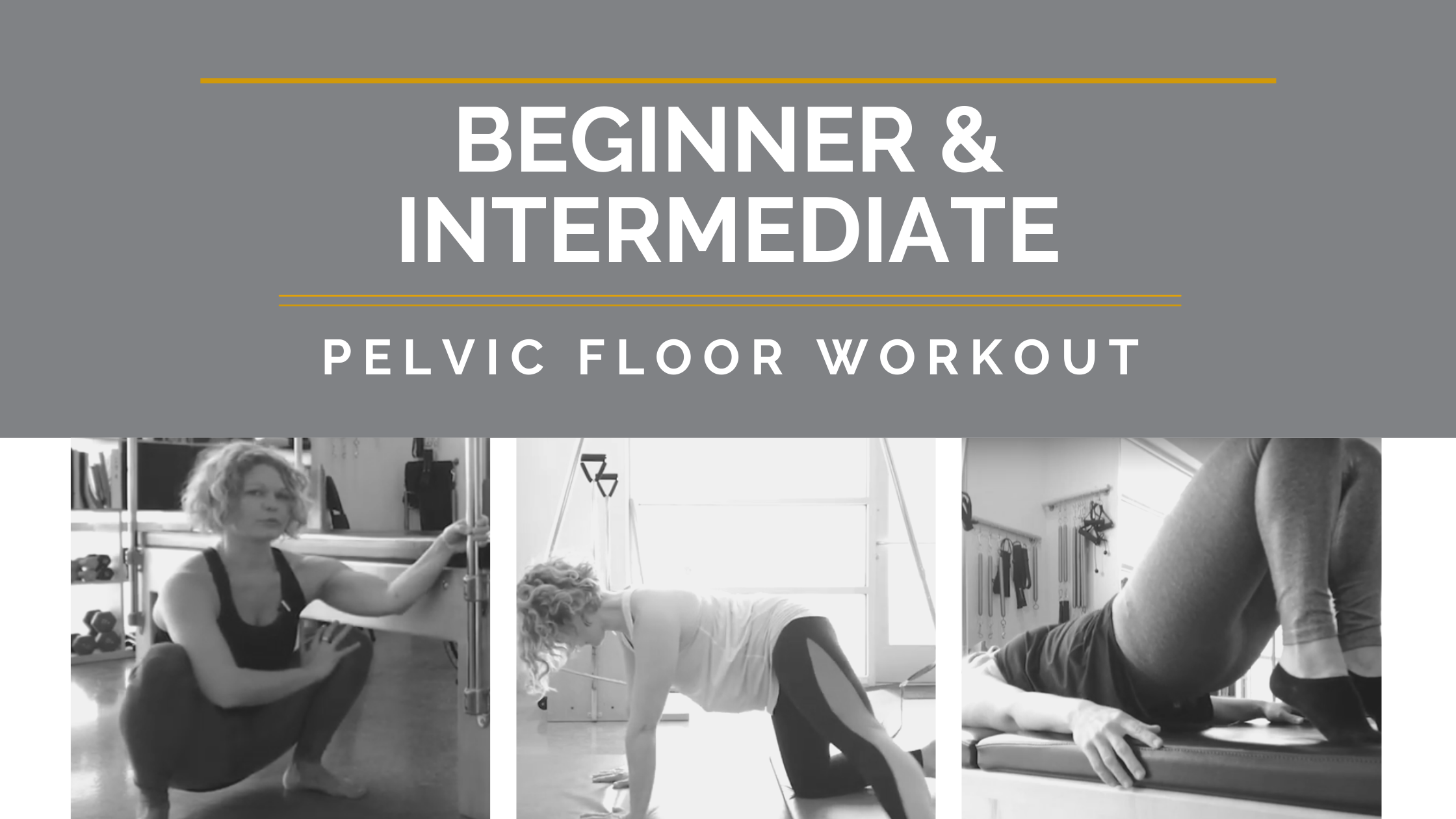
Now that we have massaged/stretched/turned on all of the things, it’s time to do some coordinated movement.
This beginner workout video is targeted to those recently in pain or currently in pain. It’s a series of gentle, mindful movements to connect these areas we’ve covered in the course and start to build some basic strength connections. We start with some cat/cow, thinking about it from your pelvic floor over just the breath or what the spine is doing. Then, we do a series of exercises to connect your legs into the fascial line of the pelvic floor, closely mirroring what should happen as you walk. We then migrate up into glute and hamstring strength, combining it with some ankle work. Our grand finale is a 1 minute squat, focusing on relaxing and releasing the pelvic floor and then pulling up energetically for some grounding work.
In the intermediate workout, we start with various exercises with the legs in a diamond shape to target the inner and outer thighs. Have a 12 inch ball or foam roller and a towel/yoga strap nearly. We then move to some hip exercises weight-bearing in the arms for a bit of a stability challenge. Then, using a towel or yoga strap, we do an exercise to isolate the adductors/inner thighs. We wrap up the workout with a series of squats to work the thighs and ankles as well as the pelvic floor.
Pelvic Floor Rehab-Energetic Connections
An aspect of my approach to bodywork is looking at emotional stressors or energetics and how that contributes to someone’s pain patterns. I always say, there are a lot of crooked people out there, but not all of them are in pain.
The root chakra and sacral chakra come into play with the pelvic floor. The root chakra can close off with anything that involves fear. I think all of us can agree that we’ve felt some amount of this over 2020-21. Any history of abuse or trauma, at any point in life, can contribute to issues in the root. Fear usually involves the breath to tighten, and as we’ve discussed, the breath mirrors into the pelvic floor. If the root gets closed off, it shuts off connection to the feet. I often feel that a lot of knee/foot issues are not just about the pelvic floor in terms of mechanics, but also this holding from current or past fear patterns.
The root is also all about stability. So any type of lack-of-safety feelings would play into dysfunction here as well. This could be financial, physical or emotional.
The sacral chakra obviously involves sexuality, but also creativity and sensuality. If you don’t feel safe, how can you feel like you have the energy or bandwidth the be creative or truly yourself?
You can bring more opening and awareness to these areas by visualizing the sphincters of the pelvic floor opening up like a valve and that water is coming down the legs. If color is your thing, the corresponding colors are red for the root and orange for the sacral.
Take this for a walk and you can visualize those colors going down one leg, back up and over to the other leg like a light up yo-yo. Check in with your body and see as you put those colors in your mind’s eye, are they vibrant? If they start off more dusky or dark, let the old stuff drop out of your feet and into the ground. Then as the light comes back up the leg, can it be a bit brighter? If you continue to do this, the colors will become clearer and you’ll feel better—promise.
This is my favorite book on energetic systems. The author connections modern psychology with the chakra system. It’s a great balance of ‘woo woo’ and philosophy.
Pelvic Floor Rehab-Release Pelvic Floor Muscles & How to Activate the Pelvic Floor
We’re finally into the meat! In this video we go over how to release SUPER common problem spots for pelvic pain and lower back pain—the pesky pectineus, iliacus and obterators.
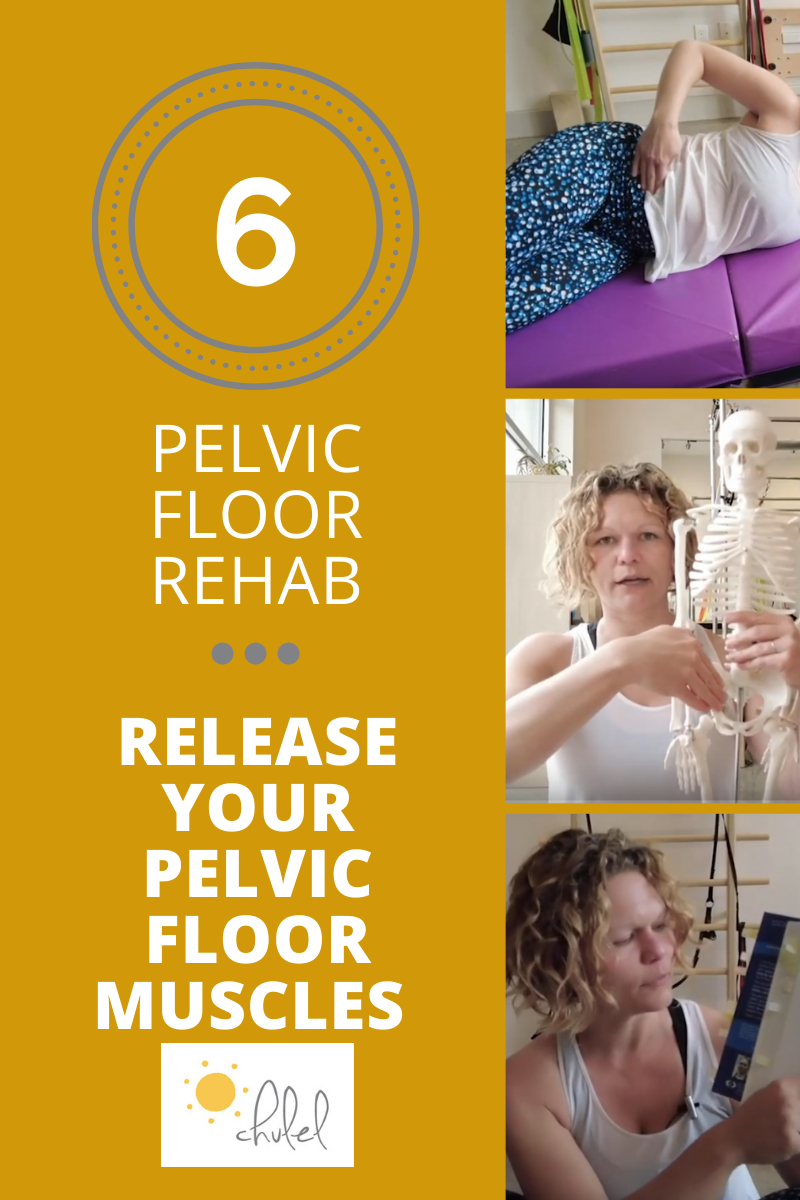
You can use just your hands to get some relaxation in these areas and they do *wonders* for relieving pain all over the body, including the neck and shoulders.
To release the pectineus, you’ll want to pin the pocket of the groin, and then you can use the weight of your leg to act as a stretch. In massage it’s called a ‘pin and stretch’. I go over the details in this video—promise you’ll feel like your leg not only gets longer, but more relaxed afterward.
The iliacus lines the ilia of the pelvis and can be a major core compensation muscle. This muscle can be tight if you also have digestive issues or hold tension in your ‘guts’. Releasing this before attempting core work may help you get more abdominal engagement.
Lastly, we go into the obterators, which are super deep at the base of the pelvis. These get tight from sitting as well as from breath-holding. Many of us also ‘pinch pennies’ down there when we’re stressed, which makes this area chronically tight. Think about the pelvis like a butterfly with its wings spread. Pinching the bottom of the wings together pulls the upper wings apart. Thus, releasing that tether on the bottom wings, relaxes the upper portions. Doing this can be a huge help in lower back pain.
I would not suggest using something like a Theragun on this area—you aren’t trying to pummel your pelvic muscles. This massager has some helpful attachments that help to hook onto bones and it has a vibrational/percussive element instead of just percussive. Also, if you gently try to push those upper edges of the butterfly wings (the ilia) together and that feels relaxing to your body, you may want to invest in a pelvic floor belt. There’s a lot of variety here and you want to find the right thickness for you as if you buy one that has too much depth, it will ride up as you bend over. Here’s the one I’ve heard the best feedback on from clients. You can find my favorite book on the pelvic floor with helpful exercises here.
Again, massaging these spots will help you relax all over and will make it easier to breathe. Please comment or reach out if you have any questions and thanks for watching!
Pelvic Floor Rehab-Jaw and Diaphragm

In this episode we hop over the pelvic floor and work superior to the pelvic floor—the head, jaw and diaphragm.
The body is a series of diaphragms, or suspension bridges. The brain rests in a diaphragm and the jaw is a diaphragm. We then have the breath diaphragm, then the pelvic floor and even the archway of the feet are diaphragms. All of these archways coordinate with one another in movement, so when there’s tension in one, it will reflect and reverberate to another one.
Since this course focuses on the pelvic floor, we get into releasing the head and breath diaphragms before going more deeply into the pelvic floor in the next episode. There’s a yummy head and jaw massage in this video. Then we combine that with releasing the diaphragm using a ball or towel combined with optional breath holds.
As the format of the course goes, we release then re-engage. In this case, this means being more aware of how our pelvic diaphragm and breath diaphragms work in conjunction in respiration. For a shorter version of that, you can watch here. Breathing correctly helps with a whole host of issues, as we know. When we inhale, the diaphragm flattens, pushing our organs into the pelvic bowl. In order for this to happen fully, our pelvic muscles have to be sufficiently relaxed. Then, on exhalation, the pelvic floor ascends and pushes our organs back up into the chest cavity like an elevator. The breath and these diaphragms are massaging our guts, as it were, aiding in digestion. Personally, I find this difficult to fully feel when I’m sitting (even as I type this on my couch) in a lounge-fashion. So try standing up, or properly situated as I explain in this video.
Warm wishes your way and thanks for watching (or just reading)!
Latest Instagram Posts