Your Custom Text Here
Carpal Tunnel & Wrist Pain 6-Emotional Connection
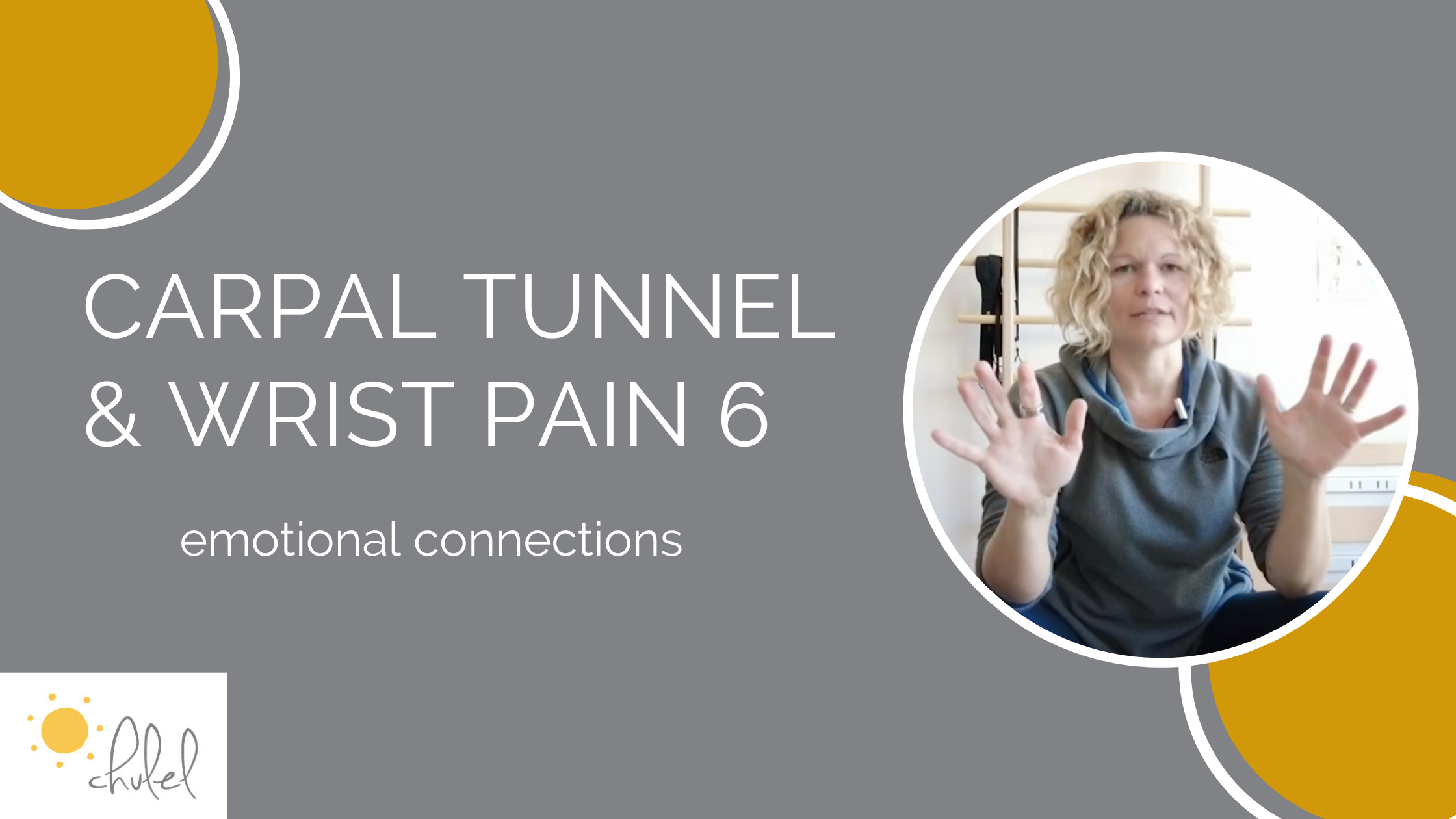
In this short video, I talk about connections between Chinese Medicine as well as the typical personality types that have come to me over the last decade for help with wrist pain and carpal tunnel.
The wrists and ankles represent the 4 gates in Chinese Medicine where chi circulates through these areas to create flow. If someone is blocked at one or more of these gates, it can lead to feelings of being trapped. To me this connects to feelings of control via the arms. As in being a doer-type—someone who is constantly in a get-er-done place.
Correspondingly, it has seemed over the years that these are also folks who have a harder time receiving since they’re so accustomed to doing. A healing practice for this would be to focus and feel what it feels like to receive love with open hands in a hug or even snuggles with a pet. Another option is to do something creative with your hands and feel that nurturing come through your hands. On a daily basis this could even be something like cooking or gardening, not just artistic pursuits.
Give this video a watch and see what speaks to you to incorporate in your own life…
Fix Your Plantar Fasciitis-Episode 7
In this episode we dive into some of the emotional or energetic undercurrents for plantar fasciitis.

Over the years of doing this work, I’ve found that there’s usually a top down approach over a bottom up in which the person approaches life. So, rather than being connected to the feet and the ground, the person is a heavy thinker and rationalizer.
A way to try to shift this mindfully in your body is to visualize your feet having roots that grow into the ground. Another suggestion is to connect to a place you can feel in your body and create new veins so-to-speak down each leg and into each toe. Then check in and see if it is easier to have a sensation of your feet in the ground.
Yet another suggestion is to purchase an earthing mat. The concept here is that we have chronic inflammation issues because we walk in rubber-soled shoes and concrete and that our bodies are unable to discharge negative ions. I know it sounds like a load of you-know-what, but I actually did find great benefit from sleeping on one of these for several years. My general sleep improved and I felt less allergies/illness. You can find ones that you can just have your feet on it, there are yoga mats and you can have ones that fit the entire bed as well.
Check out the video for the rest of my explanation on the mental aspect of plantar fasciitis.
Pelvic Floor Rehab-Energetic Connections
An aspect of my approach to bodywork is looking at emotional stressors or energetics and how that contributes to someone’s pain patterns. I always say, there are a lot of crooked people out there, but not all of them are in pain.
The root chakra and sacral chakra come into play with the pelvic floor. The root chakra can close off with anything that involves fear. I think all of us can agree that we’ve felt some amount of this over 2020-21. Any history of abuse or trauma, at any point in life, can contribute to issues in the root. Fear usually involves the breath to tighten, and as we’ve discussed, the breath mirrors into the pelvic floor. If the root gets closed off, it shuts off connection to the feet. I often feel that a lot of knee/foot issues are not just about the pelvic floor in terms of mechanics, but also this holding from current or past fear patterns.
The root is also all about stability. So any type of lack-of-safety feelings would play into dysfunction here as well. This could be financial, physical or emotional.
The sacral chakra obviously involves sexuality, but also creativity and sensuality. If you don’t feel safe, how can you feel like you have the energy or bandwidth the be creative or truly yourself?
You can bring more opening and awareness to these areas by visualizing the sphincters of the pelvic floor opening up like a valve and that water is coming down the legs. If color is your thing, the corresponding colors are red for the root and orange for the sacral.
Take this for a walk and you can visualize those colors going down one leg, back up and over to the other leg like a light up yo-yo. Check in with your body and see as you put those colors in your mind’s eye, are they vibrant? If they start off more dusky or dark, let the old stuff drop out of your feet and into the ground. Then as the light comes back up the leg, can it be a bit brighter? If you continue to do this, the colors will become clearer and you’ll feel better—promise.
This is my favorite book on energetic systems. The author connections modern psychology with the chakra system. It’s a great balance of ‘woo woo’ and philosophy.
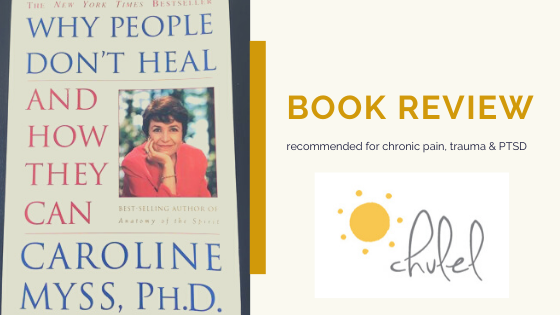
Why People Don't Heal And How They Can

I first came across Carolyn Myss, the author of this book, about 8 years ago. Since then, I've started this book 3 times and stopped because I saw different aspects of myself in the pages I wasn't yet ready to confront. If you were to put one self-improvement book on your summer reading list, I'd highly suggest this one.
Many of my clients initially come to me because they suffer from chronic pain and chronic fatigue. Naturally, they feel angry at their body and that they can't live their lives to the extent that they would like. Feeling stuck and depressed is an understandable companion to this anger. That said, the more anger we project back onto our bodies, the longer and more fraught the healing process is. A more effective path to healing is seeing the pain as a point of entry to explore deep within ourselves. In Why People Don't Heal and How They Can, Myss offers some ways to identify if we're suffering from what she calls Woundology and belief systems that could stifle our healing process.
These are the author's top 5 belief systems that most people get caught in when they're in pain or are ill. To move forward, we have to detach from the belief.
5 Myths of Healing
1. My life is defined by my wound (Woundology).
Seeing life through the lens of a traumatic experience means projecting that onto every future relationship and experience (though a book I wrote about last year here says the brain naturally will do this after trauma). Those stuck in this pattern will seek out a social support network that will be sympathetic to their experience and then they never have to move past it. Moreover, they connect with others by comparing wounds and feel empowered if they are more wounded than someone else. She specifically mentions survivor and addiction groups and that they are helpful at certain stages. To continue healing, however, one has to move past that identity of survivor or addict.
In short, we can get stuck in the healing process if we define our identity and live our lives through our wounds rather than evolving past them. It can be a tricky process because someone may think they're addressing their wounds, but what they're really doing is carrying them around like a badge of honor. Over time, our wounds accumulate and gradually suck our energy, leaving us prone to depression, pain and illness. To move past your wounds, focus efforts on things that feed you rather than deplete you. If a current event triggers you to recall all the other times this has happened to you, rather than listing the wounds, look at what you're doing in your life that is creating part of that pattern.
2. Being healthy means being alone.
This is a system that I've personally been guilty of over the last couple of years until I acknowledged that by engaging with others means I have to grow through the things that trigger me. When I envisioned myself as healthy, I was the only one in the room rather than being surrounded by those who I know love and support me. Myss contends healing is an ongoing process that is best done in a community that can help support our changes; "Healing does not represent the closure of the needs of the heart; rather, it is a doorway toward opening your heart." She cites American individualism as a culture block to realizing this yet also acknowledges that sometimes we do need to separate from someone or a community to grow.
3. Feeling pain means being destroyed by pain.
It's normal to believe that pain or illness is negative, yet these feelings can also push us to explore within ourselves and move away from destructive habits and behavioral patterns. She cautions against relying too much on prescription drugs or painkillers in general because they can mask the symptoms of what our body is asking us to heal. She suggests using a mindfulness practice like yoga or meditation to help with healing consciously.
4. All illness is a result of negativity and we are damaged at our core.
Myss encourages readers to not immediately blame a failure to heal on a past experience or negative belief. Illness is complex and there's plenty of toxins in our environment and genes that can be an aspect of illness. Our focus should instead be on our ability to create change over controlling our thoughts. Sometimes it's better to just let go of the negative thoughts or past experiences over trying to dive into them and understand them....that can do more harm than good.
5. True change is impossible.
Most of us don't really like change and to change but healing and change are the same thing. We associate illness with fear and negativity so it can be intimidating to confront the illness and look at how much we really take care of ourselves versus the needs of others. Try shifting the belief that healing will be hard or depressing to relieving and exciting.
This is one of the few books on healing that I've read that actually provides a structure for analyzing one's beliefs and how to better understand and forgive--she actually encourages making a chart/spreadsheet and guides readers on specificially how to structure it. That said, it's a very East meets West, spiritually-minded approach, so if that's not your bag, this may not be for you. If it is, Myss has a unique perspective on understanding how American culture looks at pain and illness that I found to be eye-opening in forgiving myself and others because we're all stuck in some collective, old mindsets that we can let go of reacting to individually.
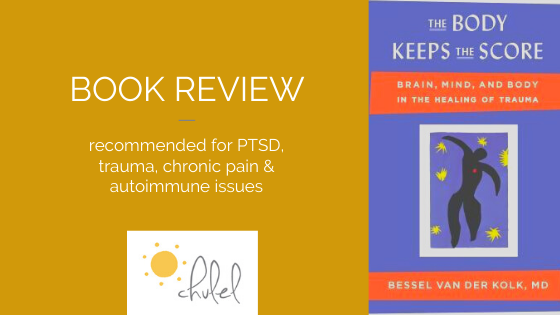
The Body Keeps Score

Did you know that if you (or someone you know) have suffered through abuse, a traumatic event or upbringing that the brain actually shifted as you (they) attempted to process the pain? This book has rocked my world the past couple of weeks in learning how amazing the body is and how healing from trauma is a layered process.
What is trauma?
In short, something that was stressful in which you felt alone. Obvious examples here include abuse, natural disaster, loss, terrorism and war. In looking at the behavioral patterns that can arise from trauma, I can't help but think most of us could cite some form of traumatic event(s)/relationship(s) in our lives.
How does the brain shift?
Trauma can actually change the brain's alert system and responding hormones in addition to leaving a mark on the brain similar to a stroke. The author, Bessel Van der Kolk, conducted a study where he showed participants images to trigger their trauma while monitoring their brain hemispheres. When participants were exposed to traumatic images, the right side of the brain that impacts how we perceive the world around us was activated, while the left, organizational side deactivated. The brain itself is in response mode to the trigger without real context of time or place. Moreover, the brain's response to trauma is pre-verbal so this explains why recounting what happened in a logical or coherent manner may be difficult or garbled.
While one may consciously choose not to respond to a trauma trigger, the body systems are still reacting, including hormones, which don't return back to normal levels after being in fight or flight or freeze mode. Because of this there is an internal disconnect so one may suffer from addiction or self-mutilation as well as illness, adrenal fatigue, fibromyalgia/chronic fatigue, poor sleep, memory issues, autoimmune disorders and irritability. (If you're super geeky about this stuff, as I am, he spends a good 10 pages going into brain chemistry specifics...but does so in a very approachable way for the brain science novice.)
What are some symptoms of trauma?
Hyper-vigilance-Because of the brain shift, one can be in a perpetual state of hyper-vigilance. This goes back to the perception lens--the brain is constantly surveying for a potential threat. This also means that one may project past traumas onto current life events.
Social isolation-Not wanting to engage with others because this could set off a trigger, so it's better to avoid interaction. On the flip side, fraternizing with those who have suffered the same trauma may feel safe (e.g. other veterans) yet this can also be limiting over time as one's identity shifts.
Loss of identity-You may more commonly know this as survivor's guilt as well as confusion if the person who abused you was supposed to be your caretaker/loved one.
Emotionally numb-A way to deal with the trauma is to disassociate from one's body and feelings, leaving one devoid of feeling.
Loss of imagination-If raised in an unsafe environment, all of the body's systems are in self-preservation (hyper-vigilance) mode so there's no room for imagination or exploration.
Risk-taking-The body releases endorphins which are like morphine, so one can become addicted to risks or even find pleasure in pain. The body seeks this out to overcome anxiety.
How does one heal?
The author suggests 3 approaches to be used in tandem as needed.
- Top down with talk therapy, specifically EMDR, Internal Family Systems and Neurofeedback. If you're in Austin, there's a great clinic that uses these approaches. Find out more about them here.
- Medications that will turn off the body's alarm systems.
- Bottom up through the physical so that the body can experience something other than helplessness and rage which gets held in the viscera (i.e. having a broken heart, stomach in knots). He suggests this in particular for those who suffer from musculo-skeletal pains that may have an emotional root. Since that is my bag and this is my blog, I'm going to spend a bit more time on this and his suggestions.
Heal trauma with mindfulness.

Ki Hara Active Stretching for mindfulness and flexibility.
The first step in releasing the past is reconnecting with and establishing ownership of the body to feel, find peace and focus so that when things trigger the past, one can maintain internal calm. When we can connect with how we feel, we can begin to change perspective. If we can't feel, we are incapable of figuring out what our body needs and how we can best take care of it. By being present in our bodies, it is safe to revisit the past without being overwhelmed by it. We can start to have words for things we may have hidden from ourselves and reintegrate the pieces of ourselves that we've lost along the way. A way of coping with trauma is disassociating from our bodies, so mindfulness and breath work reaffirm who we are as a whole being.
The author recommends yoga as an avenue to mindfully connect with the body. A former client of his specifically cited that Pilates helped her heal from a traumatic event to her pelvis. I love both of these modalities, yet I don't think I learned to be deeply connected to my own body until I encountered Ki Hara Resistance Stretching (aka yoga on steroids). It has been amazing for helping myself and my clients reconnect with areas of the body that have been forgotten and then integrating them to the whole. It's particularly effective because when I'm working with a client, it becomes a partner effort to rediscovery. In other words, it's not someone alone in their own stretching practice (though this is another component for establishing ownership of one's body). I can be an objective pair of eyes for how your body is moving when there could be a more efficient way. If you haven't connected to a part of your body in a long time, how are you even supposed to know it's there?
I found this book to be incredibly insightful both for my own understanding of some areas I need to work on and to have more compassion for others who have are trying their best to heal. If you're one who is better with video over books, here's an interview with the author with some similar themes.
Latest Instagram Posts