Your Custom Text Here
Pelvic Floor Rehab-Energetic Connections
An aspect of my approach to bodywork is looking at emotional stressors or energetics and how that contributes to someone’s pain patterns. I always say, there are a lot of crooked people out there, but not all of them are in pain.
The root chakra and sacral chakra come into play with the pelvic floor. The root chakra can close off with anything that involves fear. I think all of us can agree that we’ve felt some amount of this over 2020-21. Any history of abuse or trauma, at any point in life, can contribute to issues in the root. Fear usually involves the breath to tighten, and as we’ve discussed, the breath mirrors into the pelvic floor. If the root gets closed off, it shuts off connection to the feet. I often feel that a lot of knee/foot issues are not just about the pelvic floor in terms of mechanics, but also this holding from current or past fear patterns.
The root is also all about stability. So any type of lack-of-safety feelings would play into dysfunction here as well. This could be financial, physical or emotional.
The sacral chakra obviously involves sexuality, but also creativity and sensuality. If you don’t feel safe, how can you feel like you have the energy or bandwidth the be creative or truly yourself?
You can bring more opening and awareness to these areas by visualizing the sphincters of the pelvic floor opening up like a valve and that water is coming down the legs. If color is your thing, the corresponding colors are red for the root and orange for the sacral.
Take this for a walk and you can visualize those colors going down one leg, back up and over to the other leg like a light up yo-yo. Check in with your body and see as you put those colors in your mind’s eye, are they vibrant? If they start off more dusky or dark, let the old stuff drop out of your feet and into the ground. Then as the light comes back up the leg, can it be a bit brighter? If you continue to do this, the colors will become clearer and you’ll feel better—promise.
This is my favorite book on energetic systems. The author connections modern psychology with the chakra system. It’s a great balance of ‘woo woo’ and philosophy.
Pelvic Floor Rehab-Jaw and Diaphragm

In this episode we hop over the pelvic floor and work superior to the pelvic floor—the head, jaw and diaphragm.
The body is a series of diaphragms, or suspension bridges. The brain rests in a diaphragm and the jaw is a diaphragm. We then have the breath diaphragm, then the pelvic floor and even the archway of the feet are diaphragms. All of these archways coordinate with one another in movement, so when there’s tension in one, it will reflect and reverberate to another one.
Since this course focuses on the pelvic floor, we get into releasing the head and breath diaphragms before going more deeply into the pelvic floor in the next episode. There’s a yummy head and jaw massage in this video. Then we combine that with releasing the diaphragm using a ball or towel combined with optional breath holds.
As the format of the course goes, we release then re-engage. In this case, this means being more aware of how our pelvic diaphragm and breath diaphragms work in conjunction in respiration. For a shorter version of that, you can watch here. Breathing correctly helps with a whole host of issues, as we know. When we inhale, the diaphragm flattens, pushing our organs into the pelvic bowl. In order for this to happen fully, our pelvic muscles have to be sufficiently relaxed. Then, on exhalation, the pelvic floor ascends and pushes our organs back up into the chest cavity like an elevator. The breath and these diaphragms are massaging our guts, as it were, aiding in digestion. Personally, I find this difficult to fully feel when I’m sitting (even as I type this on my couch) in a lounge-fashion. So try standing up, or properly situated as I explain in this video.
Warm wishes your way and thanks for watching (or just reading)!
Pelvic Floor Rehab-Glutes and Hamstrings

Continuing on in all-the-things-connected to the pelvic floor journey, we arrive at the derrière and hamstrings. Since this sit cradled in a chair for days and years, it’s incredibly common that adults have underachieve and weak muscles in these areas. The pathway I’m recommending to get them back on…
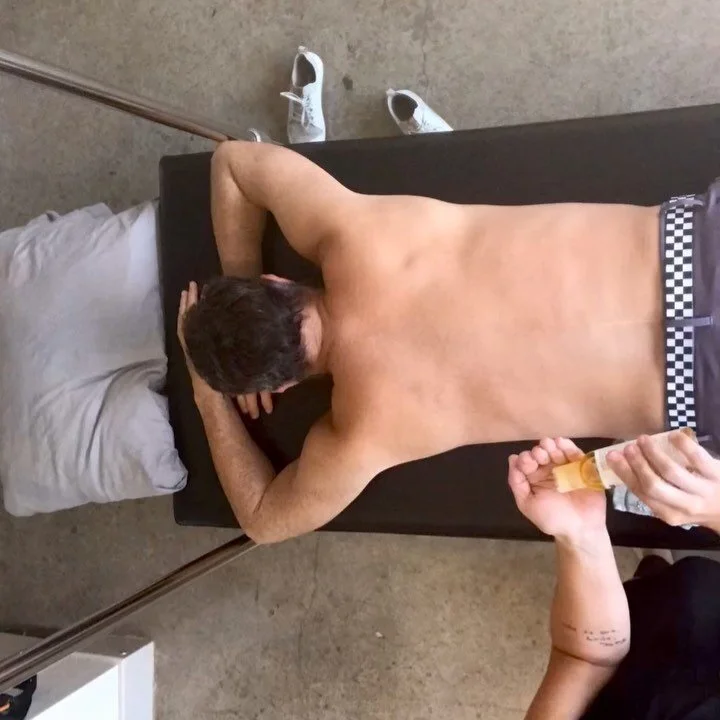
Massage
In short, foam roll just about everything. Hit up your calves, hamstrings, quads, glutes and back first. Tight adductors (groin) is a super common reason the glutes don’t fire correctly, we covered them in the last episode. Here’s a link to a shorter version of how to foam roll those.
Another crazy connection I’ve seen over the years is the opposite shoulder blade being an issue in glute/hamstring recruitment. The body balances itself on diagonals. Think about your footprints in sand, they’re not in a tightrope-like line, they zig zag. In proper gait (how you walk), the upper body should rotate over the forward leg. When working with clients, this element is often off, leading to a kind of waddle instead of a swagger. These folks are often in my studio because of back pain, knee pain and neck tension. All of it can connect to this diagonal element being lost in their walk and instead they pogo stick side-to-side. So, massaging the shoulder blade is critical as well before we get into trying to activate the rear end.
Stretch
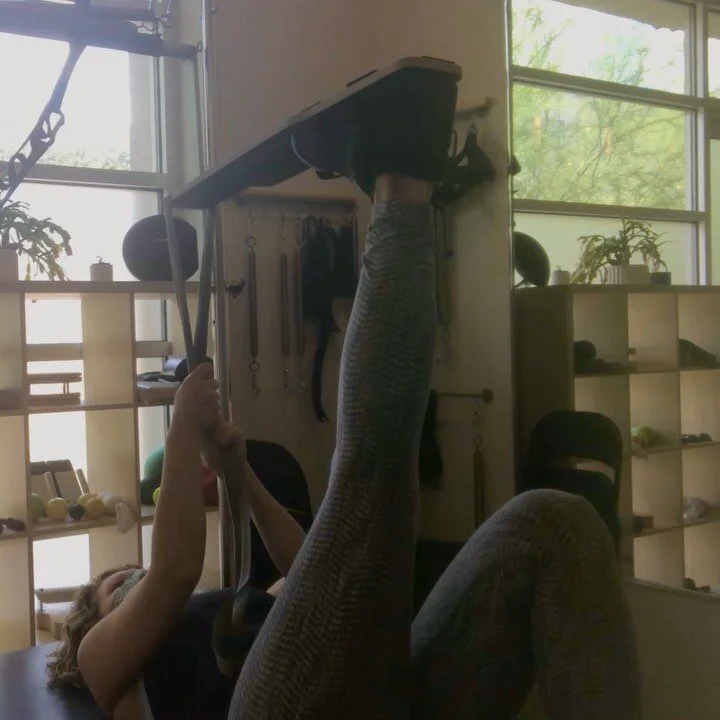
The video details a couple approaches to stretching the hamstrings to start—we stretch the muscle as well as the fascial chain. What’s the difference? Stretching the muscle means working the joint in its full range of motion, versus the fascial chain is more like stretching the skin. Someone who taught a training I once attended likened it to if you were wearing jeans or a wetsuit—if there’s greater pull on the fabric, that’s more like a fascial stretch.
The action of the hamstrings is to bend the knee. Therefore, stretching the hamstring muscle would mean actively pulling open the knee like a clamshell. We have 3 hamstrings muscles, so stretching at different angles means we can target each one.
When most of us think about stretching the hamstrings, we think about a pike stretch or putting a leg out and leaning over it. This is our fascial stretch. Something easy like putting your foot up on a chair and leaning over it, while waving your leg side-to-side to pick up those 3 hamstrings will do the trick.
For the glute and the deeper hip rotational muscles, pigeon pose is a straightforward and good bang for your buck in terms of what it hit and the time you’re in the stretch. There’s a few options in this video to add the active stretch element to pigeon as well as some different fascial components.
Activate
We then move into a couple of simple activations you could even do pre-walk or run. To activate the glute max, gently press your foot into a wall. Make sure your thighs are parallel or have the active thigh slightly behind the standing leg. Feel your rear tone up as you press.
The hamstrings bend the knee, so have the same thigh orientation as above and then pull your heel to your bum. Taking the leg and foot at different angles will help to activate the different hamstring muscles. This is all explained in the video and you can fast forward to 20:23 for details. You can do the same exercise lying on your stomach and it will automatically keep your thighs in that parallel position, making it harder to cheat in the motion.
Lastly, we do a simple hip rotation activation of internal rotation and then external. It’s a gentle exercise, yet deceptively difficult. Another option is the clam series, which you can find here.
I always say my primary concern when doing this work is aging well and not necessarily the biceps and bikini-body. That said, I’m all for a butt-tastic body if it motivates you for some post-Covid fun as well as keeping your hips strong. 🍒
FREE Pelvic Floor Rehab Course

What is the pelvic floor?
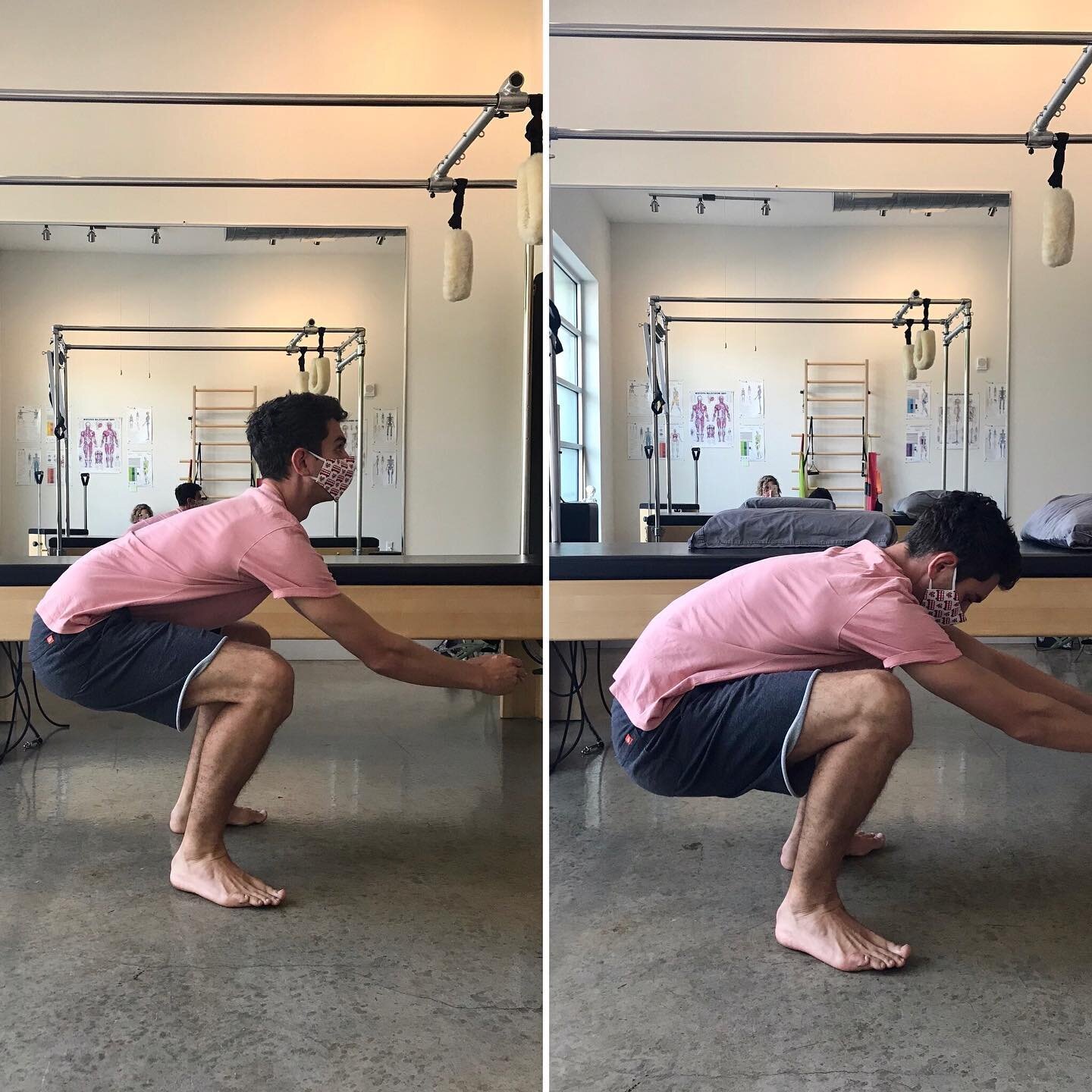
I define the pelvic floor as more than just the elimination muscles—I see it as anything that touches brief underwear lines. If you think about it, those are in contact with a chair for hours a day (for the average person), so they atrophy over time. Then as we age we’re dumbfounded as to why it can be challenging to do day-to-day tasks like squatting down, lifting things off of the floor, getting up off of the floor or even balancing.
I don’t see stand up desks as a cure all for this. I’ve worked on many people with pelvic floor issues who use standing desks. Chances are you were sitting for years professionally or in school before you started using one. So, those imbalances can already be there.
Why is pelvic health important?
These are your falling-and-I-can’t-get-up muscles! They’re critical for aging well and having solid balance and stability. And, they’re often small muscles, so just because you work out, doesn’t necessarily mean that they’re one and strong.
It’s also critical to have good strength here for proper elimination long-term and to head off pelvic organ prolapse and prostate issues.
The pelvic floor also plays a critical role with the breath. Belly breathing is great for relaxation and yogic techniques, but the bandas have to relax and expand for true health in the pelvis. So, I find that a LOT of people need to work on expanding the pelvic floor, yes even moms, because their pelvic floors are tight from improper breathing. For this reason, pelvic floor health and strength isn’t just a postpartum or post-hysterectomy issue, it’s for men and women.
Structure and format of this course
This is not a course on Kegels! I find Kegels to be a constipation view of pelvic floor health and not encouraging dynamic strength that we need there to do things like lifting and balancing.
We’ll start distal (away) from the pelvis and work our way in. We’ll look at common, faulty neuromuscular pathways I’ve seen over the last decade and try to correct those patterns. The modules will have a release then stretch then re-engage format and then I’ll also include some basic as well as intermediate exercise sequences. At that point, you’re free to go about your way in a regular exercise class, hopefully with these areas more engaged.
Why I’m passionate about this content
You can find out more about this in my bio. Long story short, I had an intense and painful bout of piriformis syndrome for about a year and a half after my dad unexpectedly passed away. Thing is, it never got diagnosed as such. I was super active and 28 at the time. MRI came back negative for disc issues and every doctor kept wanting to label it as sciatica, which it wasn’t. After thousands spent on physical therapy/massage/chiropractic/acupuncture, I started studying anatomy and biomechanics and figured out it was the piriformis. I looked up ‘piriformis problems’ and the web said it was common for people who ran a lot and who sat at a desk for a living. That was me to a T!
Thing is, the pain didn’t get better with just the biomechanics. The holistic folks kept saying it was my internalized grief. I was crying all the time, so I didn’t see anything internalized about it. That said, the more I dug into the deeper feelings about how my dad died, the pain started to change. This is why I bring this approach into my work with clients. If something has stuck around for months or years, there’s a good chance you’re holding some deeper stress and emotions around it. I’ll bring in some of the things I’ve researched over the years re:emotions and the pelvis into this course as well.
Another reason why pelvic health is so important to me…my grandmother has had chronic UTIs for 25 years. At this point, she’s pretty much immune to all antibiotics. I can’t help but think if she started doing things like this in her 50s and 60s she wouldn’t have suffered so much and have this risk in her 80s.
Internal pelvic floor physical therapists in Austin
This course is not meant to be a substitute for proper, internal physical therapy. In Texas, you typically need a doctor referral. Here are some of my favorite folks in Austin.
Stretch Out Your Sciatica!

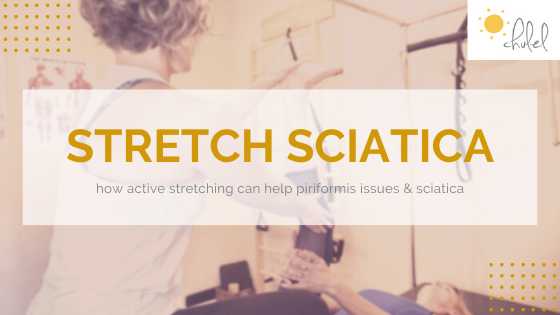
Active (Ki Hara) hamstring stretching.
For non-severe cases of sciatica (i.e. not having foot drop or incontinence) a holistic approach of regular stretching and shifting your body's biomechanics can not only lessen your pain levels, but help it from coming back. The sciatic nerve runs from the lower back all the way down to the foot on either side of the body. Sciatica can be a result of several spinal issues, so it is important to consult with your doctor to ensure that this is not the underlying cause of your lower back pain. Deep stretching of the back and hips with follow up care to strengthen the pelvic floor and shift your gait (walking) can all help your sciatica no matter if you choose a doctor-recommended approach such as a cortizone shot/epidural or a holistic approach of chiropractic/acupuncture.
Deep stretching of the hips can take pressure off of the sciatic nerve, particularly by stretching the piriformis muscle. The piriformis connects the lower back to the hip and acts as a rotational muscle for the thigh. The sciatic nerve passes through this muscle for some of us, so when the muscle gets tight, it cuts off the nerve. Ki Hara active stretching is particularly effective for loosening these muscles, because we take the muscle from its shortened length and then actively pull it long. This means that flexbility isn't coming from a ligament or the joint, we're actually creating longer muscles--kind of like stretching taffy. You can see an example of this and its effectiveness here:
I find that another contributor in back pain is that we hold our breath from stress and become 'tightasses'. Read more about this here.
After getting more space in the pelvis, we can reengage the pelvic floor muscles and strengthen the glutes that should have been doing more work before sciatica came along. After sitting for so many years--even think back to being in school, the chair ends up supporting our weight most of the day instead of our pelvic musculature, including our bums. We end up with flat behinds while the muscles in the pelvis tighten and weaken. They then tug on the sacrum or lower back, forcing it to move in ways that it shouldn't, so it rightfully gets angry. By consciously reconnecting with the pelvic floor, which is the base of our core, and pumping the butt back up, we reactivate the parts of our body that should be holding our torso upright instead of a piece of furniture.
When working with sciatica and lower back pain clients, we not only stretch and strenghten, we also shift how you walk. If you've had that seizing pain or constant aching for a while, I guarantee you've walked weird to protect yourself from feeling it. So, another way to prevent you from having a future episide is to make sure you don't keep walking in a way that supports your body's holding of that pain. Addressing sciatica, and back pain in general, from this progressive approach helps my clients' back pain improve, it also lessens the severity/duration of future episodes In many cases, it helps keep the pain from coming back all together.
Latest Instagram Posts