Your Custom Text Here
A New Way to Improve Posture
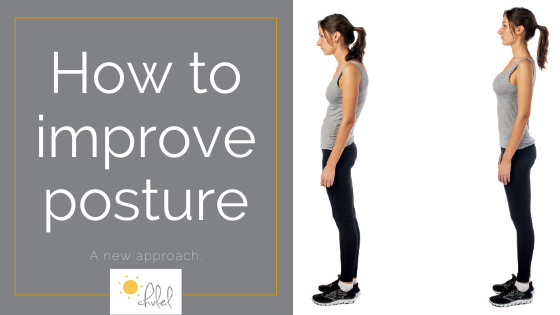
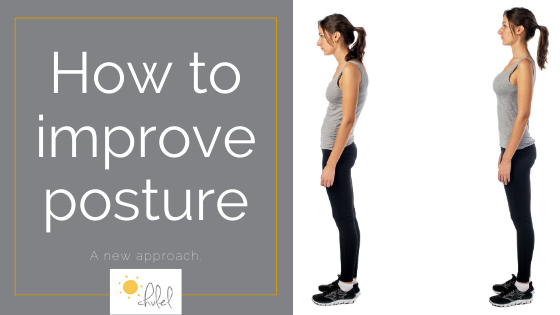
The traditional model of 'good' posture is a 2D approach (e.g. align this bone over this one) when we are 3D beings. We've all seen the poster in the doctor's office of the skeletal system, depicting a skeleton hanging by a hook. We then extrapolate this image to posture thinking we need to stack certain joints on top of one another--feet under hips, hips under ribs, ear lobe over shoulder. Thing is, we don't dangle from hooks, and while we connect to the ground, we're also constantly moving. So, we need a 21st century update to our ideas of posture, including how it connects with the breath and grounding.
How should I stand?
In the past, most of us were taught that good posture means locking our knees, straightening our back, pulling our shoulder blades together and puffing out our chest. How we were supposed to do this and breathe, I'm not sure. Moreover, this model attepts to make the spine straight when it's really shaped more like an S. Tapping into that S idea, and that our body tissues move more like a spring with each step, lends to a more organic posture with greater ease of movement.
What is good posture?
I see the body as a series of archways and that those archways, or diaphragms, act as suspension bridges and shock absorbers.

Strengthening the arch of the foot supports these archways.
- Arch of the foot.
- Arch of the pelvis at the groin.
- Arch of the breath diaphragm at the rib cage.
- Arch of the throat.
- Arch of the eyes/brain.
To me, good posture involves dynamic interaction between each of these areas. I say dynamic, because once again, we're not usually standing (or sitting) completely still. At a minimum, you're breathing, which means one of these diaphragms is always moving.
If you begin to stand and move with the visual of a bunch of suspension bridges instead of a sky hook, stacked bricks or stiff rods, your movement will be easier with alignment. You can practice this while standing and pretend like you're internally lifting your rib cage (on an inhalation) off of your pelvis--not puffing your chest out, but a 360 degree lift. You should feel your core turn on a bit and support your spine. Maintain that lift and breathe as you walk--can you feel that there's a buoyancy to your movement? That's your body moving through its diaphragms! Over time, not only will you have better posture from a state of ease rather than holding, you'll be using your core how it's supposed to be used--keeping you upright. You may even notice some new ab definition in as little as a couple of weeks.
If you didn't feel that buoyancy, you might be holding some tension at one of those diaphragms. This is where an objective pair of eyes (mine) can help you figure out where you're unconsciously holding tension, loosen things up and then you can feel more flexible and move from your core all day!
For a 3D explanation of posture (instead of just text). Here's a video for you:
Take this new feeling into your walk!
Once you feel your diaphragms, you can then tap into that buoyancy in the body as you walk. The ground becomes another 'diaphragm' and we sort of float or even gently bounce forward instead of pounding the pavement. I call it the Tigger Effect. It feels lovely! Here's an eplanation of that sensation and how to feel it when you walk. Using equipment that is spring-based, like Pilates, helps immensely to feel this and integrate it into your body. Contact me for an appointment for more personalized help on improving your posture and gait.
Stretch Out Your Sciatica!

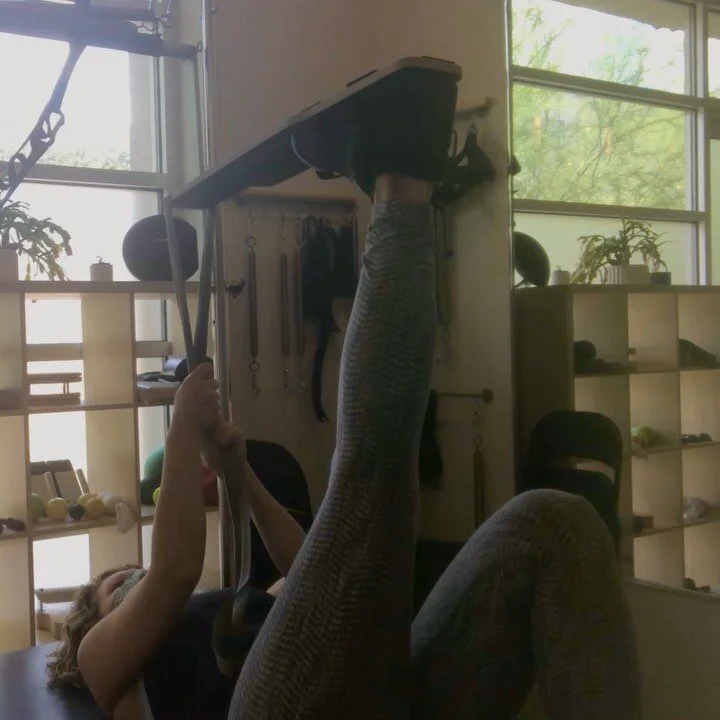
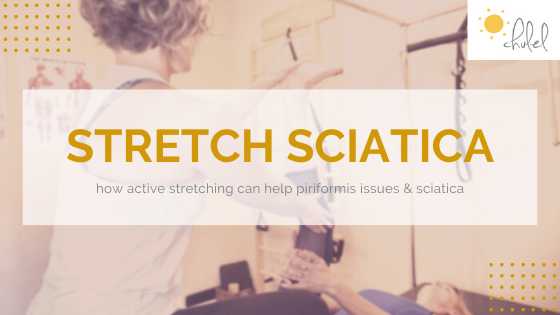
Active (Ki Hara) hamstring stretching.
For non-severe cases of sciatica (i.e. not having foot drop or incontinence) a holistic approach of regular stretching and shifting your body's biomechanics can not only lessen your pain levels, but help it from coming back. The sciatic nerve runs from the lower back all the way down to the foot on either side of the body. Sciatica can be a result of several spinal issues, so it is important to consult with your doctor to ensure that this is not the underlying cause of your lower back pain. Deep stretching of the back and hips with follow up care to strengthen the pelvic floor and shift your gait (walking) can all help your sciatica no matter if you choose a doctor-recommended approach such as a cortizone shot/epidural or a holistic approach of chiropractic/acupuncture.
Deep stretching of the hips can take pressure off of the sciatic nerve, particularly by stretching the piriformis muscle. The piriformis connects the lower back to the hip and acts as a rotational muscle for the thigh. The sciatic nerve passes through this muscle for some of us, so when the muscle gets tight, it cuts off the nerve. Ki Hara active stretching is particularly effective for loosening these muscles, because we take the muscle from its shortened length and then actively pull it long. This means that flexbility isn't coming from a ligament or the joint, we're actually creating longer muscles--kind of like stretching taffy. You can see an example of this and its effectiveness here:
I find that another contributor in back pain is that we hold our breath from stress and become 'tightasses'. Read more about this here.
After getting more space in the pelvis, we can reengage the pelvic floor muscles and strengthen the glutes that should have been doing more work before sciatica came along. After sitting for so many years--even think back to being in school, the chair ends up supporting our weight most of the day instead of our pelvic musculature, including our bums. We end up with flat behinds while the muscles in the pelvis tighten and weaken. They then tug on the sacrum or lower back, forcing it to move in ways that it shouldn't, so it rightfully gets angry. By consciously reconnecting with the pelvic floor, which is the base of our core, and pumping the butt back up, we reactivate the parts of our body that should be holding our torso upright instead of a piece of furniture.
When working with sciatica and lower back pain clients, we not only stretch and strenghten, we also shift how you walk. If you've had that seizing pain or constant aching for a while, I guarantee you've walked weird to protect yourself from feeling it. So, another way to prevent you from having a future episide is to make sure you don't keep walking in a way that supports your body's holding of that pain. Addressing sciatica, and back pain in general, from this progressive approach helps my clients' back pain improve, it also lessens the severity/duration of future episodes In many cases, it helps keep the pain from coming back all together.
Tips to Improve Forward Head Posture
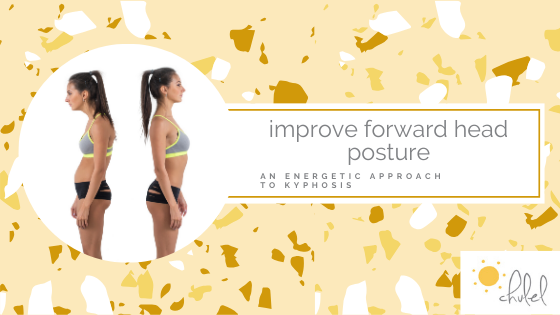
Forward head posture is pretty ubiquitous in the 21st century. There's plenty of resources online about how to fix it from a purely physical approach, but I think the long-term solution is much more of a personal one.
Some common suggestions for correcting forward head posture include simply moving the head backward, which I feel does more immediate harm than good. If the head is forward, the shoulders are usually rounded as well (aka kyphosis). So, shifting the head back with this type of body shape collapses the breath by cutting off air flow through the throat. Another 'fix' is bringing the shoulder blades together, which most people find by arching their mid back in a way that the spine is not shaped, generating a lot of unnecessary tension and/or pain in their back and neck. I find that apporaching alignment from an energetic perspective brings faster change without ticking off another part of the body.
How does forward head posture have an energetic connection?
As the head drops forward, there's also a fold at the diaphragm or solar plexus (where the rib cage splits). From an Eastern perspective, this is where the third chakra is located. This area represents our personal power and autonomy, our sense that we have volition and agency in our life.
What causes restriction at the third chakra?

Pretty much anything that compromises our ability to truly be ourselves and love ourselves. This can be events in our past and it can also be aspects of our present life. You may have not have grown up in a family culture of complete love and acceptance for your true self. Maybe you now feel burdened by responsibility and you're unhappy in your job/relationship/life. If this rings true, you may not feel like you have personal power or ability to change the parts of your life you're dissastisfied with.
Shame shuts off flow through the third chakra and limits our ability to fully embody our power. It wasn't until coming across Brene Brown's work several years ago that I realized how much shame I've held onto--I don't think I fully understood what that word meant before reading her book. Shame=all of the ways you don't feel like you're enough. For me this came in sneaky ways....maybe I didn't say 'I'm not attractive,' when looking in the mirror, but I did hold myself to a super high standard and compared myself to my percpetion of others. Shame lies on the other side of all of that because I could never be or do enough. Finding self-love has been a beautiful thing!
Some of us self-sabotage as a part of being constricted in this area. Maybe we put too many things on our plate and have a tough time saying 'no' to commitments. Others procrastinate and feel shame for doing so. Regardless of our personal habits, we can find ourselves in the midst of a big ol' shame snowball.
So how does all this connect to posture again?
Basically, forward head posture, just like everything else in the body, is more than just you looking at your phone too much. It's also a relfection of feeling burdened and not enough.
What helps?
The third chakra is located at the diaphragm, so doing more things to connect with your breath and lift through that space will help. Here's a video to help explain that in a seated position.
In addition to connecting with your breath, start noticing how you treat yourself. Do you belittle yourself or have a harsh inner critic? Do you take on more than you can reasonably accomplish without feeling stressed? How do you approach your responsibilities? Is there a way to visualize the best possible outcome over feeling overwhelmed?
Allow yourself to feel more over thinking. We value thought over feeling as a culture and that contributes to the head falling forward--we decapitate ourselves from the rest of the body. Taking a moment to feel and appreciate something in your day can show you how much power you already have.
And that's always a good place to start. :)
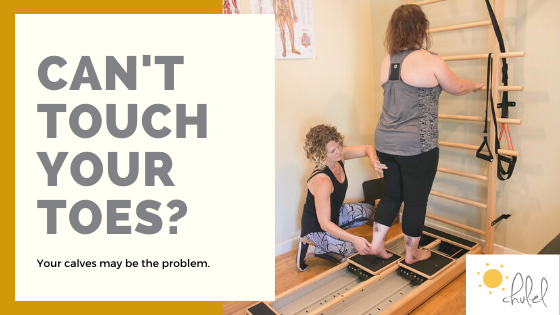
Can You Touch Your Toes? Your Calves May Be the Culprit.

Gait re-patterning to rehab injury and chronic pain.
When was the last time you thought about stretching your calves? Our body awareness typically gets pulled to the places where we hurt or where we want to create more muscle tone leaving the calves a bit lonely. They're just...there. Thing is, calf tightness can correspond with pain in other areas of the body including foot pain, knee pain, back pain and neck pain, even headaches! The fascial or connective tissue line runs up the entire back side of the body--sole of foot, calves, hamstrings, piriformis (deep muscle in the butt), up that respective side of the spine, neck and then stops at the browline of the forehead. This is the connective tissue line that also contacts a chair most of the day, so no wonder there would be some tightness. It can also remain constricted due to our walking pattern.
Why are my calves tight?
Unless you live in San Francisco or in a national park, you're walking on flat surfaces all day long. That's a pretty small range of motion for the ankle so the calf muscles tighten because they aren't being worked in their full, anatomical range. This means that in general, most people have tight and weak calf muscles. Why should you care? Calf and ankle strength affect posture all the way up the body and is critical for balance. Plus, due to the connective tissue line, your calf tightness could be a major culprit in your knee, back and neck pain.
Do my shoes make my calves tight?
Absolutely. High heels are an obvious example because the calf muscles are contracted or shortened all of the time. That said, every Austinite who wears flip flops and cowboy boots year round isn't faring much better. Flip flops cause people to become toe grippers, meaning they're always clawing at the ground, or really the shoe, just to keep it on. When the heel isn't cupped in the back of a shoe, our gait pattern (how we walk) shifts so we stop using our whole foot and calf to take a step. If you love flip flops, look down at your toes and you may even see them scrunched up a bit rather than nice and open. Boots keep the ankle at a fixed, right angle, so this also makes for tight calf muscles--once again, because the full range of motion of the ankle is limited. I'm not suggesting that there's the perfect shoe, or that you should never wear your boots again, but try regularly changing up your footwear. Flip flops on the other hand...if you have any pain or tension along this fascial line, you may want to consider swapping your flip flops for sandals that have a strap around the back to support your ankle. This usually keeps folks from doing the toe grip motion to take a step.
How do I stretch my calves?
I have several options on YouTube, foam rolling and stretching the shins, but this is my favorite:
From an energetic or emotional perspective, I find that when people have tight calves, they can't feel the ground, meaning they don't feel supported by the earth. When someone walks into my studio with chronic neck and shoulder pain, I will often do a deep calf stretch in the first session so that they relax their lower leg. I always stretch one leg first, then have the client stand to feel the difference. About 90% of the time, they feel more relaxed and lighter on that side, plus their shoulder on that side, will lower. Lack of grounding, or feeling supported from below, puts all of the energy into the shoulders and head. This looks more like someone who holds the weight of the world on his/her shoulders instead of feeling relaxed and connected. Try this at home on one side and see if you feel what I'm talking about.
If you know that you have pain along this back, fascial line, and that you may walk a little funny, schedule an appointment and we'll shift your gait a bit so that you aren't reinforcing tension along the back side of your body with every step!
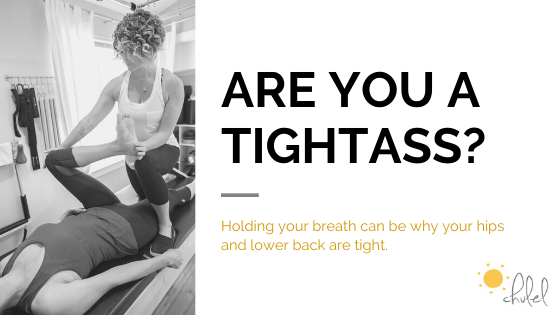
Are you a tightass?
Most of us are, and the funny part is, we're completely unaware.
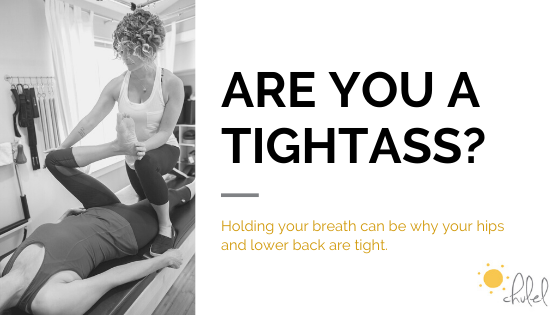
Ki Hara Active Hip Stretch
What is a tightass?
I define it as one who perpetually grips in their pelvis, specifically in the urinary and anal sphincters. Clenching here tightens muscles in the pelvic floor, which pull on the hips, which pull on the lower back.
How does one become a tightass?
Stress
Our bodies (nervous systems) are wired to process stress with fight or flight. Evolutionarily, if something threatened our survival, we fought or we ran. In the 21st century reality, it's usually not possible to discharge stress at the moment we're feeling it. Plus, we usually have multiple stressors hitting us simultaneously. We are then left with a freeze response, so the body goes on lockdown, as do our bums.
Breath
Building on the above, shortening our breath is a top physical holding response when we freeze. Unfortunately, this is where we spend the bulk of our time--barely breathing, which, only keeps our nervous system in a hightened state of stress. So the stress/breath cycle snowballs. Right now, take an inventory of your breath. Can you even out your inhalation and exhalation time? How many seconds does it take you to do an inhale/exhale? Can you increase that duration by 1 second, or maybe even 2 seconds? Does your body (pay attention to your pelvis, in particular) relax a little bit with this slightly longer breath cycle? Now pause and hold your breath...do you feel your sphincters tighten again?
Digestive Issues There's a greater awareness now about food sensitivities and allergies. When our digestive system is upset on a regular basis, it can lead to chronic clenching of the digestive sphincters. I also think sitting for long periods and the subsequent slowing of our metabolism can let things feel stuck in our digestive tract.
Sucking in the Stomach/Wearing Restrictive Clothing This usually applies more to women than men. Wearing restrictive clothing or sucking the stomach in, once again means the breath is affected so the tightass tendency follows.
Energetic/Emotional Component The area we're talking about in the body corresponds to the root chakra. This chakra, or energy center, represents our foundation, sense of safety, financial stability and tribal (family of origin) identity. Pretty much everyone has some emotional crap involving at least one of these issues. Emotional holding patterns surrounding fear, in particular, contribute to chronic clenching in the pelvis.
Why does it matter?
Tightening your holes pulls on your hip rotation muscles (especially the obterator internus), locking your femur (thigh bone) in a shortened range of motion. Chronic holding in this area of the pelvis directly affects not just hip rotation but also low back pain. The femur is a ball and socket, a super mobile joint. When we restrict its full range of motion (most of us don't even work the hips in their full range of motion on a regular basis, that will be another blog post) the sacral area of the low back gets pissed off because it's having to do the work that the ball and socket should be doing. Then we have low back pain. I'm not saying this is the exclusive reason for lower back pain, but it is a significant one.
What should you do about it?
Wear clothing that doesn't restrict your breathing and try to relax these muscles with your breath. For more information, check here on how to do that:
Pay attention to which foods your body is happy and nourished by and try to eat more of those. One of my favorite go-tos for eating more vegetables is eating 5 different vegetables each day. I find that the goal becomes the center-point of my meal planning because the focus is how I give my body nutrients rather than a thou-shalt-not-eat __ approach.
Do something for you throughout each day...even if it's just 5 minutes. As a movement person, let me suggest this be something movement-related. Not just because you're taking care of your body, it will also help aid your digestion and kick in your parasympathetic (calming) nevous system. Maybe it's taking a timer-motivated break for 5 mintues in which you just focus on your breathing or on your favorite cup of tea. Maybe it's repeating a favorite mantra each time you look in the mirror or take a bathroom break.
Start looking at your fear patterns and letting those fears go. We often hold onto fears that took root in our childhood that are no longer relevant and necessary in adulthood. A good place to start is noticing when you're triggered by something someone says or does and ask yourself why you had a reaction at all. Did it highlight a fear you have? Was it a way your parents/sibling/family member spoke to you growing up? Are you reacting to that trigger now the same as when you were younger? How does your body feel? Where do you feel tightness or restriction?
Trying a multi-faceted approach, meaning looking at your back pain (or maybe just your tight ass) from a physical as well as emotional perspective can lead to greater and longer-lasting pain relief...and help you grow as a person.
Double-click to edit...
Latest Instagram Posts