Your Custom Text Here
Meet Izzy Swanson, Shamanic Reiki Master
Izzy and I met almost two years ago, and my first Shamanic Reiki session with her was epic. I have continued to see her regularly and her work has supported me through family illness, a miscarriage and relationship growing pains. I walk away from our meetings feeling more calm and anchored with perspective on whatever is going on in my life at that moment. She is a critical piece of my personal wellness and self-care, and I'm delighted to share her with you.

What is Shamanic Reiki?
Shamanic Reiki is the combination of shamanic practice and the healing energy of Reiki. Shamanic healing techniques include cord cutting or removing emotional attachments in the energy body, soul retrieval, working with past life experiences, and healing areas of the body that may be in pain. The shamanic practitioner travels into the spirit world and communicates with guides to gain insight about the methods that are necessary to provide healing. Reiki, also known as Universal Life-force Energy, is a form of energy that the practitioner channels into and around the body of the recipient. Reiki energy adjusts itself to the needs of the patient and promotes a sense of calm, relaxation, and peace while stimulating the body’s healing response. Reiki can also facilitate the release of intense emotions such as anger, worry, and sorrow. These healing techniques blend together for the benefit of the patient. Reiki amplifies and provides energetic support for shamanic healing techniques while restoring and comforting the body. It also helps to maintain a state of calm and balance as the practitioner and patient work together using shamanic practices to heal at a deep, soul level.
How did you arrive at this healing modality? Why did you choose it?
I didn’t set out to choose Reiki, it chose me. I set out to make my spiritual practice deeper and began exploring shamanic practice. I come from a background in wildlife biology and being close to nature was important to me. So shamanic practice seemed to resonate the most for me because it was connected to ancient traditions and was based in working with the land. It was a physical illness that led to me to go deeper into the work though. In 2011, I nearly died from an autoimmune disease and somewhere in my recovery process, I became very clear that healing my sprit had to be a part of surviving. I signed up for a shamanic training apprenticeship that ended abruptly due to an emergency with my teacher’s family. One of the women in my class offered to teach me and two others Reiki if we wanted to continue together as a group, so I said yes. There was no plan. It was as though the steps on the path were laid out before me and I became a Shamanic Reiki Master. In the beginning I thought it was something that I would use for my own healing but it did not take me long to realize that I needed to be of service to others, especially to those who had experienced trauma.
What conditions benefit from Shamanic Reiki?
Overall the possibilities of healing with this work are endless. Anyone can benefit from releasing energetic blocks and restoring the balance in mind, body and spirit. I primarily focus on working with the energetic signature of autoimmune diseases and healing trauma. The energetic pattern for both of these conditions is similar in that they create a sympathetic nervous system response that wears down the both the physical body and the emotional condition of the person experiencing them. Reiki can be used to help reset the body’s flight or fight response and help a person begin to rest. When a person feels calm and rested, they also feel safe. It is in that space that shamanic healing can be done to begin mending the soul wounds caused by trauma and the effects of the autoimmune response on the body.
Can you give us a self-care tip?
We pick up a lot of the energy of the people we interact with each day and not everyone we encounter is energetically balanced at that moment. Healers, ministers, and medical professionals are exposed to the unhealed energy of others every day. At the end of the day it is important to take a few minutes to cleanse yourself of the energy you have picked up from others. An easy way to do this is to take a shower and imagine that you are washing away any energetic debris you have picked up. Consciously think about releasing the energy you have and washing it down the drain. Also visualize any of your energy that you may have given away coming back to you while you do this. You can imagine that the water becomes a yellow, cleansing light as is washes over you. If you are not able to take a shower at night take a moment to go outside and stand on the Earth and imagine that the energy you need to release is flowing down into the Earth. Don’t worry, the Earth can use this energy as fuel and can turn it into positive energy.
Izzy does sessions in Austin and distance sessions. Learn more and book here.
Want to learn Reiki? Learn from Izzy! More info here.
Izzy also makes Reiki-infused essential oils, incense and sprays so you can cleanse your environment. Check out her Etsy shop here.
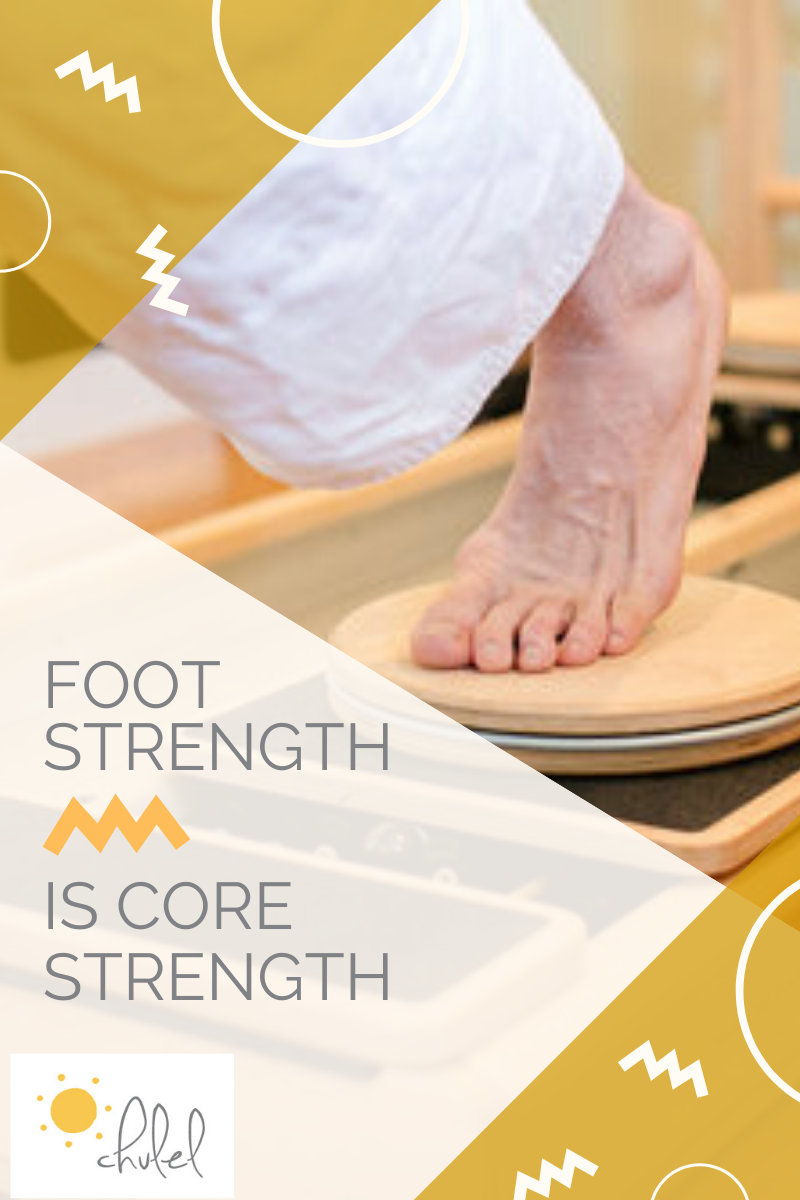
Flexible, Grounded Feet=A Strong Core
Until I got really nerdy about my running stride 10 years ago, I was quite foot phobic. We pay for others to touch our feet or hope for a little love from our significant other on the couch, but most of us don't consciously massage our feet like we foam roll our legs or actively strengthen our feet like we do our arms. It's funny because our feet are our main mode of transport yet they're low on the self-care totem pole.
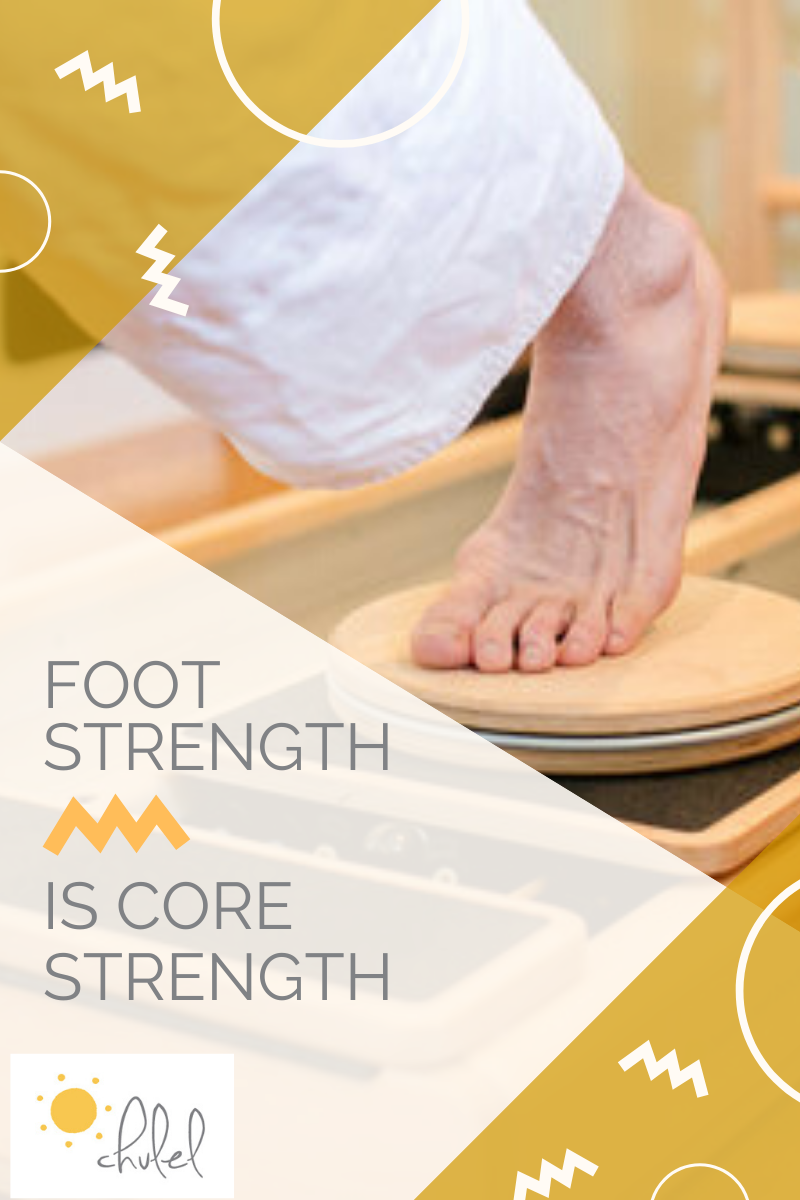
Grounded feet help with balance.
How are the feet related to core stability and strength?
The feet aren't what I call Hollywood Muscles. No one is going to eye you up at the pool for your toe muscles. Yet, the feet mirror our core muscles and help to support deep, instrinsic movement from the core with every step. The feet are the first in a series of archways to the body that act as suspension bridges and shock absorbers as we move. Two of those other archways, or diaphragms, are the pelvic (read: pelvic floor) and breathing diaphragms. If you've read some of my other posts, you already know how much I love talking about these diaphragms, more about that here and here...because, they are the real foundation to core strength! Yes, people, I know most of you out there probably hate ab exercises. Good news is, if you keep your feet relaxed and open, you're always exercising your core muscles.
The feet should act as little trampolines as we walk, but they often become more like bricks of ice because of the types of shoes we wear (more about that here) and from breath holding--once again, you hold in one diaphragm, the others are affected.
Open feet are grounded feet.
Keeping the feet loose and open, has an impact on shoulder tension as well. When our body feels supported by the earth, we cease to put the weight of the world on our shoulders. All of that goes into the ground, also known as grounding or earthing. :)
Here is a simple way to open your feet, even while you watch tv.
Once your feet are relaxed, you can get even deeper into strengthening them. I love this set of exercises, because it helps to restore the motions our feet most often forget, spreading and using the sole of the foot. Kind of like how our pelvic muscles atrophy sitting in a chair all day, the sole of the foot weakens from wearing shoes all the time. This is a small sample of a series of exercises I do with my clients to wake up their feet and consciously connect that feeling to their core as they walk and move. Afterward my clients often say they feel like their feet are wider and that they can sense the pads of their feet. I call it Frodo feet!
The new sensory awareness from open feet will not just help you ground, it will also help your balance in other activities like yoga, martial arts and dance, not to mention walking. For a more personalized connection to those activities, including gait, make an appointment to come to the studio. In the meantime, opening and grounding your feet will have you using your core in a deep and profound way without even trying!
Why I Hate Kegels

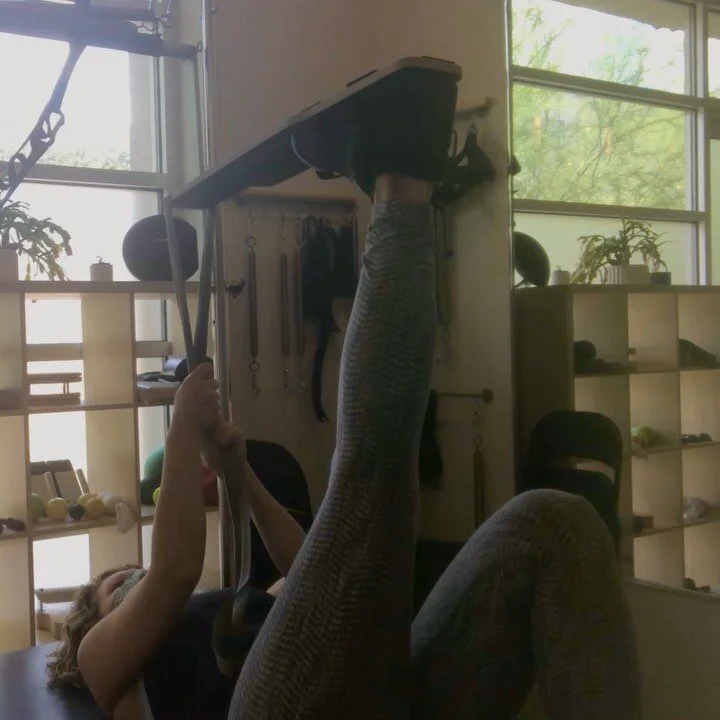
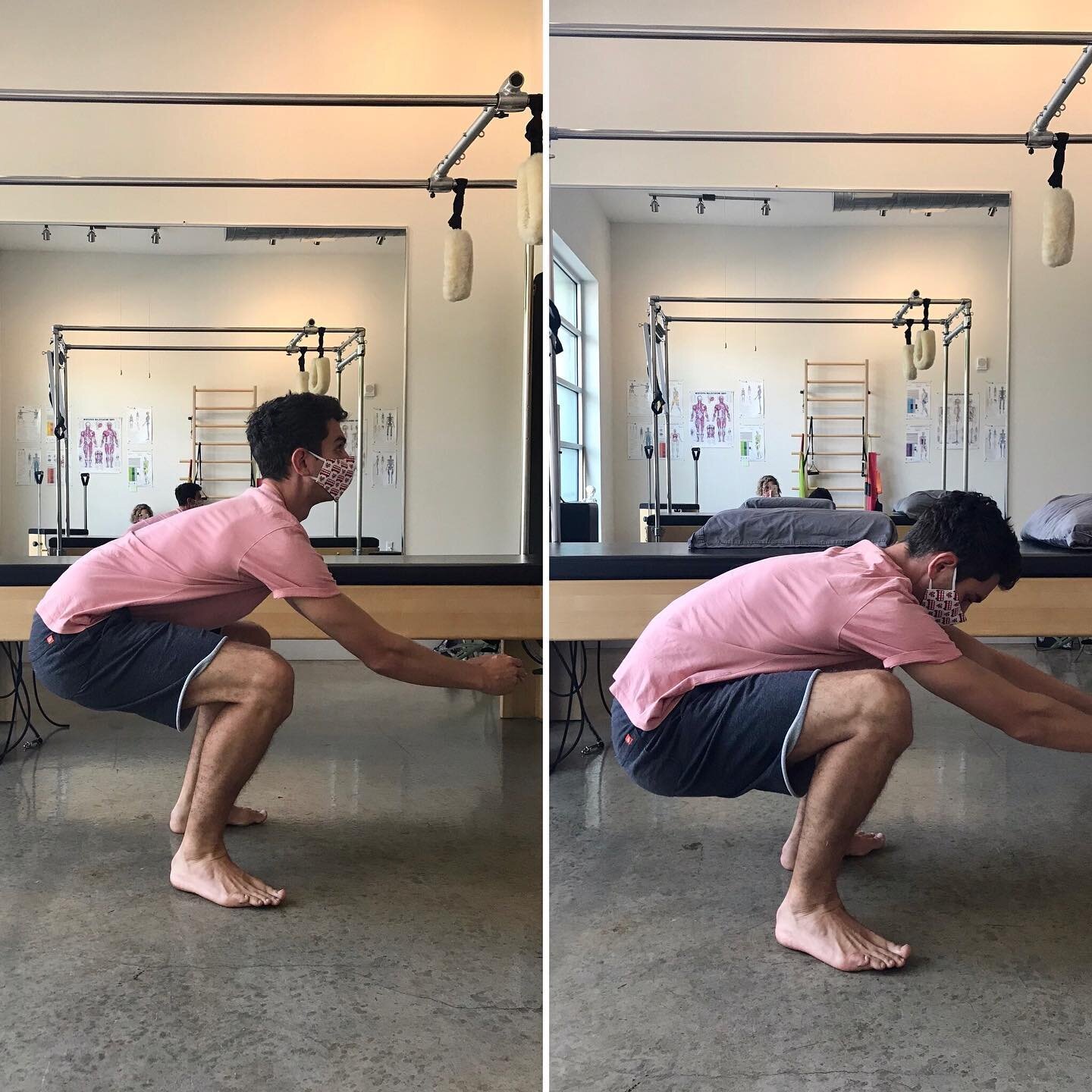
Pilates squats on the reformer for lower body alignment and pelvic floor strength.
Just about every woman out there has had her doctor prescribe Kegel exercises--hold your urine flow for a few seconds to strengthen your pelvic floor. I see Kegels as a constipation view to strengthening the pelvic floor because they encourage bracing and holding in an area that is often too tight. Plus, Kegels are more often emphasized for women over men when we all need strong and flexible pelvic muscles. More about that here. If we all think pelvic floor health=Kegels, we lose the sense of how these muscles are connected to other movement in everyday life. To me, the pelvic floor is more than just your elimination muscles, it includes all the muscles of your pelvis that support your torso and posture--this includes your rear.
One of my favorite pelvic floor exercises is a squat because it works the pelvic floor in a large range-of-motion. This way, you're getting stretching on the way down and strengthening on the way up. Think of squats as coming from the bones of your pelvis to kick these muscles into gear.
Don't feel like you need to go all the way down into a full squat if it doesn't feel good in your body. Many folks can't because of knee or hip pain. Try holding onto something, or putting something underneath your heels, and you may find you can get lower to the floor. As you descend, these muscles are stretching and opening like an umbrella. When you stand up, they contract and come closer together like the closing of an umbrella.
If you think about it, we squat every time we sit down. With a bit of mindfulness and maybe some props, you can reconnect with your pelvic floor and use it to sit down and stand up. No more plopping on the couch!
Pilates is a great modality to strengthen the pelvis for everyday movement. This includes strengthening your inner and outer thighs, which are critical for balance. I love working with clients to rehab their pelvic floors because it's an area of much importance, and for many of us, an area of much trauma. If you've had any abuse in your past, sexual or otherwise, regardless of gender...it may be difficult for you to feel these muscles (read more about this here). This is why I love working one-on-one with clients. In a private session, you're in an environment where it is safe to go here, to connect and to heal, bringing a true sense of self. It brings me to tears when I get to witness this transformation and see my clients discover how much power they have. Love the pelvic floor!!!!
Why is my body tight?

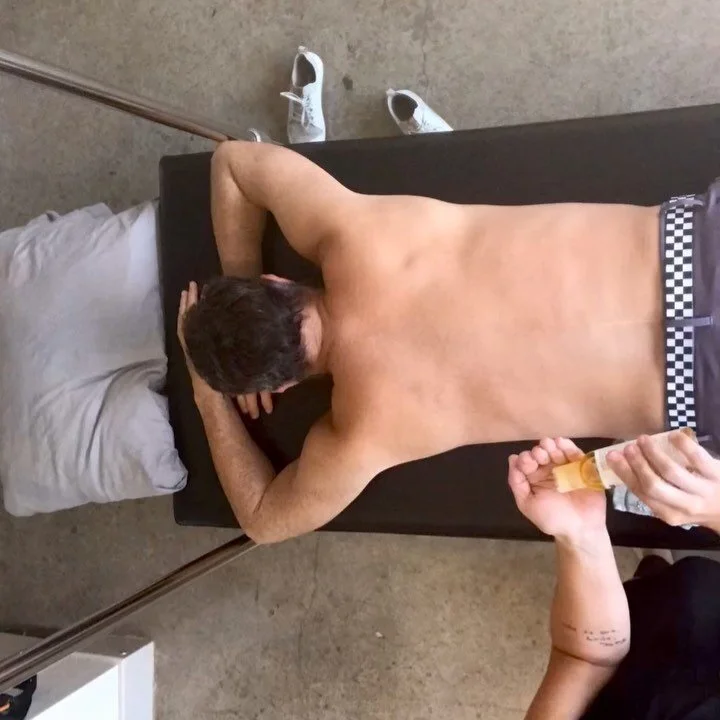
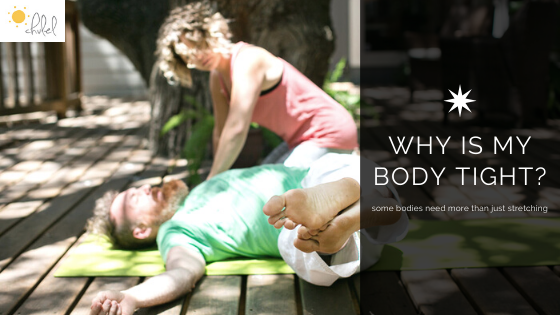
Full body, active Ki Hara stretching! Soooo yummy!
This is a question I'm often asked and believe that we have to look at more than just range-of-motion or trigger points for a good explanation. Some clients immediately tell me that their body is tight because it runs in their family, like they have an inflexiblity gene and traditional stretching just doesn't work for them. I see body tightness that runs in families as a cultural way that the family deals with stress and how we then handle stress as adults. Are things shoved under the rug or not acknowledged? Or, are things discussed and worked through together? Do you feel overwhelmed and overburdened by responsibility? Or, are you able to shift your perspective and carve out some self-care time?
The nervous system automatically charges up to help when we're stressed (sympathetic nervous system). One result when it kicks in is that the muscles tighten to prepare for action--we can see this in animals. When they perceive a threat, the breath cycle shortens, their whole body tightens and is ready to pounce. When we, as humans, hold in this way everyday, it leads to chronic body tightness and fatigue.
To offset this stress from a movement perspective, we most often think exercise. Yet, how many of us hold our breath when we try to burn off some steam? Muscles can't relax if they're being starved of oxygen. As someone who is also prone to this, I've started doing some diaphragm releases to connect with my breath before I intentionally move. This is my favorite diaphragm release to do pre-workout.
Ki Hara active stretching unwinds tension from the body, creating space for more breath. Clients always stand up at the end of a session saying they feel more alive, relaxed and have more blood flowing through their body. We target the areas you personally hold tension and dynamically release muscle tension there. Full body stretching like in the photo above, allows for the body to have a feeling of flow over bracing. To learn more, click here.
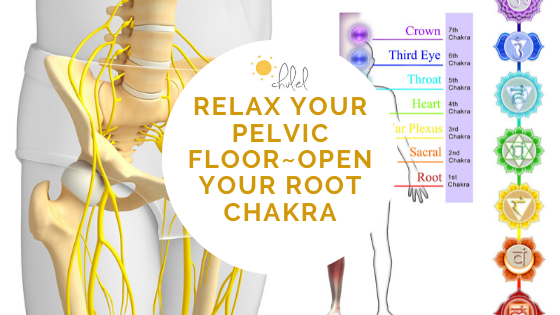
Loosen Your Pelvic Floor, Open Your Root Chakra!

When we hear "pelvic floor" it's usually with regard to women who have had children and how their pelvic floors become weak or distended. Years go by and then there's a new wave of pelvic floor awareness with prostate issues or pelvic organ prolapse. Based on my work with clients, I find tight pelvic floors to be super common due to stress and prolonged hours of sitting which contribute to lower back and hip pain/tightness.
What is the pelvic floor, exactly?
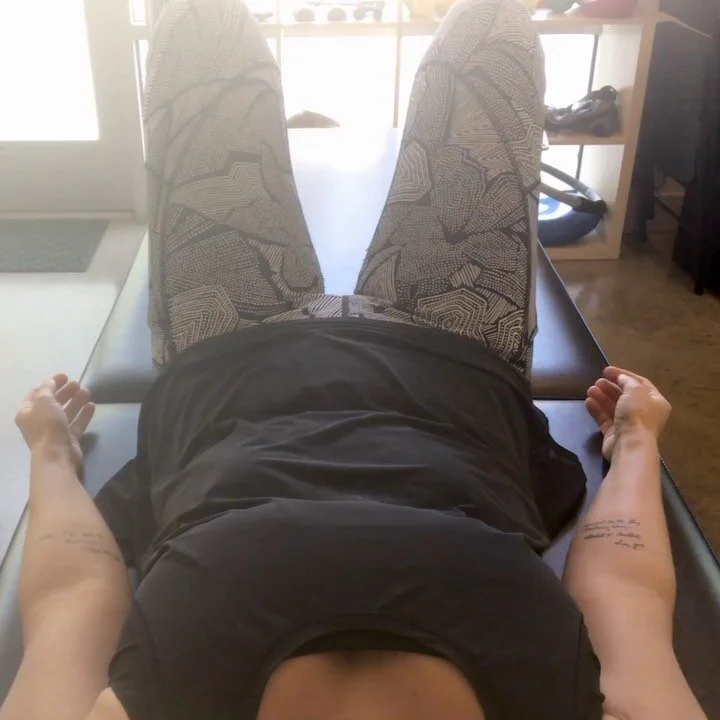
I see it as more than just our elimination muscles. If you were wearing brief underwear as in the photo, your pelvic muscles are in contact with fabric. So, there's three main sections:
- Front-lower abs, the little triangle between your hip sockets and pubic bone
- Undercarriage-elimination muscles and connective tissue
- Back-hip rotational muscles, gluteals
How does the pelvic floor tighten?
Sitting, feeling stressed and holding our breath. I wrote more about this in detail here. If you're prone to sucking in your stomach or have suffered from digestive issues, these muscles would also become chronically tense.
In addition to stress-holding, we can also have some unresolved emotional issues that can cause these muscles to restrict and hold.
What the heck is a 'root chakra'?

You can look at chakras as being areas of the body that emotionally (energetically) represent certain things we all face in life. In the case of the root chakra, it correlates to things that are foundational to our being--safety, security (including financial), family/clan identity and physical health. Issues here can come from not just our personal experience, but from the experiences of our family members. SO, pretty much everyone has crap to work through in this chakra.
Fear is a big factor in holding patterns here including, pelvic floor tightness. If we're constantly bracing for something to happen or afraid that there won't be enough, the muscles of the pelvis respond to that emotional outlook. Origins of that fear can include:
- Abuse, including abandonment or neglect
- Poverty, war
- Major personal illness or in your family
- Not having good personal boundaries so we're constantly at the whim of others' actions
- Inherited trauama and issues from our families
How can you shift these patterns?
Physically, you can practice relaxing these muscles.
In my one-on-one sessions with clients we discover where you're holding physically and emotionally and then intentionally create space there. I construct a series of exercise sequences to reinforce a new pattern in your body that doesn't involve bracing or restriction. With repetition, your body generates a new neurological pattern via flow instead of holding. To reconnect with your root chakra and maintain a relaxed pelvic floor day-to-day, try these tips.
- Breathe and feel the breath connect down to your pelvic floor. I wrote more about that here.
- Do things that honor your body and its health.
- Celebrate what you already have in your life--these things may not be material or tangible.
- Find and connect with a community to feel a sense of belonging.
- Go outside and put your bare feet in the ground. Feel how you are a living being!
Latest Instagram Posts