Your Custom Text Here
Carpal Tunnel & Wrist Pain 2-Favorite Tools and Assessing Your Wrist

In this video I highlight my favorite props and tools for alleviating chronic wrist, hand and forearm pain. These things will be helpful as you work through the course to have the most ease of self-massage and soft tissue release. My top 3 massage options include: Armaid (seen pictured above), Breo hand massager and an inexpensive, little finger/forearm roller. On the strengthening side of things, there’s a simple, affordable grip kit for strengthening the different aspects of the hand and wrist.
The second portion of this video covers how to assess the strength in your hands, fingers and forearms. I would encourage you to make a note as to which movements feel strange or difficult. As you work through the course, you can then come back to those movements and see if they’re getting easier. I’ll reference these particular muscles throughout the course and which other videos will build on specific strength areas.
Carpal Tunnel/Wrist Pain Course Launches!

Welcome! For the next couple months we’ll dive into the fascial connections behind carpal tunnel as well as general wrist pain. This is a great series for anyone who does repetitive movement throughout the day including manual labor. A lot of this content will also be relevant if you have tight wrists from weight lifting, push ups and working out.
We’ll primarily focus on kinetic chains, not just fascial chains as defined by Tom Meyers. The posters I reference to throughout the course are from Joseph Schwartz. The difference between the 2 being how fascial chains engage in movement and walking over just standing.
Please subscribe on YouTube if this content is relevant to you. And, please share with others who you think could benefit. It’s free!
Fix Your Plantar Fasciitis 9&10-Beginner and Intermediate Workouts

In these episodes we’ll go through a couple short, 10-minute workouts you can do at home to strengthen various connections to both improve plantar fasciitis and prevent it.
In the beginner workout, we start with some easy ways to strengthen the posterior fascial chain (read: your rear end and back side) as well as your lateral stabilizers (your balance muscles). We then take that into some coordinated movement that mimics some of the connections that need to happen when you walk. Lastly there’s a quad-strengthening exercise that also works your core. I love a good two-fer!
In the intermediate workout, we work some more esoteric connections related to plantar fasciitis. We get more into the mid-back as well as more global strength patterns in the hips and core. These connections are targeted at improving balance from the pelvis, not the ankles.
Work it!
Fix Your Plantar Fasciitis-Episode 8 How to Improve Your Gait
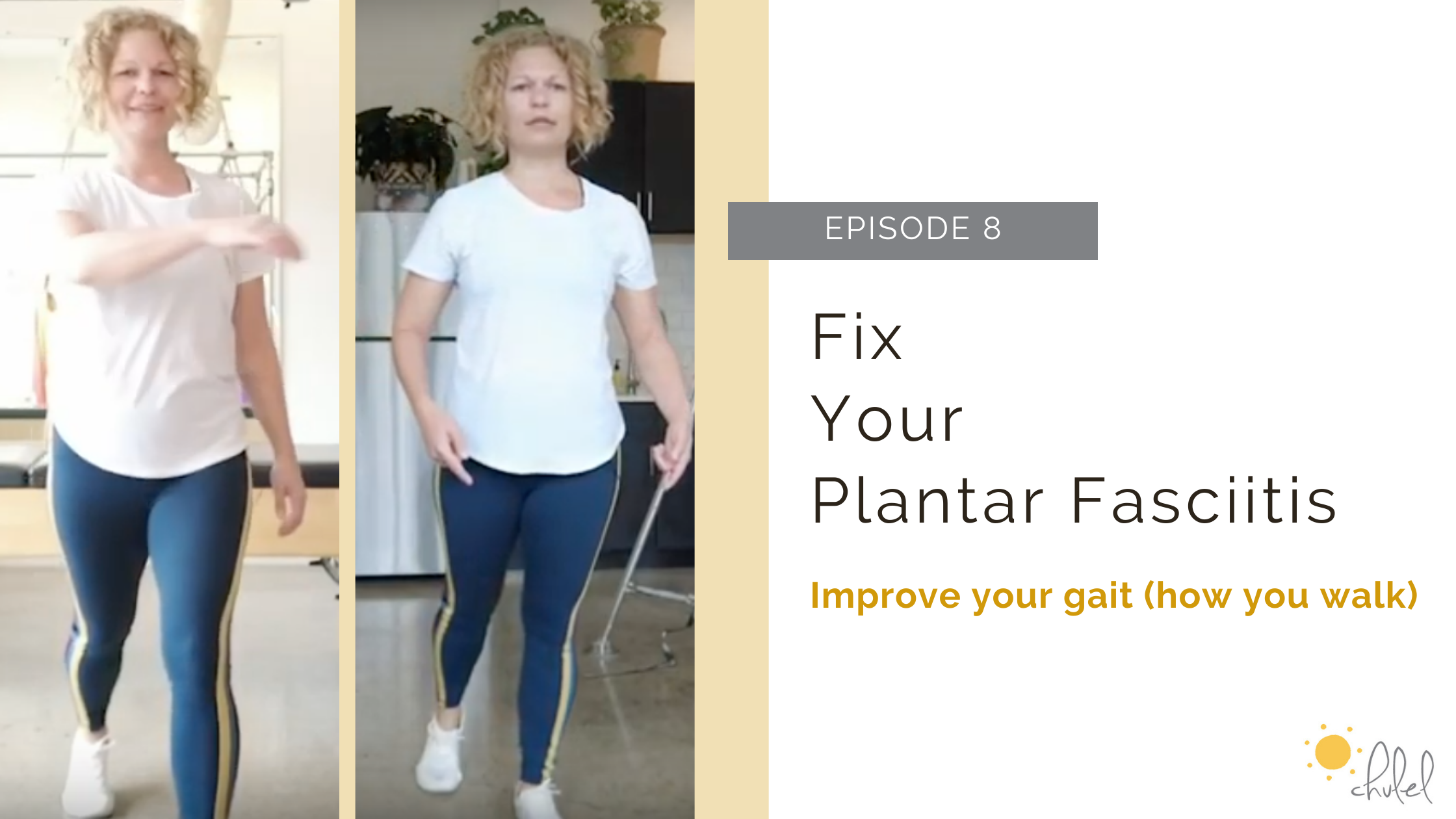
Over the years I’ve taken several workhops and read many books on how to fix your gait (how you walk/run) to correct several injuries I’ve had to my lower leg—including being hit by a car in a crosswalk.
This video highlights some of my favorite exercises I’ve learned that can be done from anywhere.
The first is from an Aston Patterning workshop that trains your body how to transfer weight from one leg up through the pelvis to the other leg. I always liken it to feeling like you have a slinky momentum as you walk. I’ve noticed that those with plantar fasciitis, tight feet, even bunions and Morten’s neuroma don’t fully roll through their midarch when they roll through their foot. It’s more of a heel-toe clomp. This simple exercise can help your body improve balance and change that pattern.
The next couple of exercises are from a workshop I took with James Earls who wrote a book called Born to Walk. They emphasize a fascial spring to walking and really hone in on the rotation aspect of walking. This is another plantar fasciitis thing—that gait pattern can often be more of a waddle instead of there being a subtle twist of the upper body on the lower body with each stride.
Lastly, we look to deepening the feeling of that twist with a connection to the diaphragm. This is a good, little balance challenge.
I recommend doing these on a longer walk or a run to let your tissues get into the flow and so that the new pattern can set into your tissues.
Fix Your Plantar Fasciitis-Episode 7
In this episode we dive into some of the emotional or energetic undercurrents for plantar fasciitis.

Over the years of doing this work, I’ve found that there’s usually a top down approach over a bottom up in which the person approaches life. So, rather than being connected to the feet and the ground, the person is a heavy thinker and rationalizer.
A way to try to shift this mindfully in your body is to visualize your feet having roots that grow into the ground. Another suggestion is to connect to a place you can feel in your body and create new veins so-to-speak down each leg and into each toe. Then check in and see if it is easier to have a sensation of your feet in the ground.
Yet another suggestion is to purchase an earthing mat. The concept here is that we have chronic inflammation issues because we walk in rubber-soled shoes and concrete and that our bodies are unable to discharge negative ions. I know it sounds like a load of you-know-what, but I actually did find great benefit from sleeping on one of these for several years. My general sleep improved and I felt less allergies/illness. You can find ones that you can just have your feet on it, there are yoga mats and you can have ones that fit the entire bed as well.
Check out the video for the rest of my explanation on the mental aspect of plantar fasciitis.
Latest Instagram Posts