Your Custom Text Here
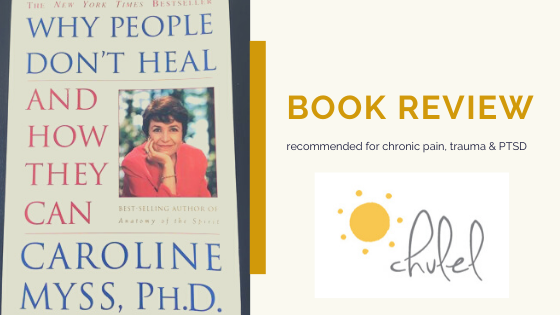
Why People Don't Heal And How They Can

I first came across Carolyn Myss, the author of this book, about 8 years ago. Since then, I've started this book 3 times and stopped because I saw different aspects of myself in the pages I wasn't yet ready to confront. If you were to put one self-improvement book on your summer reading list, I'd highly suggest this one.
Many of my clients initially come to me because they suffer from chronic pain and chronic fatigue. Naturally, they feel angry at their body and that they can't live their lives to the extent that they would like. Feeling stuck and depressed is an understandable companion to this anger. That said, the more anger we project back onto our bodies, the longer and more fraught the healing process is. A more effective path to healing is seeing the pain as a point of entry to explore deep within ourselves. In Why People Don't Heal and How They Can, Myss offers some ways to identify if we're suffering from what she calls Woundology and belief systems that could stifle our healing process.
These are the author's top 5 belief systems that most people get caught in when they're in pain or are ill. To move forward, we have to detach from the belief.
5 Myths of Healing
1. My life is defined by my wound (Woundology).
Seeing life through the lens of a traumatic experience means projecting that onto every future relationship and experience (though a book I wrote about last year here says the brain naturally will do this after trauma). Those stuck in this pattern will seek out a social support network that will be sympathetic to their experience and then they never have to move past it. Moreover, they connect with others by comparing wounds and feel empowered if they are more wounded than someone else. She specifically mentions survivor and addiction groups and that they are helpful at certain stages. To continue healing, however, one has to move past that identity of survivor or addict.
In short, we can get stuck in the healing process if we define our identity and live our lives through our wounds rather than evolving past them. It can be a tricky process because someone may think they're addressing their wounds, but what they're really doing is carrying them around like a badge of honor. Over time, our wounds accumulate and gradually suck our energy, leaving us prone to depression, pain and illness. To move past your wounds, focus efforts on things that feed you rather than deplete you. If a current event triggers you to recall all the other times this has happened to you, rather than listing the wounds, look at what you're doing in your life that is creating part of that pattern.
2. Being healthy means being alone.
This is a system that I've personally been guilty of over the last couple of years until I acknowledged that by engaging with others means I have to grow through the things that trigger me. When I envisioned myself as healthy, I was the only one in the room rather than being surrounded by those who I know love and support me. Myss contends healing is an ongoing process that is best done in a community that can help support our changes; "Healing does not represent the closure of the needs of the heart; rather, it is a doorway toward opening your heart." She cites American individualism as a culture block to realizing this yet also acknowledges that sometimes we do need to separate from someone or a community to grow.
3. Feeling pain means being destroyed by pain.
It's normal to believe that pain or illness is negative, yet these feelings can also push us to explore within ourselves and move away from destructive habits and behavioral patterns. She cautions against relying too much on prescription drugs or painkillers in general because they can mask the symptoms of what our body is asking us to heal. She suggests using a mindfulness practice like yoga or meditation to help with healing consciously.
4. All illness is a result of negativity and we are damaged at our core.
Myss encourages readers to not immediately blame a failure to heal on a past experience or negative belief. Illness is complex and there's plenty of toxins in our environment and genes that can be an aspect of illness. Our focus should instead be on our ability to create change over controlling our thoughts. Sometimes it's better to just let go of the negative thoughts or past experiences over trying to dive into them and understand them....that can do more harm than good.
5. True change is impossible.
Most of us don't really like change and to change but healing and change are the same thing. We associate illness with fear and negativity so it can be intimidating to confront the illness and look at how much we really take care of ourselves versus the needs of others. Try shifting the belief that healing will be hard or depressing to relieving and exciting.
This is one of the few books on healing that I've read that actually provides a structure for analyzing one's beliefs and how to better understand and forgive--she actually encourages making a chart/spreadsheet and guides readers on specificially how to structure it. That said, it's a very East meets West, spiritually-minded approach, so if that's not your bag, this may not be for you. If it is, Myss has a unique perspective on understanding how American culture looks at pain and illness that I found to be eye-opening in forgiving myself and others because we're all stuck in some collective, old mindsets that we can let go of reacting to individually.
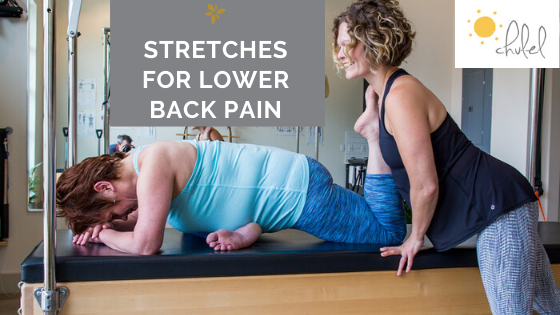
Stretches to Relieve Lower Back Pain
Lower back pain can have many different causes. Muscle weakness, poor posture, disc/spinal issues, leg length differential or an old injury can all factor into back pain. That said, this chronic pain can be helped by stretching certain areas and building hip strength.

From a fascial (connective tissue) line perspective, the tension you feel in the lower back could be coming from anywhere along that posterior side of your body. So a tight foot or calf on that side could also be a tight sacrum. Below is a simple foot fascia stretch you could do while watching tv or before a walk/run. If you know you have tight calves, this is my favorite stretch to release the muscles as well as the fascial line.
For a more active approach, anyone with a tight lower back has tight quad muscles (front of thighs). This version integrates a yoga pose with some turbo options for stretching. Your front leg doesn't need to be crossed in front of the opposite thigh, you can just tuck that knee underneath you. You can also place a pillow underneath the glute that is stretching. Just being here may be intense enough. If so, breathe and visualize new space in your hips. You may also feel this more in your butt than in your quad. Try to bend the elongated leg for the thigh stretch. If your hamstring cramps, scroll up and do the calf stretch first. If you can bend the knee, this stretch is a great twofer for the thigh and rear.
Another area that can pull on the lower back is the groin. Most of us never think to stretch here yet it can really compound tension in the lumbar spine. This is a pretty intense stretch, so here is a more gentle stretch.
When you're out of the pain or as a preventative measure, you want to build hip strength. If you've recently had pain, doing this may not feel good, so listen to your body. If you feel a sharp pain, this is not for you right now. You may need more individualized help, so gimme a call! Or, reach out to your trusted chiropractor, massage therapist or physical therapist.
I find that lower back pain perhaps more than any other chronic pain area always has an emotional or stress-holding connection. I already wrote about how lower back pain connects with breath holding here. Some things to explore for the emotional connection would be: When did this pain start? What else was going on in your life around that time? Does the pain tend to get worse during certain times of the day? If it's in the morning, are you happy in your work/relationship? In the evening, are you feeling burdened by your responsibilities? Does it hurt more when you speak to a certain person? Are you holding or internalizing anger, frustration or another emotion with regard to that person?
Noticing your personal patterns can help you start to process some of these underlying aspects that are keeping this pain chronic. I believe this is a big reason why a massage or even a stretching routine doesn't keep the pain from coming back. If some of this resonates for you, visualize these emotions/memories leaving your body via your breath. Let it go!
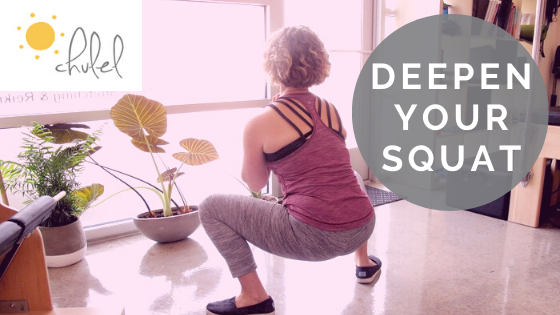
Improve your Squat Form
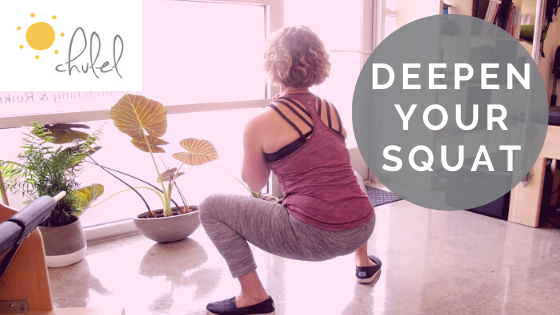
A few years ago I visited Japan and enountered my first non-Western toilet on a regional train. Not only did I struggle at using 'squatty potty', it was even harder in a moving train. Perfecting and holding a full, deep squat with heels on the floor became my physical focus of that year. The deeper my squat became, the more I felt new muscles in my pelvis that I had no idea existed!
Squatting is a fundamental human movement and helps to maintain a healthy pelvic floor with core stability. As we squat, the pelvic floor has to expand like a suspension bridge to support us, meaning we have to let go of stress-holding in that area. Regularly practicing a full squat is a great way to release tension in the pelvic floor. It's also a great way to build hip strength if you have ever been pregnant.
As we spend more time in chairs with our knees and ankles fixed at 90 degree angles, squats become important for foot and knee health so that our body understands it can still move those joints deeply. We can forget about this until small children come into our lives and we realize that we don't feel confident squatting down to pick up the child from the floor. Not only are we lacking hip strength, there's a general inflexiblity in the lower joints of the body.
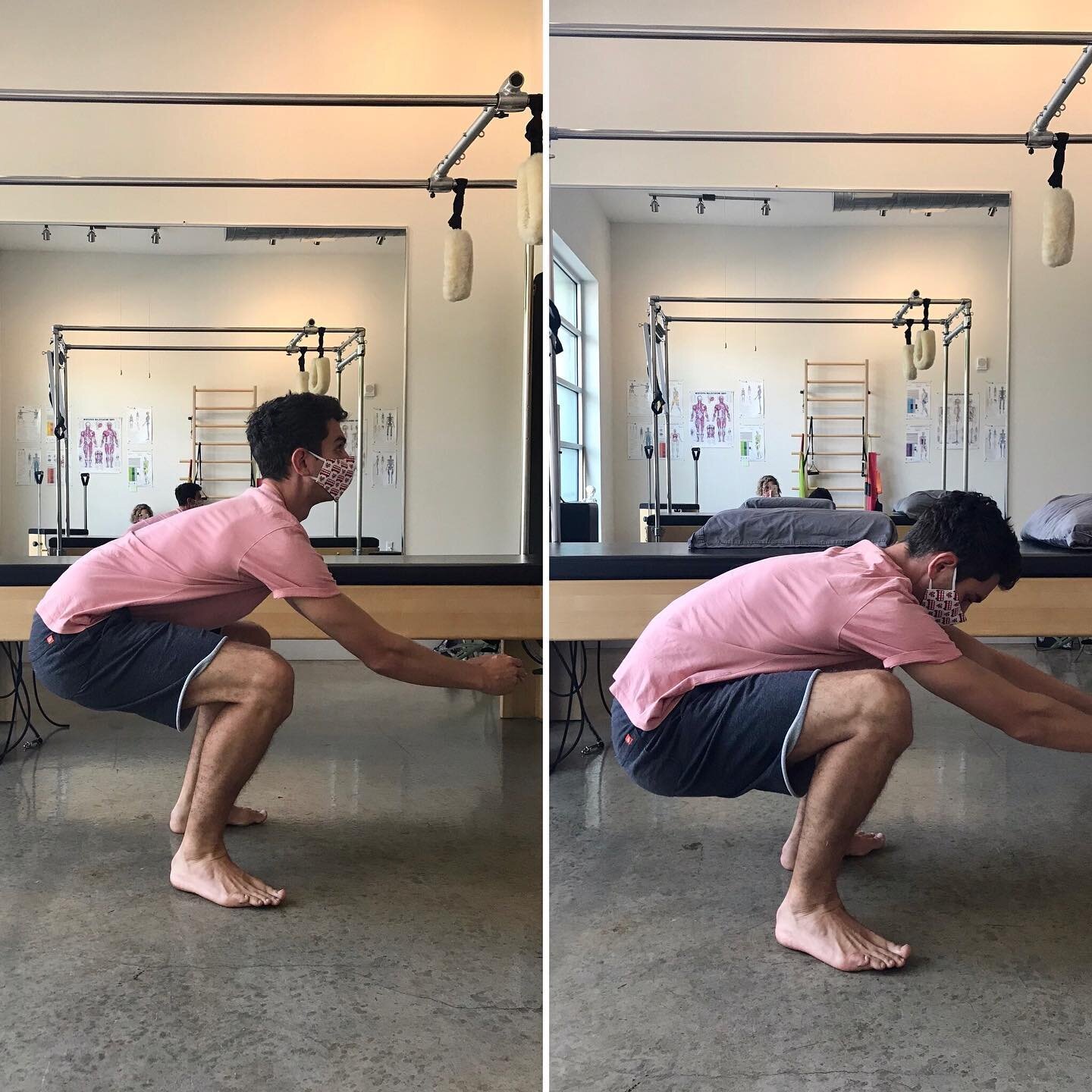
Squatting, and the muscles required to do one are important for aging well and not succumbing to a 'falling-and-I-can't-get-up' scenario. I'm an advocate of an unweighted squat, meaning just your body weight on these joints is sufficient. We're all shaped differently with different movement pasts, so I'm also more free form on how wide the feet are and if the legs are turned out or not. If your ankles are tight and you have a hard time keeping your heels down, hold onto something and place a towel or wedge under your heels. You can also try stretching your calves first to see if that helps your heels stay down. My favorite way:
You can deepen your squat if you understand that your bones spiral as you descend and ascend. If these bones didn't pivot and move, we would just toppple over. Feeling them move, and even coaxing your muscles with your hands, can remind your body that we're always in rotation and that twisting can allow for deeper movement and more core engagement.
Squatting is a phenomenal way to ground yourself and feel like you're connecting downward instead of holding the weight of the world on your shoulders. It doesn't matter how deep or how perfect your squat is, just try to drop down towards the earth and feel how you are supported. Feeling this sensation can help alleviate stress and relax the body. Feel how much your life can improve by doing a squat a day!
Latest Instagram Posts